Peak season doesn’t have to be chaotic. Learn simple, practical steps to reduce disruptions, secure capacity, and keep shipments moving smoothly next year.
On this page
1. Review What Actually Went Wrong This Year
Peak season always exposes weaknesses. Before you plan forward, look backward.
Ask your team:
- Where did shipments slow down?
- Which carriers missed the most pickups or deliveries?
- Which lanes blew up on cost?
- Which suppliers caused recurring delays?
Focus only on patterns. You don’t need a 50-page analysis, just identify the few issues that caused the most pain.
2. Lock In Capacity Earlier Than You Think
Waiting until peak season to book capacity is the #1 cause of preventable disruptions.
Do this instead:
- Secure primary and backup carriers months in advance
- Build multi-carrier redundancy for your most sensitive lanes
- Add regional carriers for high-density delivery zones
- Identify “risk lanes” and get guaranteed coverage early
Early capacity planning creates stability when demand spikes.
Read More: What’s the Best Way to Automate Load Tendering?
3. Strengthen Supplier Readiness
Suppliers create peak season problems long before your freight hits a trailer.
Keep it simple:
- Share next year’s demand forecast early
- Set clear cutoff times for inbound shipments
- Add buffer days for chronically slow suppliers
- Use appointment scheduling to prevent dock congestion
When suppliers stay predictable, your peak season stays predictable.
4. Reduce Internal Bottlenecks Before They Start
Small internal delays snowball during peak season.
Check these areas now:
- Are your dock doors overloaded at certain hours?
- Do you have enough staff for inbound and outbound?
- Are appointments constantly running late?
- Do you lose time switching between systems?
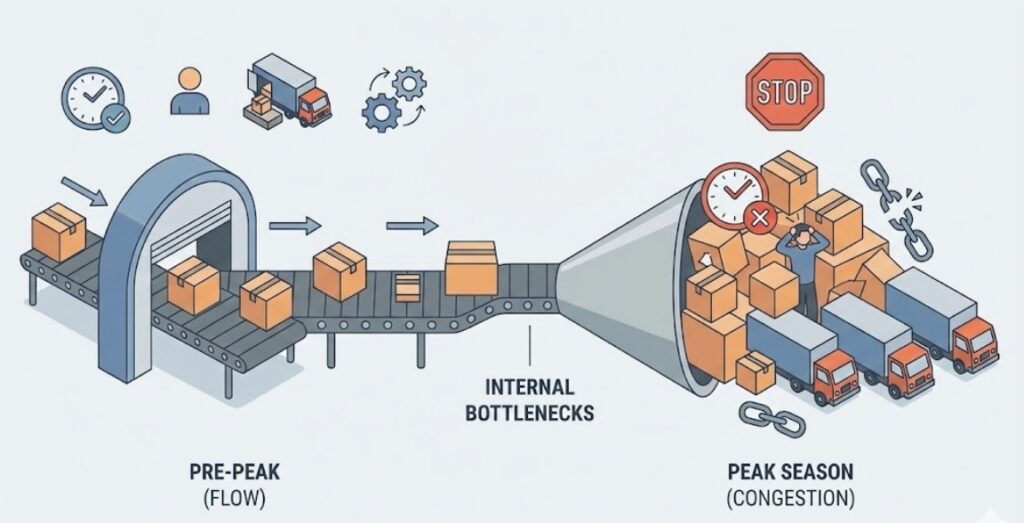
Anything that slows your operation in normal months will break during peak.
5. Improve Your Carrier Mix, Not Just Your Rates
Rates matter, but carrier performance matters more during peak.
Evaluate carriers based on:
- On-time pickup rate
- On-time delivery rate
- Responsiveness during issues
- Willingness to scale capacity
- Performance on high-volume weeks
A carrier that costs slightly more but never leaves you stranded is worth it.
Read More: Load Acceptance Optimization: How Carriers Win More Freight in 2026
6. Build an Exception-Response Plan
Most peak season disruptions are caused by slow reaction, not the disruption itself.
Create simple playbooks:
- If a carrier misses pickup → who gets notified, what is the backup?
- If a shipment will be late → who contacts the customer?
- If a supplier misses receiving → what’s the alternative?
Your team shouldn’t guess during chaos. They should execute.
7. Use Technology That Reduces Stress, Not Adds to It
Many logistics tools overcomplicate things. What you actually need is:
- One view of all shipments
- Fast exception alerts
- Simple carrier and supplier coordination
- Easy appointment management
- A way to reroute or reassign loads quickly
Technology should remove mental load, not add more.
How FTM Helps You Stay Ahead of Peak Season Disruptions
FTM makes peak season preparation easier by giving teams one simple platform to organize everything that usually breaks during high-volume months.
With FTM, you can:
- Track inbound and outbound shipments in one timeline
- Get early alerts for delays, missed pickups, or supplier issues
- Automate appointment scheduling and avoid dock congestion
- Assign loads faster and switch carriers instantly when needed
- Share real-time updates with carriers, suppliers, and customers
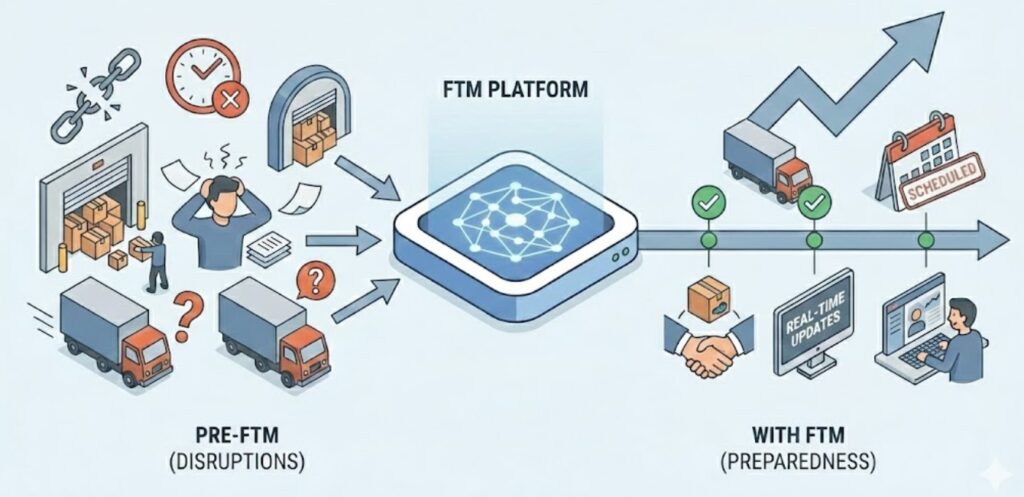
Instead of reacting during peak season, FTM helps you stay ahead, calmer, faster, and more prepared.
Read More: Top Integrations to Improve Real-Time Shipment Visibility
Final Takeaway
Peak season is only chaotic when companies wait too long to prepare.
Start now. Fix the patterns. Lock in capacity. Strengthen suppliers. Simplify your systems.
And if you want a tool that helps you execute all of this without the stress, FTM can support you every step of the way.
Ready to get ahead of peak season disruptions?
Book a free demo and start planning smarter.
