Imagine cutting your company’s freight emissions while trimming empty miles and boosting profitability. What used to sound like a trade-off, sustainability vs profitability, is now emerging as a strategic advantage. In 2026, eco-friendly logistics isn’t just “green thinking”: it’s smart operations that reduce dead-headed miles, cut fuel costs, and strengthen your competitive edge.
Transportation emissions account for a major portion of freight’s carbon footprint, but that doesn’t mean carriers, shippers, or brokers have to choose between operational goals and environmental impact. By leveraging a modern Transportation Management System (TMS), logistics networks can harmonize efficiency with sustainability and reshape how fleets perform at scale.
Here’s how eco-friendly logistics strategies, combined with TMS tools, are reducing empty miles, lowering emissions, and redefining competitive freight.
What Are Dead-Headed Miles and Why They Matter
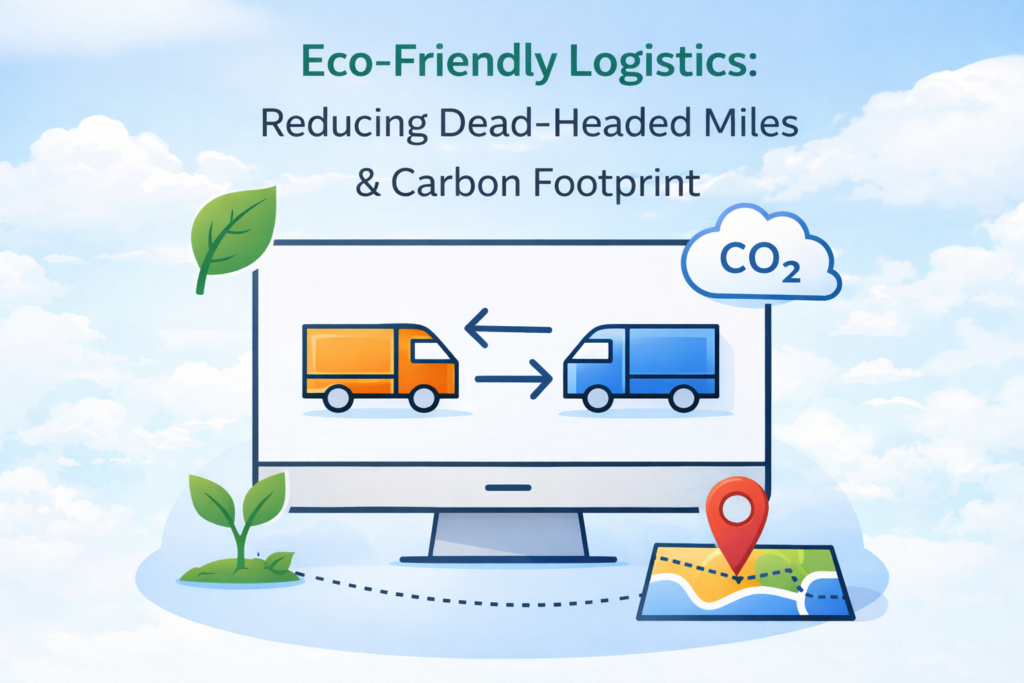
Dead-headed miles are the trips trucks make without a paying load, typically returning to base, repositioning for another load, or moving to a pickup with no cargo. These empty miles waste fuel, add wear and tear to equipment, and inflate carbon emissions.
Since a single truck can burn hundreds of gallons of fuel simply by running empty, the cumulative carbon impact across a large fleet becomes significant. Moreover, dead-headed miles represent lost revenue opportunities and unnecessary operational costs, making them a primary focus for carriers and shippers who want to improve both economics and sustainability.
Reducing dead-headed miles isn’t just an environmental tactic, it’s an integration of planning, execution, and forecasting that elevates logistics performance.
How a TMS Improves Load Matching and Reduces Empty Trips
At its core, eco-friendly logistics revolves around better planning and that’s where a modern TMS shines. Rather than viewing planning and execution as separate tasks, a TMS connects both in real time, which leads to smarter load matching.
Load matching algorithms inside TMS platforms analyze capacity, location, time windows, and carrier preferences. By doing so, they identify opportunities to minimize repositioning without cargo, align backhauls, and prioritize loads that reduce fleet idle time.
When dead-headed miles drop, fuel consumption drops and so does carbon output.
Outbound mathematical optimization not only enhances efficiency, but also helps carriers increase asset utilization, lower operating costs, and maintain stronger reliability for shippers.
Real-Time Visibility: The Foundation of Eco-Friendly Logistics
One of the biggest barriers to sustainable freight operations is the lack of visibility across carriers, warehouses, brokers, and shipment timelines. Without real-time data, planners rely on historical patterns and manual workflows, which often miss dynamic opportunities to reduce empty movement.
Real-time visibility tools integrated into a TMS provide GIS tracking, carrier updates, and live status feeds. This allows transport managers to:
- Identify unproductive routes in progress
- Reallocate capacity where needed
- Respond to external disruptions before emissions escalate
- Predict optimal backhaul opportunities
As a result, visibility doesn’t just inform decisions, it enables immediate actions that prevent needless miles and resource waste.
Predictive Analytics: Forecasting for Efficiency and Sustainability
Thanks to advances in data science and AI, many TMS platforms now include predictive analytics. Rather than reacting to exceptions after they happen, systems forecast demand, traffic conditions, weather patterns, and carrier behavior.
Predictive models can anticipate where capacity will be available and where backhaul potential exists. This allows logistics teams to plan routes that cut down empty miles weeks ahead of execution, not in the middle of a shift.
Integrating predictive analytics into sustainability strategies bridges operational planning with carbon management, turning data into actionable plans that benefit both profit and planet.
Route Optimization: Cutting Fuel and Emissions
Route optimization is one of the most direct ways to reduce carbon footprints. Modern TMS tools calculate routes not just on distance, but on:
- Traffic patterns
- Road grade and terrain
- Delivery windows
- Load priority
- Weather disruptions
Smarter routing means fewer repeat miles, fewer late deliveries, and less unnecessary fuel consumption. Over time, efficiency gains translate into major reductions in carbon emissions and measurable cost savings.
Carrier Scorecards and Sustainability KPIs
Traditionally, carrier scorecards focus on on-time delivery, claims, or cost per mile. However, TMS tools can expand KPI tracking to include sustainability-centric metrics:
- Empty Mile Percentage
- Fuel Efficiency per Route
- CO₂ Emissions per Load
- Average Backhaul Utilization
Tracking these indicators helps carriers benchmark progress, incentivize greener operations, and even communicate sustainability performance to partners and customers.
Scorecards that integrate environmental KPIs not only reduce waste, but also reinforce accountability across freight networks.
Collaboration Across the Freight Ecosystem
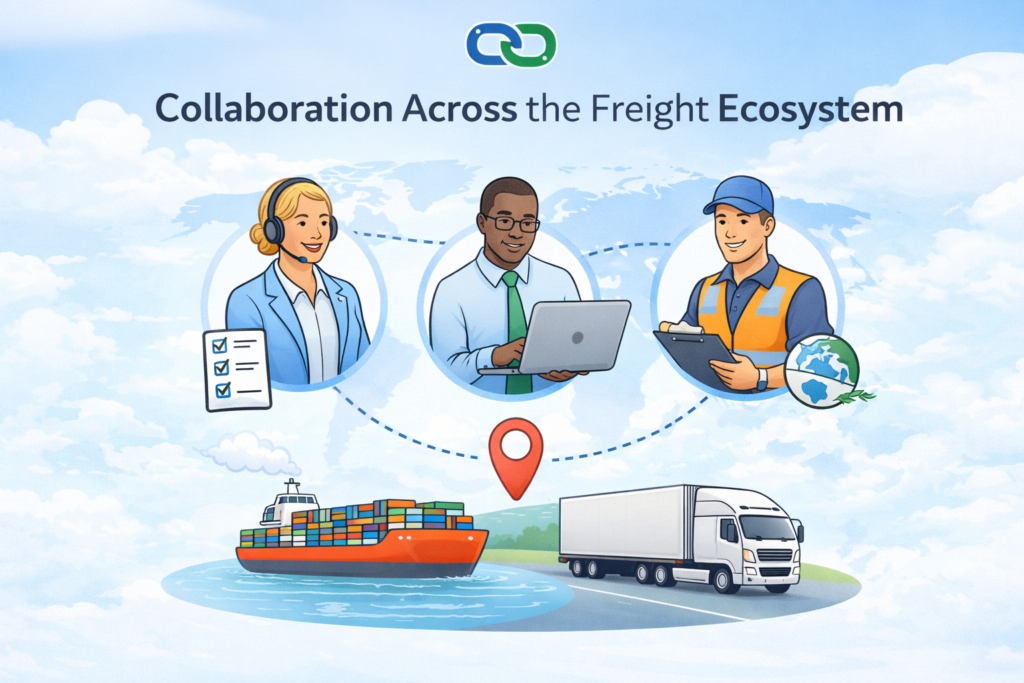
Reducing dead-headed miles and emissions isn’t a siloed activity. It’s a collaborative effort involving:
- Carriers
- Brokers
- Shippers
- Visibility vendors
- Fleet maintenance partners
A TMS enables multi-party coordination by connecting all stakeholders on a shared platform. Whether it’s sharing capacity data, visibility feeds, or compliance documents, collaboration across systems prevents redundancy and reduces inefficiencies that often result in needless miles.
Through shared access and common data models, logistics teams can unlock coordinated planning that supports sustainability strategies, and supports commercial goals simultaneously.
The Economics of Eco-Friendly Logistics
It’s worth underscoring that sustainability and profitability are not opposing forces. Reducing dead-headed miles delivers concrete economic benefits:
- Lower fuel costs
- Reduced maintenance overhead
- Higher asset utilization
- Better carrier capacity fulfillment
- Enhanced customer satisfaction
In fact, many customers now expect sustainability commitments from their logistics partners. Offering greener freight options isn’t just good for the environment, it’s a differentiator in customer acquisition and retention.
Regulatory Pressures and Future Expectations
Governments and industry bodies worldwide are tightening emissions standards for transportation. In Europe and North America alike, regulations are pushing fleets toward cleaner practices and incentivizing greener operations.
A TMS that tracks carbon intensity and operational inefficiencies positions carriers to proactively meet regulatory goals. This means avoiding fines, qualifying for incentives, and aligning freight operations with both compliance and sustainability goals.
both compliance and sustainability goals.
Implementation: Where to Start with a TMS
If you’re building an eco-friendly logistics strategy, focus on:
- Data Consolidation – unify carrier, route, and visibility data.
- Load Matching Optimization – reduce empty trips with smarter matching.
- Route Planning Tools – leverage dynamic routing for lower emissions.
- Sustainability KPIs – expand scorecards to measure environmental impact.
- Predictive Insights – forecast planning to minimize waste.
With each step, you’re not just lowering your footprint, you’re future-proofing your logistics operations.
Final Words
Eco-friendly logistics is no longer just a corporate buzzword. It’s a measurable, executable strategy that directly reduces dead-headed miles and carbon footprint, while strengthening operational performance. A modern TMS integrates planning, visibility, analytics, and collaboration, giving logistics teams the tools they need to operate smarter, greener, and more cost-effectively in 2026 and beyond.
Ready to transform your logistics strategy with sustainability at its core?
Book a demo with FTM to see how eco-friendly logistics and TMS tools can work together to cut costs, carbon, and empty miles.