What if by the end of 2026 you could run your entire freight operations with almost zero manual input, from booking to delivery to carrier selection?
With technological breakthroughs and mounting pressure for speed, visibility and cost-efficiency, full TMS automation might finally be within reach. In this article we explore why 2026 could be the turning point for autonomous, AI-driven logistics and what to watch for.
Why the Push Toward Full Automation Is Stronger Than Ever
Global supply chains are evolving fast. Rising demand volatility, tighter labor markets and delivery expectations are pushing companies to do more with less. As a result, automation is no longer a luxury it’s a necessity. TMS platforms are evolving accordingly. According to a 2025–2026 logistics trends report, AI and automation are expanding across warehousing, fleet management, and fulfillment workflows.
Simultaneously, market outlooks forecast solid growth for TMS solutions: one research note estimates that the TMS market will grow by several billion USD between 2025 and 2029, driven by demand for smart-connected systems, IoT analytics, and real-time decision capabilities.
Taken together, these trends mean that many logistics teams are now deciding: automate fully or risk falling behind.
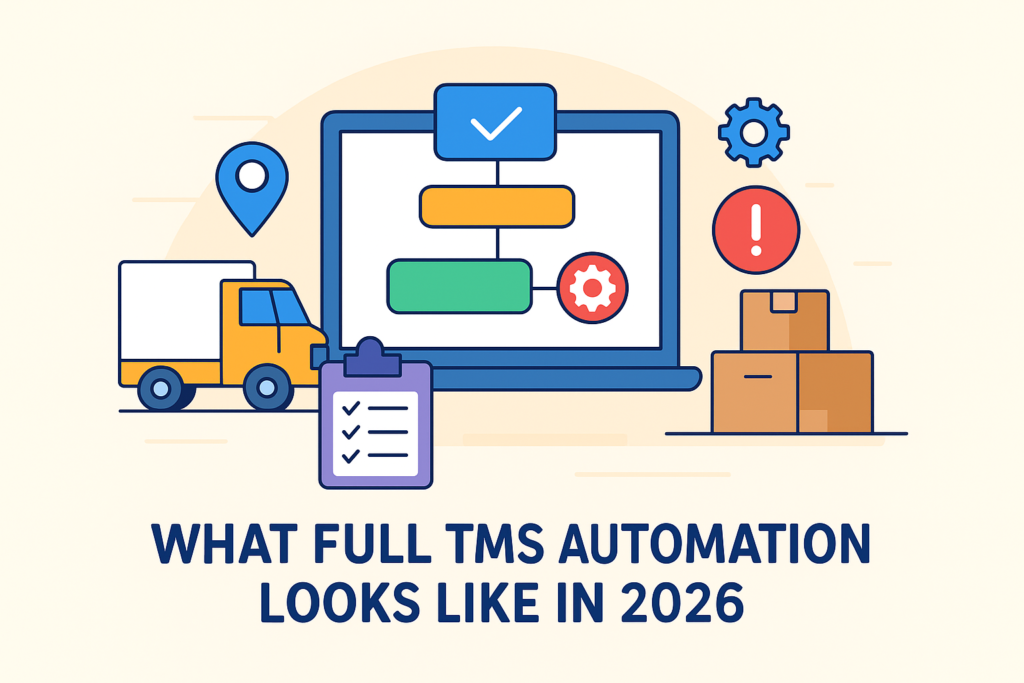
What Full TMS Automation Looks Like in 2026
A “fully automated” TMS won’t just digitize paperwork. It will orchestrate the entire transport lifecycle end-to-end. Here’s how:
- Order Booking & Carrier Matching: As soon as a shipment is created, an AI-driven engine matches it against carrier availability, past performance, cost, and route efficiency. Manual tendering becomes optional.
- Real-Time Planning & Routing Optimization: Using live traffic, weather, load history and predictive modeling, the system generates optimal routes automatically and updates them dynamically.
- Automatic Compliance & Documentation: From customs paperwork to carrier contracts and compliance checks, everything is generated and validated automatically. This reduces human error and speeds up load turnaround.
- Proactive Alerts & Exception Handling: If a disruption appears (traffic jam, carrier unavailability, customs delay), the system doesn’t wait, it reroutes or re-allocates loads in real time, almost like having a 24/7 control tower.
- Analytics & Performance Tracking: Every shipment, delay, cost variation and delivery metric gets logged and fed into dashboards that guide continuous improvement without manual data entry.
All of the above moves logistics from reactive “putting out fires” to strategic orchestration.
Why 2026 Is Uniquely Positioned for This Shift
Several external and internal factors converge to make 2026 the “perfect storm” for full TMS automation:
- Rapid AI & ML Maturation: As machine-learning models get more robust, AI-powered TMS modules are now capable of handling complex decisions, from load matching to disruption response.
- Labor Shortages and Cost Pressures: With driver scarcity and rising labor costs, automation isn’t just about speed, it’s about survival.
- Regulatory & Compliance Complexity: New trade and sustainability regulations force shippers and carriers to stay more compliant than ever. Automated documentation and compliance modules in TMS ease that burden.
- Demand for Real-Time Visibility & Sustainability Tracking: Customers and regulators alike expect transparency — real-time tracking, carbon footprint reporting, and accurate ETAs. Modern TMS platforms deliver all this while scaling for volume.
Put simply: the technology, business case, and external pressures align, creating a rare opening where full automation is not only feasible, but optimal.
What Still Needs to Be Solved Before “Fully Automated” Becomes Reality
Even with all the promise, some challenges remain:
- Integration Complexity: Automating everything requires seamless integration among TMS, WMS (warehouse), ERP (enterprise), and external data sources. Many companies still run siloed systems, bridging them is a must.
- Data Quality & Real-Time Input: AI decisions are only as good as the data fed. If real-time tracking, carrier feedback, and IoT inputs fail, automation may deliver poor results.
- Change Management & Trust: Teams used to manual control may resist handing over decision-making. Achieving the right balance between human oversight and automation requires trust and clear governance.
- Cost of Transition: While long-term ROI is promising, initial investments, in technology, training, and data infrastructure, may still be significant.
These barriers explain why many organizations are adopting hybrid approaches for now: partial automation with human oversight in critical areas.
How Full TMS Automation Strengthens Predictive Decision Making
As TMS platforms evolve, predictive decision making becomes the core of operational planning. Automated systems analyze lane history, load density, fuel fluctuations and seasonal behavior to forecast challenges before they begin. This helps brokers and shippers stabilize pricing, plan capacity with fewer risks and avoid last minute scrambling. Automated forecasting also improves customer reliability since the platform provides consistent delivery outlooks backed by real data instead of manual assumptions.
How Full TMS Automation Improves Shipper and Carrier Collaboration
A fully automated TMS reduces friction across the entire supply chain by streamlining updates between shippers and carriers. Automated milestones, instant check calls, digital confirmations and real time location visibility remove the communication gaps that have slowed freight for decades. Stronger collaboration increases tender acceptance, reduces missed appointments and gives both sides a shared operational view with no manual follow up needed.
Why Full TMS Automation Creates Better Cost Control in 2026
One of the most overlooked advantages of full TMS automation is cost stability. Automated systems optimize routing, consolidate shipments, track accessorial trends and identify recurring cost leaks that human teams often overlook. As a result, companies gain more accurate forecasting and stronger rate negotiation power. With economic volatility rising, cost control becomes a major factor pushing organizations toward complete automation by 2026.
What Logistics Leaders Should Do Now
If your business aims to lead in 2026, here are practical steps:
- Audit your current workflows, identify manual chokepoints.
- Evaluate modern TMS platforms that support AI automation, real-time analytics and API integration.
- Start small: automate non-critical workflows (e.g. documentation, carrier matching), then gradually expand to routing, exceptions, and compliance.
- Establish data governance, consistent data collection, quality controls, and feedback loops.
- Prepare internal teams, communicate change, build trust, and train staff to monitor but not micromanage the system.
Final Words
Given the technological advances and rising pressures in cost, labor, compliance, and customer demand, 2026 stands out as the most likely year when full TMS automation becomes mainstream. Companies that begin migrating now, blending AI, automation, and clean data workflows, will gain speed, resilience, and competitive advantage.
If you’re ready to explore how an AI-driven TMS could transform your operations, book a demo with FTM today and discover how automation can make your logistics smarter, faster, and future-proof.