You might think driver shortages are an old problem with an obvious fix. But by 2026, the labor market pressures shaping freight will be deeper, more complex, and more strategic than carriers have ever faced. After years of industry grumbling, the driver shortage pressure hitting the trucking world is finally forcing carriers to redesign how they recruit, retain, schedule, and even automate their fleets.
On this page
This isn’t a short-term cycle of tight markets and easy rate hikes. Data shows driver availability and delivery performance remain among the top pressures on freight operations, nearly as high as on-time delivery itself.
Carriers that lean on outdated workforce models will struggle; those who acknowledge this structural shift will survive and grow. Here’s how the driver shortage pressure will shape carrier strategy in 2026 and beyond.
Why the Truck Driver Shortage in 2026 Is Different
Previous labor shortages in trucking were cyclical. The current shortage is structural. Aging driver demographics, tighter regulatory oversight, shifting workforce expectations, and freight volatility are converging at the same time. Unlike past cycles, this imbalance is not resolving with minor rate adjustments or seasonal hiring pushes. It requires structural redesign of carrier operations.
This strengthens search clarity immediately.
What the Data Says About Driver Shortage Pressure
Truck driver availability isn’t just an anecdote at industry events, it’s a statistical reality. According to recent industry reports, nearly 42% of U.S. freight operations say driver availability is among their top pressures, tied closely with delivery expectations and cost control.
Beyond North America, Europe is facing similar imbalances: surveys indicate tens of thousands of unfilled truck driver jobs and aging workforces where more drivers retire than new ones enter the profession.
Carriers aren’t just short on bodies, they’re short on workable labor models. That increases operational risk, pushes rates up, and forces carriers to adapt structurally.
Beyond raw labor numbers, driver shortage pressure is reshaping freight networks differently across regions. In North America, long-haul routes and cross-border lanes are experiencing the highest strain, while European carriers are struggling with fragmented regulations and aging driver populations. As a result, carriers operating internationally must account for regional workforce realities when planning capacity, compliance, and service commitments. This geographic imbalance means that a one-size-fits-all staffing strategy is no longer viable in global freight operations.
The Operational Cost of Driver Shortages
When drivers aren’t available, the immediate impact isn’t always a headline. Instead, it shows up inside execution:
- Higher cost per delivery due to staffing premiums
- Greater reliance on third-party carriers to fill gaps
- More route exceptions and rescheduling pressure
- Behind-the-scenes scramble to meet contractual ETA obligations
In fact, industry surveys show a majority of freight companies rely on outside carriers when they cannot fill driver slots, a clear sign that driver shortage pressure is reshaping operational models.
This reliance is not without cost: third-party carrier usage typically increases variable expenses, complicates service consistency, and reduces direct control over driver performance.
Recruitment Challenges Are More Than Pay and Hours
Carriers often assume pay and lifestyle are the primary barriers to driver hiring. That’s only part of the problem. Broader structural issues include:
- Inefficient training pipelines and long CDL licensing timelines
- Demographic gaps with aging drivers retiring faster than new ones enter
- Regulatory hurdles around age limits and compliance requirements
- Work conditions that don’t align with modern workforce expectations
These factors combine to make hiring slower and retention harder. And while some carriers offer bonuses and pay increases, that only addresses half the issue: supply. The other half is supply sustainability, keeping drivers engaged for years, not weeks.
How Driver Shortage Pressure Impacts Carrier Planning
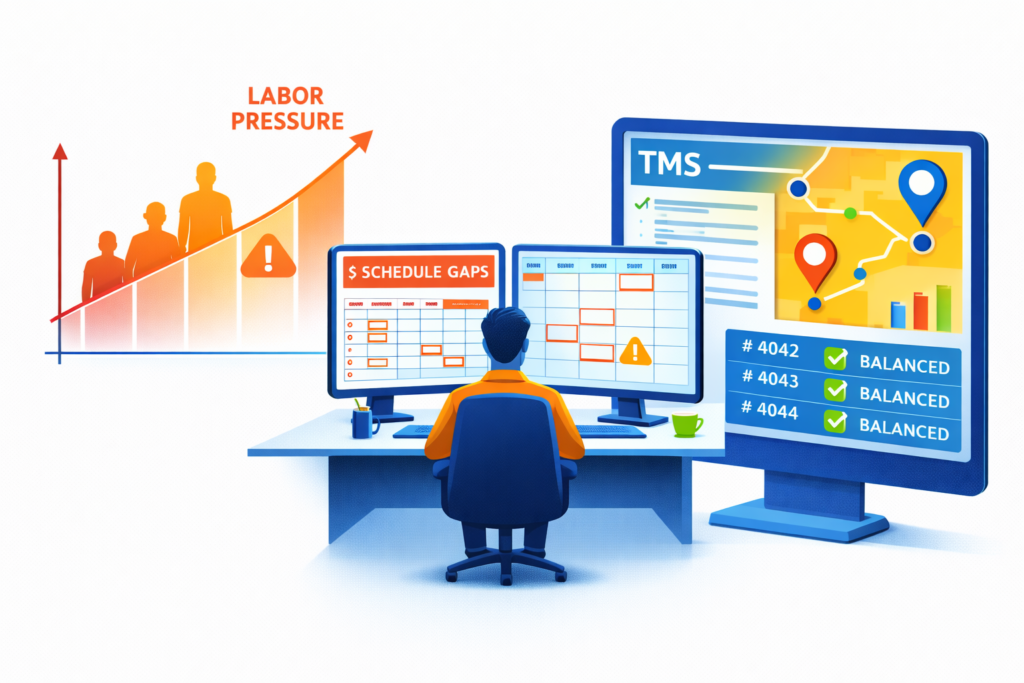
When driver labor becomes an unpredictable variable, carriers must rethink planning dynamics. Traditional models assumed a steady flow of licensed, available drivers; the modern freight environment does not.
Instead, successful carriers are adjusting:
- Route assignments around driver aptitudes and hours-of-service windows
- Regional staffing models to reduce long-haul fatigue and improve home time
- Predictive scheduling systems to anticipate gaps weeks in advance
- Cross-training teams for backup roles and flexibility
This is where technology plays a crucial role. Automated workforce planning and real-time schedule adjustment engines allow carriers to respond faster than manual spreadsheets ever could.
Automation and Technology: Not Replacements, But Amplifiers
Automation isn’t here to replace drivers tomorrow, but it’s already shifting how carriers use them. Tools that help with load matching, telematics, and ELD compliance reduce the burden on drivers and planners alike.
Initial steps involve driver-assist and documentation automation, but long-term strategies include:
- Intelligent dispatch systems that distribute workloads fairly
- Telematics that improve safety and reduce burnout
- Analytics that flag at-risk routes based on driver availability
- Integrated TMS platforms that unify planning, tracking, and obligations
Rather than automation supplanting human labor, carriers are using it to remove manual friction points, making driver jobs more sustainable and careers more attractive.
In response to driver shortage pressure, carriers across the U.S., Canada, and the EU are accelerating digital transformation initiatives. Transportation management systems that integrate dispatching, workforce planning, and compliance data are becoming essential rather than optional. Consequently, freight companies that operate across borders are prioritizing platforms that adapt to regional labor laws, hours-of-service rules, and driver availability patterns. This shift highlights how technology adoption is now driven as much by labor scarcity as by cost efficiency.
Shifting Compensation and Career Pathing Strategies
Competitive wages are part of the solution, but carriers must think beyond rates. Benefits and quality-of-life offerings are increasingly decisive:
- Structured home-time policies
- Flexible scheduling and regional assignments
- Health, retirement, and family support perks
- Career progression and mentorship paths
Carrier recruitment now mirrors strategies once seen in professional fields: long-term engagement, career clarity, and work-life alignment.
Regulatory Pressures That Amplify Shortage Effects
Driver shortage pressure doesn’t exist in a vacuum. Regulatory burdens, like hours-of-service limits, ELD mandates, drug screening, and safety compliance, insist on precision and time investments from existing drivers. This reduces operational elasticity, especially when fleets are already stretched thin.
By 2026, carriers that embrace compliance-friendly workflows and automated driver support tools will have a clear advantage.
Talent Pipelines and Future Workforce Development
Long-term relief will require deeper partnerships with community colleges, CDL training programs, and industry associations. Carriers investing in training pipelines now will benefit as tomorrow’s workforce enters the field.
Additionally, outreach to underrepresented demographics, women, veterans, and younger candidates, is slowly reshaping the talent pool. Programs targeting these segments are gaining traction as carriers seek sustainable growth.
Redefining Performance Expectations
Carriers used to measure performance primarily through speed and cost. With driver shortage pressure now a core constraint, performance metrics must account for:
- Driver utilization efficiency
- Retention and turnover rates
- Route resilience under labor constraints
- Predictive staffing accuracy
Redefining KPIs helps carriers align both operational goals and human capital strategies.
Looking ahead to 2026, driver shortage pressure is expected to remain a defining constraint for freight growth rather than a temporary disruption. Market analysts anticipate continued demand volatility, stricter regulatory oversight, and rising expectations for delivery reliability across global supply chains. Therefore, carriers that invest early in workforce intelligence, predictive analytics, and integrated logistics platforms will be better positioned to operate sustainably. Preparing now allows organizations to protect margins while maintaining service quality in increasingly competitive freight markets.
Driver Shortage and On-Time Delivery Performance
Labor scarcity directly impacts on-time delivery. When driver capacity becomes constrained, carriers face increased route exceptions, tighter hours-of-service windows, and higher rescheduling frequency. Companies that integrate workforce data into dispatch systems can anticipate disruptions before they impact customers. Those relying on reactive scheduling often experience cascading delays.
Frequently Asked Questions About the Truck Driver Shortage
What is causing the truck driver shortage in 2026?
Aging workforce demographics, long CDL training pipelines, regulatory constraints, lifestyle expectations, and freight demand volatility are key contributors.
How does the driver shortage affect freight rates?
Reduced driver availability increases labor premiums, raises reliance on third-party carriers, and drives up operational costs, which often translates into higher freight rates.
Is automation replacing truck drivers?
No. Automation is primarily improving dispatch efficiency, compliance management, and route planning, not eliminating drivers.
How can carriers manage driver shortages effectively?
Through predictive workforce planning, integrated TMS platforms, improved retention strategies, and regional staffing models.
Market Outlook Beyond 2026
Industry projections indicate that freight demand volatility and labor supply constraints will remain interconnected beyond 2026. As global supply chains regionalize and cross-border compliance tightens, workforce agility will become as important as fleet size. Carriers investing in predictive analytics and digital dispatch ecosystems will be structurally advantaged compared to those relying on traditional staffing models.
Final Words
By 2026, driver shortage pressure will no longer be a looming trend, it will be a structural reality shaping carrier economics, operations, and technology choices. Resistance will not make it go away; adaptation will determine who thrives.
Carriers that recognize workforce scarcity as a strategic influence and invest in technology, culture, and workforce design, will control costs, maintain service levels, and strengthen resilience in an ever-tight labor market.
Carriers that treat workforce scarcity as a planning variable—not a crisis—will outperform competitors. Integrated platforms that unify dispatching, compliance, workforce forecasting, and visibility are no longer optional tools. They are operational infrastructure.
If your team wants to turn driver shortage pressure into strategic advantage, explore how FTM connects workforce planning, real-time dispatch, and performance analytics in one unified system.
