If you work in dispatch, transportation ops, or supply chain, you have seen this play out.
A team buys a GPS tool so they can see the trucks.
Then they add a route planner to fix miles.
Then leadership asks why service issues and billing disputes still happen.
Someone eventually asks if a TMS is missing or if it does the same thing.
It does not do the same thing.
These tools overlap on the surface, but they solve different problems. The clearest way to understand them is to follow one load from order to payment and ask a simple question.
Which system owns this step?
A real day in operations, four different jobs
On a normal day, here is what actually happens.
- Sales enters an order with a tight ship date and fixed delivery window
- Dispatch chooses a carrier, assigns equipment, and locks appointments
- A planner builds a route that respects time, stops, and driver limits
- Customer service answers ETA questions when something slips
- Finance reconciles documents and charges after delivery
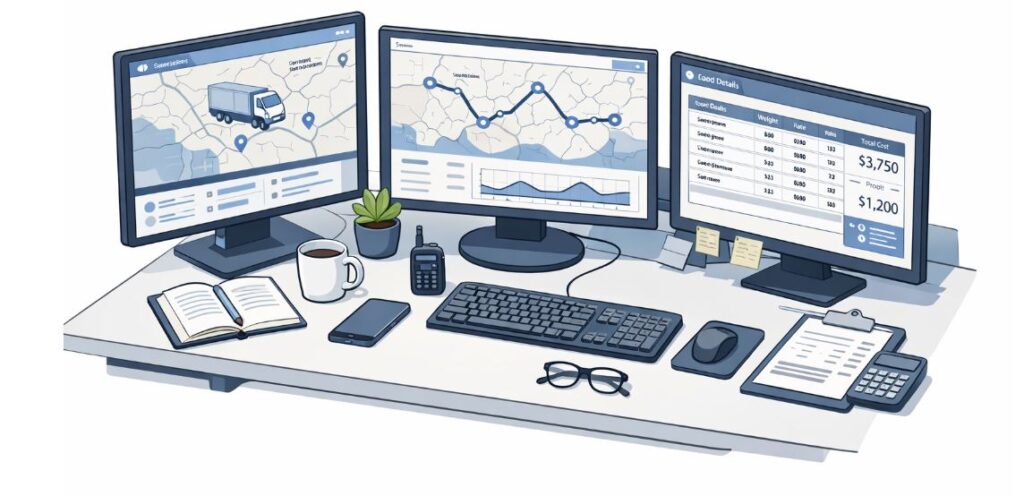
A GPS system cannot manage most of this.
A route planner manages only one slice.
An optimizer manages a bigger slice.
A TMS connects the slices into execution and financial truth.
Read More: TMS Buyer’s Checklist 2026: What Every Logistics Company Needs
A fast comparison you can send to your team
When teams argue internally, this table usually ends the debate.
| Tool | What it does well | What it does not cover |
| GPS or telematics | Live location, vehicle status, ETA signals | Tendering, rating, billing, performance |
| Route planner | Shortest or fastest path between stops | Service rules, cost impact, execution |
| Route optimizer | Multi-stop planning with constraints | Carrier workflows, invoicing |
| TMS | End-to-end transportation workflow | Deep vehicle telemetry without integration |
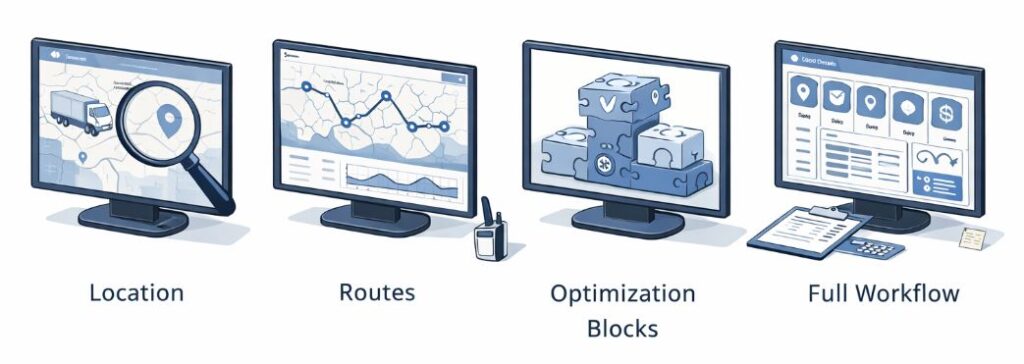
Routing improves movement. A TMS manages outcomes.
GPS systems deliver visibility, not control
A GPS or telematics system is your live pulse.
You see location pings, movement, and status updates. You always know where the truck is.
That visibility is valuable. It is also limited.
GPS does not choose carriers.
GPS does not manage appointments.
GPS does not resolve billing disputes.
Teams often mistake awareness for control. Visibility tells you something is wrong. It does not fix it.
Route planners clean up miles, not operations
Route planners answer a narrow question.
What is the best path from A to B to C?
They help reduce unnecessary miles and avoid restricted roads. They do not understand:
- Customer service commitments
- Dock capacity
- Carrier contracts
- Cost tradeoffs
- Penalty exposure
You get a technically correct route that still fails operationally.
Route optimizers think in scenarios
Optimizers add intelligence.
They account for:
- Multiple stops
- Time windows
- Capacity limits
- Tradeoffs between speed and efficiency
They shine in dense networks and multi-drop environments.
But an optimizer still needs a system to execute the plan.
Without a TMS, the optimized plan gets handed to people who then tender loads, manage documents, and chase invoices manually.
That is where ROI leaks.
Read More: Smart TMS for Retail: Master First & Last Mile Logistics
A TMS connects planning, execution, and money
A TMS owns the full transportation lifecycle.
It connects:
- Orders and loads
- Carrier selection and tendering
- Rates and accessorial rules
- Appointments and exceptions
- Tracking milestones
- Documents and proof of delivery
- Invoicing and audit

This is why a TMS feels heavier.
It is not solving one task. It is managing the business logic around freight.
Why teams confuse these tools in real life
Because failures show up all at once.
A late delivery triggers:
- A GPS check
- A route review
- A carrier call
- A cost question
Under pressure, everything feels like the same problem.
In reality, these are different problems happening in sequence. Without a TMS, teams stretch routing tools and GPS platforms beyond their purpose. That is when spreadsheets appear. That is when email chains grow.
A practical way to think about the stack
Experienced teams use this mental model.
- GPS shows what is happening
- Route planners suggest how to move
- Optimizers test scenarios
- A TMS decides, executes, and records
Remove the TMS and the other tools become isolated. You see motion, but you lose accountability.
Where cost and margin enter the picture
This distinction matters most when finance gets involved.
Without a TMS:
- Rates live in inboxes
- Accessorials slip through
- Detention disputes surface late
- Invoices do not match execution
Routing tools and GPS cannot explain margin changes.
A TMS can, because it ties events to cost.
Read More: What Are the Hidden Logistics Costs & How Do You Cut Them?
What most modern logistics teams actually run
Very few teams rely on one tool.
A common setup looks like this:
- GPS or telematics for live tracking
- Routing or optimization for planning support
- A TMS as the operational backbone
The mistake is treating the backbone as optional.
Choosing based on your operation, not marketing
Ask these questions honestly.
- Do you need visibility or control?
- Does pain show up during planning or after execution?
- Can you explain margin without rebuilding data manually?
If problems surface after the truck moves, routing and GPS are not enough.
Where FTM fits
FTM sits at the point where these tools meet.
Routing inputs, GPS signals, carrier workflows, documents, and billing stay inside one operational flow. Teams stop switching tabs and start managing outcomes.
If your organization is debating tools right now, the real question is not features. It is ownership.
Which system owns the freight outcome?
Book a demo at FTM