Enterprise fleets do not fail because of a lack of trucks, drivers, or contracts. They fail because complexity outpaces control.
As fleets grow across regions, business units, customers, and asset types, visibility fragments. Costs drift quietly. Service quality becomes uneven. Decisions rely on partial data and delayed reports. This is where an enterprise fleet TMS stops being optional and becomes structural.
A Transportation Management System is no longer a dispatch tool. For enterprise fleet management, it is the system that holds planning, execution, visibility, and financial control together.
This article breaks down how Transportation Management Systems support enterprise fleets, where traditional tools fall short, and what leaders should expect from a modern platform.
The reality of enterprise fleet operations
Enterprise fleets operate under conditions smaller fleets never face. Multiple terminals. Mixed asset ownership. Dedicated and spot freight. Customer specific service rules. Complex billing structures.
As a result, operational friction compounds quickly.
Common enterprise challenges include:
- Disconnected regional operations
- Inconsistent carrier and driver performance data
- Limited real time visibility across business units
- Rising cost per mile without a clear cause
- Manual reconciliation between operations and finance
Without centralized control, teams compensate manually. However, manual fixes do not scale. They hide risk until it becomes expensive.
Why an enterprise fleet TMS is fundamentally different
An enterprise fleet TMS is not just a bigger version of a small fleet system. It is designed for coordination, not just execution.
Key differences include:
- Multi entity and multi region architecture
- Role based access across departments
- Shared master data with local flexibility
- Network wide performance measurement
- Integrated financial and operational workflows
Instead of optimizing individual loads, an enterprise TMS optimizes the network.
Planning at enterprise scale with an enterprise fleet TMS
Planning at scale is not about route optimization alone. It is about aligning assets, labor, customer demand, and cost constraints across the network.
With an enterprise fleet TMS, planning teams can:
- Balance freight across terminals
- Allocate assets based on utilization trends
- Simulate cost impacts before committing capacity
- Adjust plans dynamically as conditions change
Therefore, decisions move from reactive to intentional.
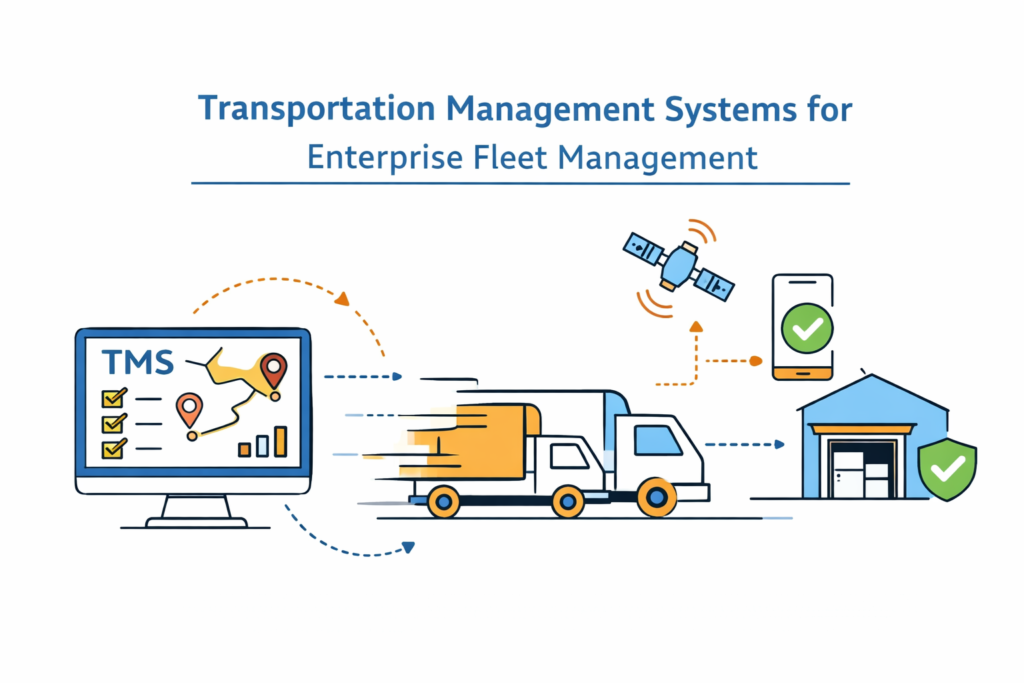
Execution control across fleets and regions
Execution is where enterprise complexity usually breaks systems.
A modern enterprise fleet TMS enforces consistency while allowing flexibility:
- Standardized load creation and tendering
- Embedded appointment and service rules
- Unified exception handling workflows
- Real time coordination between dispatch, drivers, and operations
Meanwhile, regional teams retain the autonomy needed to handle local realities.
Visibility that drives action, not dashboards
Visibility is meaningless if it does not change behavior.
Enterprise fleets need visibility that is:
- Network wide
- Real time
- Operationally embedded
An enterprise fleet TMS enables teams to:
- Detect risk before service failures occur
- Reallocate assets during disruption
- Align customer communication with execution reality
Consequently, visibility becomes a control mechanism, not a reporting layer.
Cost control and financial alignment
Enterprise fleets rarely struggle with revenue reporting. They struggle with understanding true cost.
A strong enterprise fleet TMS connects:
- Load level cost drivers
- Asset utilization
- Driver time
- Fuel and accessorials
- Billing and settlement cycles
As a result, finance and operations work from the same data, not reconciled versions of the truth.
This is where margin protection actually happens.
Performance management at enterprise level
Enterprise leaders need answers to questions like:
- Which lanes destroy margin
- Which customers generate operational drag
- Which terminals outperform the network
- Which carriers or drivers introduce risk
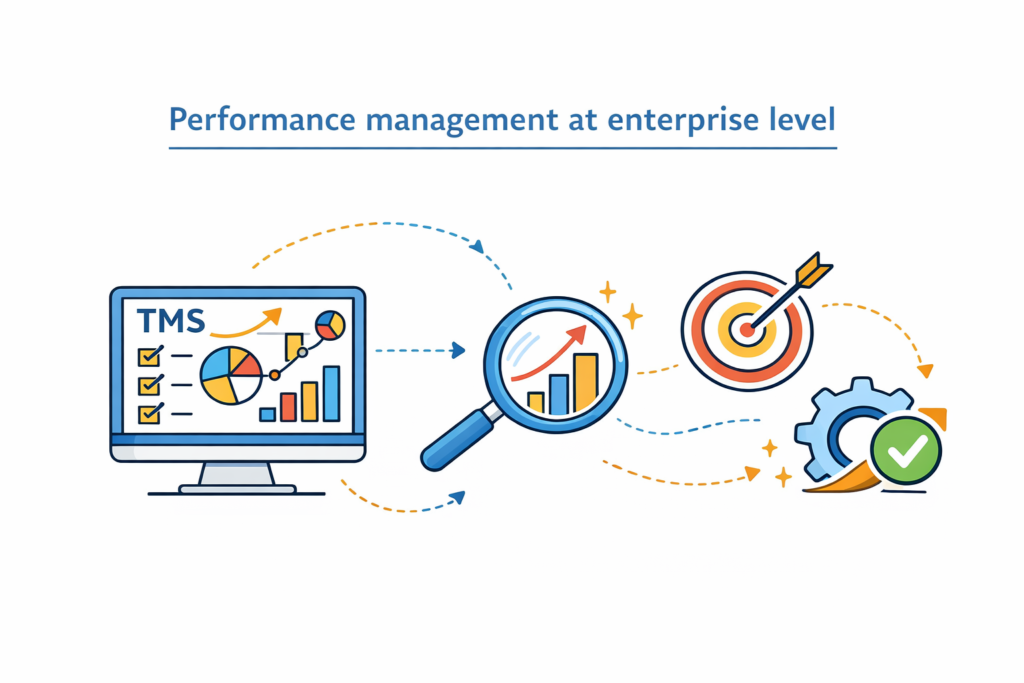
An enterprise fleet TMS ties execution data directly to scorecards:
- On time pickup and delivery
- Dwell time
- Cost per load
- Margin by lane and customer
Therefore, performance conversations shift from opinion to evidence.
Integration as a requirement, not a feature
Enterprise fleets operate within an ecosystem of systems.
A viable enterprise fleet TMS must integrate with:
- ERP systems
- Telematics and ELD providers
- Accounting and billing platforms
- Customer and carrier portals
Without integration, teams manually bridge systems. That friction becomes permanent overhead.
What this means for enterprise fleet leaders
Technology does not create discipline. However, it makes discipline possible.
Enterprise fleets that succeed share common traits:
- Centralized control with local execution
- Data driven decision making
- Network level visibility
- Financial and operational alignment
An enterprise fleet TMS is the system that enables these behaviors at scale.
From operational noise to network clarity
Most enterprise fleets are not constrained by capacity. They are constrained by fragmentation.
Data lives in too many systems. Decisions lag behind reality. Teams solve the same problems repeatedly.
FTM is built to remove that fragmentation.
FTM connects planning, execution, visibility, and financial workflows into a single enterprise platform. Your teams stop stitching data together and start managing performance deliberately.
If your fleet is growing in size, complexity, or expectation, now is the right time to evaluate whether your current TMS supports enterprise control.
Book a demo to see how enterprise fleet management looks when it runs on one system.