The freight recession has already changed the transportation market. What matters now is not whether it continues, but how its effects show up inside shipper operations.
On this page
For shippers, this cycle is not playing out as a simple “cheap freight” story. Yes, spot rates dropped. Yes, capacity loosened. But behind the pricing headlines, carrier behavior, service reliability, and network risk have all shifted.
As the market moves into 2026, shippers that treat the freight recession as a temporary pricing opportunity will struggle. Those that understand the structural impact on carriers, lanes, and contracts will be better positioned to control cost without sacrificing reliability.
This article breaks down what logistics teams should realistically expect and how to respond.
The freight recession did not reset the market evenly
The biggest mistake shippers make is assuming the downturn affected all carriers and lanes the same way.
It did not.
- Large carriers with diversified networks and strong balance sheets survived with margin pressure.
- Mid-sized carriers cut capacity, parked equipment, or exited unprofitable lanes.
- Small carriers disappeared quietly, often without notice until tenders started failing.
For shippers, this means historical lane performance is less reliable than it used to be. A carrier that performed well in 2022 may no longer have the same assets, drivers, or appetite for certain freight.
The result is hidden fragility. On paper, capacity looks available. In practice, it is thinner and more selective.
Read more:
Cross-Border Freight at Scale in 2026: A Practical Regulatory & Customs Compliance Checklist
Pricing power is lower, but volatility risk is higher
Shippers have enjoyed lower transportation costs during the downturn. That relief comes with a tradeoff.
Spot rates can move quickly when demand shifts. Contract rates look stable, but carrier compliance is more fragile when margins are thin. Rejections rise faster when carriers have less buffer to absorb disruptions.
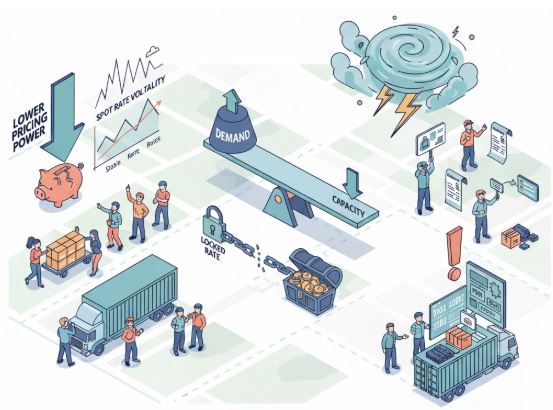
In practical terms, shippers should expect:
- Shorter periods of stable pricing
- Faster swings between soft and tight conditions on key lanes
- More aggressive carrier behavior around accessorials and exceptions
This is where many logistics teams get caught off guard. The rate is locked, but the cost is not.
Carrier behavior has changed in subtle but important ways
During strong markets, carriers chase volume. During weak markets, they protect cash.
That shift shows up in ways shippers feel operationally:
- More scrutiny of detention and layover
- Less flexibility on appointment changes
- Higher sensitivity to dwell time and facility performance
- Selective acceptance of tenders, even at contracted rates
From the shipper side, this creates friction that looks like a service issue but is actually a margin survival tactic.
Logistics teams that still operate on informal agreements or manual processes feel this pain the most.
Read more:
What’s the Best Way to Automate Load Tendering?
Service reliability becomes harder to predict
One of the least discussed impacts of the freight recession is service inconsistency.
Carriers running leaner networks have less slack. When disruptions happen, weather, labor issues, equipment failures, the recovery window is longer.
For shippers, that means:
- Fewer backup assets when a load falls apart
- More last-minute re-tenders
- Higher risk on time-sensitive or customer-facing freight
Visibility alone does not solve this problem. Shippers need the ability to act quickly when signals change.
Contract strategy needs to evolve
Many shipper contracts were designed for a different market. Long fixed commitments made sense when capacity was tight. Purely transactional spot buying made sense when rates were falling.
Neither extreme works well going forward.
Shippers heading into 2026 should reassess:
- Which lanes truly benefit from long-term commitments
- Where flexible pricing is safer than locked volume
- Which carriers deserve preferred status based on performance, not just price
This is not about renegotiating everything. It is about segmenting the network and aligning contract structure with actual risk.
Internal operations feel more pressure than expected
The freight recession does not just affect carriers. It puts pressure on shipper teams too.
Lower rates often lead leadership to expect lower logistics budgets across the board. At the same time, planners, dispatchers, and analysts deal with more exceptions, more rework, and more communication overhead.
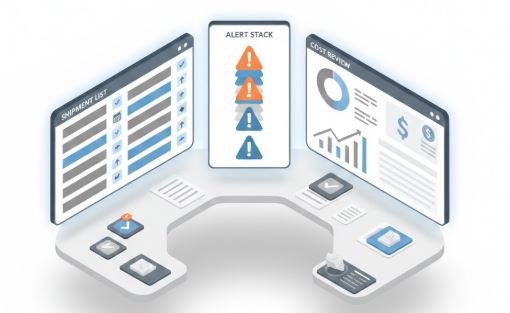
Common symptoms inside shipper organizations include:
- Increased manual intervention to keep loads moving
- More time spent explaining variances to finance
- Tension between cost targets and service expectations
This is where tooling and process maturity start to matter more than headcount.
What smart shippers are doing differently
The most resilient shippers are not waiting for a market rebound. They are adapting how they operate.
Key moves include:
1. Strengthening carrier evaluation
Performance, responsiveness, and reliability now matter as much as rate history. Shippers are tracking behavior during disruption, not just on-time percentages.
2. Improving cost transparency
Teams are tightening control over accessorials, invoice validation, and exception-driven costs that quietly erode savings.
3. Planning for faster pivots
Instead of annual strategy resets, shippers are building workflows that allow them to shift capacity and pricing assumptions within weeks.
4. Reducing dependence on manual work
Spreadsheets and email chains break under volatility. Systems that connect planning, execution, and finance reduce reaction time.
Read more:
Autonomous Trucks in Logistics: What Shippers & Brokers Need to Know
Why technology decisions matter more in a downturn
In stable markets, weak systems can survive. In volatile ones, they become liabilities.
Shippers that lack clean integration between planning, execution, visibility, and billing struggle to answer basic questions quickly:
- Which loads are truly at risk right now?
- Which carriers are failing more often this quarter?
- Where is the cost increasing despite lower base rates?
A modern TMS should support these answers without forcing teams to stitch together data manually.
What this means for 2026
The freight recession has reshaped expectations. Shippers will not measure success by rate alone.
They will be judged by:
- How well they protect service during disruption
- How fast they adapt to shifting capacity
- How clearly they understand true transportation cost
- How resilient their carrier network really is
Those outcomes depend less on market timing and more on operational discipline.
Where FTM helps
FTM is designed for shippers that need control in uncertain markets.
By connecting load planning, execution, carrier performance, visibility, and billing in one system, FTM helps logistics teams respond faster and with better information. That matters when pricing is volatile, carriers are selective, and service expectations remain high.
If you are planning how your transportation strategy should evolve through 2026, now is the right time to assess whether your systems and workflows can keep up.
Book a quick demo to review your current setup and risk areas.
