Nobody announces when things start breaking down.
On this page
There’s no moment where someone walks into the office and says, “Our processes have officially failed.” It doesn’t work that way. What actually happens is quieter and slower. A customer starts asking more questions. A carrier relationship frays. A billing dispute drags into its third week. Margins shrink and nobody can quite explain where the money went.
That’s what running logistics without a TMS looks like from the inside. Not a collapse. A slow erosion.
And by the time most companies recognize what’s happening, they’ve already been paying the price for months.
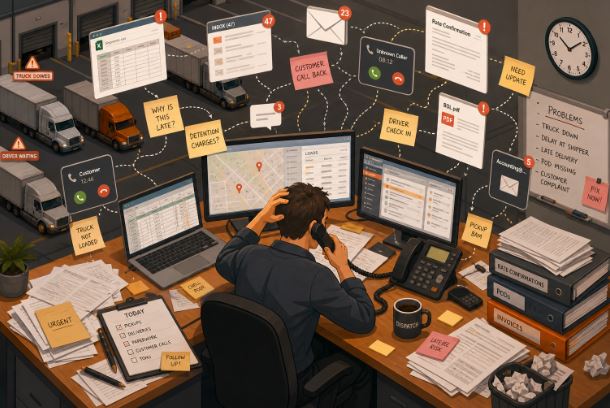
The Invisible Cost of Doing It Manually
There’s a version of manual logistics management that feels like it’s working. Loads are moving. Customers are getting updates. Invoices are going out. The team is busy, which usually gets mistaken for productive.
But busy and efficient are not the same thing.
When a business operates logistics without a TMS, the work gets done through a combination of phone calls, spreadsheets, email chains, and tribal knowledge. That works at small volumes. Ten loads a week. Twenty, maybe. But scale that up and each one of those manual touchpoints multiplies. A dispatcher who could manage 30 loads comfortably is now drowning at 60, not because they’re less capable, but because the system they’re using was designed for a different scale.
The is the time. Hours spent updating spreadsheets that should be automated. Time burned tracking down a carrier on a load that a system should already have flagged. Energy wasted reconciling two different versions of the same rate because nobody had a single source of truth.
That time has a dollar value. Most companies never calculate it. They should.
Visibility Is Not Just a Nice-to-Have Anymore
In 2026, customers don’t wait for updates. They expect them. Shippers want to know where their freight is without making a call. Receivers want accurate ETAs, not a range. And when something goes wrong, they want to know before it becomes their problem.
Logistics without a TMS means visibility is reactive. You find out about delays when someone calls to complain. ETAs are based on the last conversation with a driver, which could be three hours old. Exception management means waiting for exceptions to surface instead of catching them before they land.
This is where customers start leaving. Not because of one bad shipment. Because the experience of working with a company that can’t answer basic questions quickly feels unreliable, even when the freight usually arrives fine.
Trust in logistics is built on consistency. Consistency requires visibility. And real visibility requires a system.
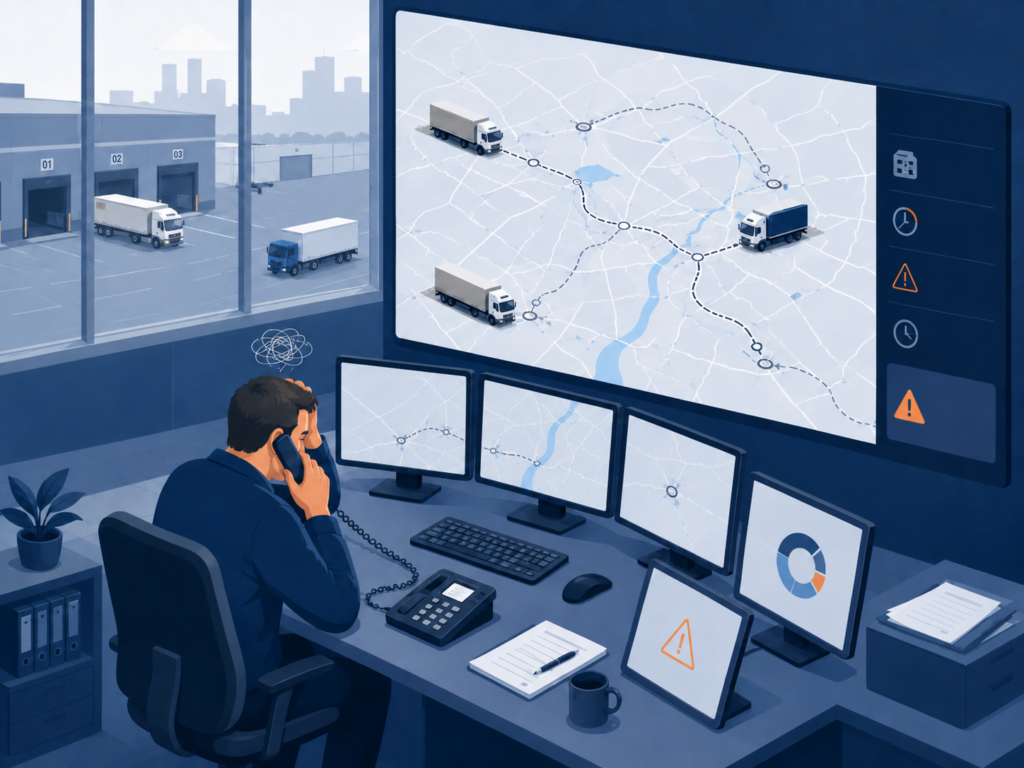
The Carrier Relationship Problem Nobody Talks About
Ask any freight broker or fleet manager who they trust with their best lanes. They’ll give you a short list. Ask them how they built that list, and most of them will say: experience. Memory. A gut feeling built over years.
That’s not a bad thing on its own. Relationships matter in freight. But when carrier performance lives in someone’s head instead of a system, the business becomes dependent on that person. They leave, and suddenly nobody knows which carriers actually perform on the Chicago to Atlanta lane, or which ones have a pattern of going dark on Friday afternoons.
Operating logistics without a TMS means carrier management is informal by default. There’s no structured performance data. No on-time rates by lane. No way to look at a carrier’s history before tendering them a load and knowing what you’re actually getting.
Over time, this creates two problems. Good carriers get underused because nobody can prove on paper how reliable they are. And bad carriers keep getting loads because nobody has the data to justify cutting them. The relationship layer stays emotional when it should be informed.
Billing and Cash Flow: Where It Really Hurts
Freight billing is one of the most underestimated sources of pain in a logistics company.
On paper, invoicing sounds simple. Load moves, invoice goes out, payment comes in. In practice, every load carries the potential for disputes. Accessorials that weren’t documented at pickup. Detention that happened but nobody captured. A fuel surcharge calculated one way by the carrier and a different way by the shipper.
Logistics without a TMS means every one of those disputes gets resolved manually. Someone has to dig up the original rate confirmation. Someone has to find the email where detention was discussed. Someone has to build a case from scattered documents and hope the other party agrees.
That process takes time. And while it’s happening, cash isn’t moving. For smaller logistics companies operating on thin margins, a handful of stuck invoices can create real cash flow pressure. Not theoretical pressure. The kind where you’re watching payment timelines closely and hoping next week looks better.
A TMS ties documents, rates, and billing to the load from the start. Disputes still happen. But they get resolved in hours, not weeks.
The Scaling Trap
Here’s the pattern that repeats across the industry: a logistics company grows, so they hire more people to keep up. Then they grow again, so they hire more people again. The operation gets bigger but not better. Margins stay flat or shrink. The team is always stretched.
This is the scaling trap that comes from running logistics without a TMS. Growth adds headcount instead of capability. The bottleneck isn’t talent. It’s the absence of a system that scales with the business.
A dispatcher managing 50 loads in a TMS is not the same as a dispatcher managing 50 loads in a spreadsheet. One of them has time to think. The other is just keeping up.
Companies that recognize this early are the ones that build something durable. The ones that don’t keep hiring until the cost of people outpaces the value they’re producing.

What “Failing” Actually Looks Like in Logistics
It’s worth being direct about what failure means here, because it rarely looks like a shutdown.
Most logistics companies that fail without a TMS don’t close overnight. They lose one key customer who got tired of chasing updates. They lost a great dispatcher who burned out on manual work. They lose a high-volume lane to a competitor who could offer better visibility. They lose margin, slowly and quietly, to billing errors and carrier inefficiencies that never got measured.
Failure in logistics often looks like staying the same while the market moves forward. The companies you’re competing against are automating workflows, capturing data, and building carrier networks on a foundation of real performance history. You are doing the same thing you did three years ago, just with more people and more spreadsheets.
That gap compounds. And at some point, it becomes very hard to close.
What Changes When a TMS Enters the Picture
The shift is not just operational. It’s structural.
When a logistics company moves from managing freight manually to running it through a TMS, the first thing that changes is clarity. Load status becomes something you can see, not something you have to ask about. Carrier performance becomes data, not instinct. Billing becomes tied to documentation from the start, not assembled after the fact.
The second thing that changes is capacity. The same team can handle more volume without the cognitive overhead of tracking everything manually. Planners spend their time on decisions, not data entry. Customer service responds to questions in real time instead of calling around to find answers.
And the third thing that changes is confidence. Confidence to take on a larger customer because you know your system can handle the volume. Confidence to cut an underperforming carrier because you have the numbers to back it. Confidence to quote a lane accurately because your data is clean.
That confidence is what separates logistics companies that grow deliberately from the ones that grow chaotically and wonder why it doesn’t feel like success.
Where FTM Fits In
FTM is built for logistics companies that are patching together manual processes and ready to operate with a real system underneath them.
For brokers, carriers, and shippers that want visibility from load creation to delivery, billing that connects to the load record from day one, and carrier management built on data instead of memory. FTM gives operations teams what they actually need: control.
If any part of this article felt familiar, that’s not a coincidence. It’s a signal.
Book a demo and see what your operation looks like with a TMS built for how freight actually works.
