Most logistics companies do not fail because their teams are not working hard enough. They fail because their systems quietly work against them.
On this page
A dispatcher updates one spreadsheet. Finance checks another file. Customer service waits for an ETA. Leadership asks why margin looks different from last week. Everyone is doing their job, but the operation still feels slower than it should.
That is why learning how to choose the right TMS matters. A Transportation Management System is not just another software purchase. It becomes the structure behind how your logistics company plans, executes, tracks, bills, and grows.
The wrong TMS creates workarounds. The right one removes them.
This guide explains how to choose a TMS that fits your real operation, not just a polished demo.
Why Choosing the Right TMS Matters More in 2026
The TMS market is crowded. Almost every platform promises automation, visibility, optimization, and better control.
However, most buying mistakes happen because companies focus too much on feature lists and not enough on operational fit. A system can look powerful in a demo and still fail inside your daily workflow.
Choosing a transportation management system in 2026 is closely tied to how companies handle growing shipment complexity, real-time decision-making, and multi-system data flow. As freight networks expand across regions, partners, carriers, and customers, the process of choosing the right TMS becomes more important for maintaining operational consistency.
Companies that evaluate systems carefully before implementation avoid rework, reduce training friction, and align operations, finance, and customer service faster.
Choose the Right TMS Based on Your Operation Type
Not all logistics companies need the same TMS.
A freight broker needs fast carrier communication, flexible pricing, tendering tools, and strong load visibility. A carrier needs dispatch control, driver visibility, equipment tracking, and settlement support. A shipper needs cost control, multi-carrier visibility, compliance, and reliable reporting.
Therefore, your first question should not be, “What features does this TMS have?”
It should be:
“Does this system support how our operation actually works?”
If your company handles multi-stop loads, cross-border shipments, container moves, warehouse appointments, or complex rate structures, those realities should be tested during the sales process. Do not accept a generic walkthrough. Ask the vendor to show your real workflow from order creation to final invoice.
That is where the truth appears.
Evaluate Workflow Flexibility Before You Commit
Rigid workflows are one of the biggest reasons logistics teams outgrow software too quickly.
A strong TMS should support configurable workflows, custom statuses, exception rules, approval steps, and user-specific views. Logistics is not static. Your process today may not be your process next year.
However, many systems force teams into predefined steps. At first, that may feel manageable. Later, it becomes a bottleneck.
You start hearing things like:
“Our process does not fit the system.”
“We need another spreadsheet for that.”
“We still have to track this manually.”
Those are warning signs.
The right TMS should give structure without trapping your team inside someone else’s process.
Choose the Right TMS With Strong Integration Capability
No modern logistics operation runs in isolation.
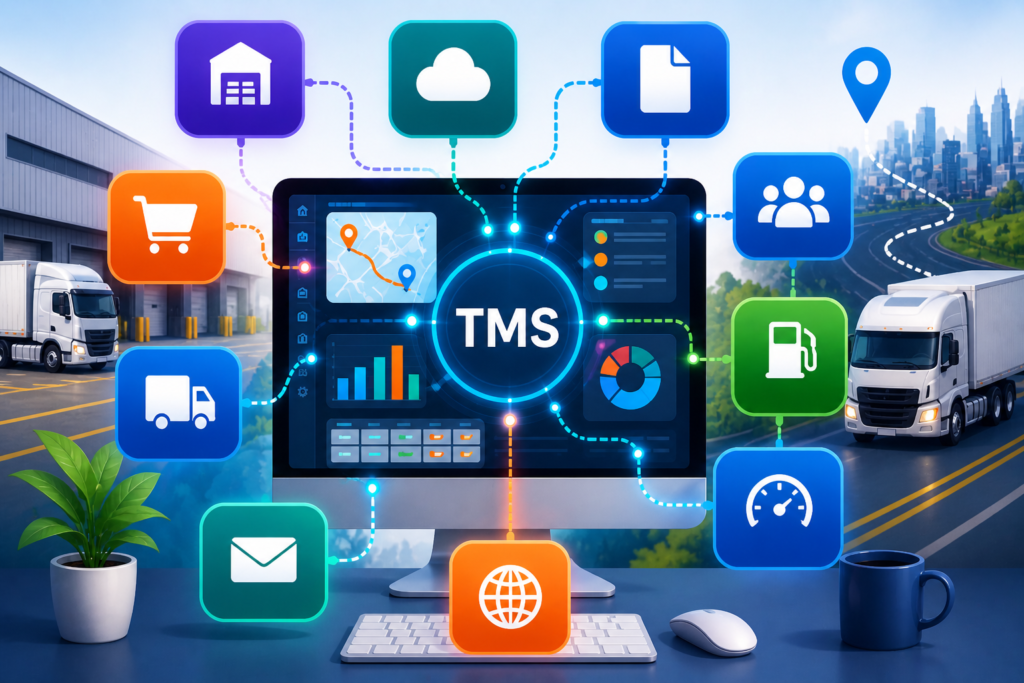
Your TMS needs to connect with accounting systems, ERP platforms, ELD tools, carrier portals, visibility providers, mapping tools, and customer systems. IBM describes a TMS as a real-time logistics tool that helps manage inbound and outbound shipping and can connect with ERP or supply chain management software.
That connection matters because disconnected systems create duplicated work.
If dispatch enters load data manually, finance re-enters cost data later, and customer service checks another portal for tracking, your team becomes the integration layer. That is expensive, slow, and risky.
A good TMS should support clean data exchange through APIs, EDI, or other integration methods. More importantly, the vendor should be able to explain how those integrations work in plain language.
Ask:
How does data move in and out of the system?
How long does a typical integration take?
Which systems are already supported?
What requires custom development?
How are errors handled?
If the answers are vague, be careful.
Think About Global and Multi-Region Operations
For companies operating across multiple regions, integration is not just technical. It is geographical.
Different countries and markets introduce different regulations, carrier standards, currencies, tax rules, and data formats. Therefore, when you choose the right TMS, your team should consider whether the system can support multi-region operations, cross-border compliance, and localized workflows.
This becomes especially important for companies moving freight across North America, Europe, or mixed international lanes. A system that works well for one region may struggle when documentation, compliance, or carrier processes become more complex.
A scalable TMS should not only support today’s lanes. It should support where your business is going next.
Data Visibility Should Lead to Action
Most TMS platforms show data. Fewer systems make that data useful.
A dashboard is only valuable if it helps someone make a faster or better decision.
When evaluating a TMS, ask:
Can dispatchers see load status clearly?
Can finance see margin by load?
Can managers compare carrier performance by lane?
Can customer service give accurate updates without chasing people?
Can leadership trust the reports without rebuilding them manually?
Furthermore, visibility should be connected to action. If a shipment is at risk, the system should help your team respond. If a carrier is missing delivery windows, the system should make that pattern visible before the next tender.
The goal is not more data. The goal is better control.
User Adoption Determines the Real ROI
The best TMS on paper is useless if your team does not use it.
This is where many buying teams make a mistake. Managers watch the demo, approve the system, and assume the team will adapt. Then implementation starts, and daily users quietly return to spreadsheets, calls, and side notes.
Why?
Because the system is too complicated, too slow, or too far from their actual workflow.
Before choosing a TMS, involve the people who will use it every day. Dispatchers, planners, finance users, operations managers, and customer service teams will see problems that executives may miss.
Ask them:
Is the interface clear?
Can you complete daily tasks quickly?
Does it reduce clicks or add more?
Can new users learn it without weeks of training?
User adoption is not a soft factor. It directly affects ROI.
Choose the Right TMS by Reviewing Total Cost
Subscription price is only one part of the cost.
The real cost includes implementation, training, integrations, customization, support, upgrades, and time lost during transition. A cheaper system can become expensive if it requires constant manual work.
Therefore, evaluate total cost of ownership.
Ask:
What is included in onboarding?
Are integrations included or billed separately?
Will future configuration changes cost extra?
How does pricing change as users or shipments increase?
What support is available after go-live?
The right question is not, “Which TMS is cheapest?”
The better question is, “Which TMS reduces the most operational waste over time?”
That is how you protect margin.

Implementation Support Can Make or Break the Project
Buying software is the easy part. Implementation is where the real work begins.
A strong vendor should help with data migration, workflow setup, user training, document configuration, integrations, and go-live support. Without this structure, your team may struggle to turn the system into a working operation.
Implementation should have clear steps:
Discovery
Workflow mapping
Configuration
Data migration
Testing
Training
Go-live
Post-launch support
If a vendor cannot explain the implementation process clearly, that is a risk.
A TMS is not just installed. It is adopted.
Security and Compliance Are Not Optional
Freight data is sensitive.
Customer details, carrier information, pricing, shipment history, documents, and financial records all move through your TMS. Therefore, security needs to be part of the buying decision from the beginning.
Ask:
How is data stored?
How are permissions managed?
Can users have role-based access?
Is activity tracked?
How are documents protected?
How does the system support compliance workflows?
A weak security structure can damage trust quickly. A strong one protects your operation as it grows.
Common Mistakes When Choosing a TMS
Even experienced logistics teams get this decision wrong.
The most common mistake is choosing based on how the system looks instead of how it works. A clean interface matters, but it does not replace operational depth.
Other mistakes include:
Ignoring integration limits
Underestimating implementation effort
Choosing for today’s volume only
Forgetting finance and billing workflows
Not involving daily users
Overlooking reporting accuracy
Assuming every TMS works the same way
Consequently, the wrong choice often looks fine at the beginning and becomes painful later.
What the Right TMS Actually Changes
When you choose the right TMS, the operation starts to feel different.
Dispatch stops chasing updates. Customer service gets cleaner visibility. Finance spends less time reconciling invoices. Managers see performance patterns earlier. Leadership gets reports that reflect reality.
The impact shows up in practical ways:
Faster load planning
Cleaner carrier communication
Fewer manual updates
Better cost control
More accurate billing
Improved delivery visibility
Stronger performance analysis
In other words, the company stops operating as a collection of disconnected tasks and starts operating as one system.
Think About Time-to-Value
Another factor many companies overlook is how quickly the TMS can deliver operational value.
Some systems require long implementation cycles before teams see results. Others offer faster deployment through configurable workflows, pre-built integrations, and practical onboarding.
When evaluating options, ask:
How soon can we manage real loads in the system?
How quickly can our team be trained?
Which features can go live first?
What can be phased in later?
How will we measure early success?
Time-to-value matters because long delays reduce momentum. A system that starts improving daily work quickly is easier for teams to trust.

Choose a TMS That Can Evolve With You
Your logistics company will not stay the same.
Shipment volume may grow. Customers may demand better visibility. Your team may add new modes, new regions, new carriers, or new billing rules. What works now may not be enough in two years.
That is why flexibility matters.
A TMS should support your current needs and your future operating model. As logistics companies grow, their needs shift from basic load management to advanced analytics, automation, performance optimization, and deeper financial visibility.
Systems that support configurable workflows and continuous improvement allow organizations to adapt without replacing their core platform.
That flexibility becomes a long-term advantage.
Choosing a TMS Is Choosing Your Operating Model
Most logistics companies think they are buying software.
They are not.
They are choosing how their business will function every day.
The right TMS becomes the operational backbone of the company. It connects planning, execution, visibility, carrier management, documents, billing, and performance analysis into one flow.
The wrong system creates friction, workarounds, and hidden costs.
If you want to choose the right TMS, do not start with features. Start with your operation. Look at how work actually moves through your company. Then choose the system that supports that reality while giving you room to grow.
Before you choose a TMS, it helps to know where your current workflow is already costing you money.
Send us your current dispatch flow, rate confirmation process, or invoice workflow. We’ll review it and show you 2–3 places where time, money, or visibility is leaking.
No pressure. No generic demo.
Just a practical workflow review so you can see what needs to be fixed before those small issues become expensive.
Send your current flow or request a review at FTM.CLOUD
