There’s a moment most growing logistics companies know well. You’re moving more loads than ever, your team is expanding, and the system you’ve been using starts to crack under the pressure. Emails get missed. Reporting takes forever. Someone’s pulling data from three different places just to answer a basic question from a customer.
On this page
So you go looking for a TMS. You find a few options, pick the one that looks the cleanest, and sign up. For a while, things feel better.
Then the cracks show up again.
This time, they’re in the software.
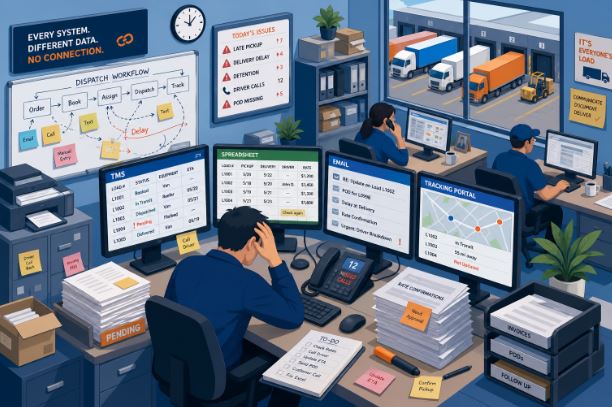
The Problem With “Good Enough” Software
Generic TMS platforms are built to serve the widest possible audience. That sounds like a good thing until you realize what it actually means in practice: the features are broad, the customization is limited, and the workflows are designed around an imaginary average user that probably doesn’t look much like your operation.
A broker working high-volume spot freight has completely different needs than a regional carrier managing dedicated lanes. A shipper coordinating inbound and outbound across multiple warehouses operates nothing like a small fleet running local deliveries. A generic TMS treats all of them the same.
That works fine when your volume is low and your processes are simple. But logistics companies don’t stay simple. They grow. And growth exposes every limitation a generic TMS was quietly hiding.
Read more: How TMS Technology Simplifies Daily Fleet Operations
Where Generic TMS Systems Actually Break Down
Carrier and lane management gets messy fast. Most generic TMS platforms give you a basic carrier list and some rate fields. That’s fine until you’re managing hundreds of carriers across different regions, tracking performance, comparing rates in real time, and trying to build preferred carrier relationships. At that point, you need more than a list. You need logic.
Reporting stays surface-level. Generic TMS vendors love to show you dashboards during the sales demo. What they don’t show you is how hard it is to get a specific report when you actually need one. Growing logistics operations need visibility into margins, carrier performance, load profitability, and customer trends. When your TMS can’t produce that without a workaround, your team fills the gap with spreadsheets. And now you’re right back where you started.
Billing and invoicing become a bottleneck. As volume increases, so does the complexity of billing. Accessorials, fuel surcharges, detention, lumper fees. A generic TMS often handles the straightforward stuff fine but starts to wobble the moment exceptions show up. And in logistics, exceptions are not the exception. They’re part of the job.
Integrations break or don’t exist. Shippers want EDI. Customers want API connections. Carriers want load tenders sent a specific way. Generic TMS systems usually offer a handful of standard integrations and call it done. The moment you need something outside that list, you’re either paying a developer or doing it manually.
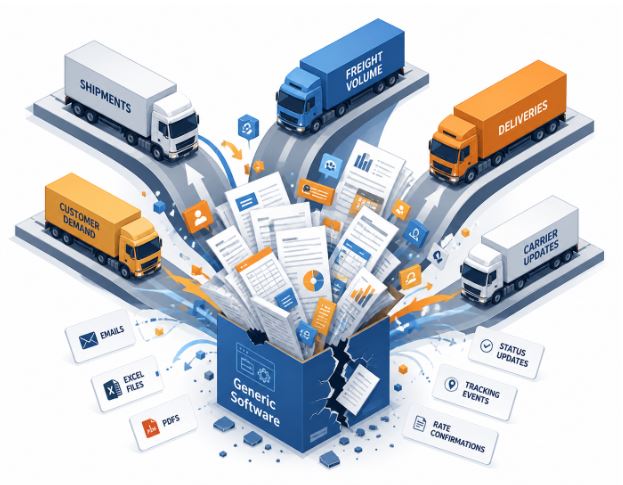
Growth Doesn’t Wait for Your Software to Catch Up
Here’s what makes this painful. By the time a logistics company realizes their generic TMS is holding them back, they’re already deep into it. Data is stored in the system. The team has built habits around its quirks. Switching feels like a project nobody has time for.
So companies stay longer than they should. They hire an extra person to handle what the software can’t. They build workarounds. They tolerate slow load times and missing features because changing feels harder than staying.
But staying has a cost too. It just gets paid in overtime, in lost customers, and in opportunities you never had the visibility to see.
Read more: How TMS Manages Big Data in Logistics
What a TMS Built for Growth Actually Looks Like
The difference between a generic TMS and one built for growing logistics companies isn’t just about features. It’s about philosophy.
A purpose-built TMS is designed with the understanding that your freight mix will change, your carrier network will expand, your customers will expect more, and your team will need tools that grow with the operation rather than fight against it.
That means flexible rate management. It means configurable workflows that match how your team actually works, not how the vendor assumes you work. It means reporting that tells you something useful, not just something pretty. And it means an implementation team that understands logistics, not just software.
Read more: TMS, Route Planner, Optimizer or GPS System? What’s the Difference?
The Right TMS Grows With You
Switching from a generic TMS is not just a technology decision. It’s a business decision. The companies that make the move at the right time are the ones that recognize the ceiling before they hit their head on it.
If your team is spending more time managing the software than managing freight, that’s a signal. If your reporting requires a spreadsheet detachment and three hours of manual work, that’s a signal. If you’re turning down new business because your system can’t handle the volume or the complexity, that’s the loudest signal of all.
Generic TMS systems are not bad products. They’re just not built for where you’re going.
FTM is. Built specifically for brokers, carriers, and shippers who are growing, FTM gives you the tools to manage more freight, more carriers, and more complexity without adding more headcount or more workarounds. If you’re hitting the ceiling on your current TMS, it might be time to see what a purpose-built platform looks like.
