How do you build a resilient freight network?
On this page
A resilient freight network is built on four things: multiple routing options so you’re never locked into one lane, a flexible carrier strategy that treats capacity as a dynamic portfolio, multi-modal fallback so you can shift between road, rail, and ocean when needed, and connected technology (like a TMS) that helps you spot problems and reroute before they become service failures.
Step 1
Multiple routing options
Step 2
Flexible carrier strategy
Step 3
Multi-modal fallback
Step 4
Connected TMS technology
Freight networks are being tested in ways that were once considered edge cases. Geopolitical tension, climate events, infrastructure strain, labor shortages, and sudden capacity shifts are no longer rare disruptions. They are part of normal operations.
For logistics leaders, resilience is no longer about reacting faster after something breaks. It is about designing networks that can absorb shocks without collapsing service, cost, or customer trust.
This article focuses on how shippers and logistics leaders can build freight networks that remain functional under pressure, using technology as an enabler rather than a crutch.
Risk in freight has become multi-layered
Risk used to be compartmentalized. Political risk lived with trade teams. Weather risk lived with planners. Carrier risk lived with procurement.
That separation no longer works.
Today, a single disruption can cascade across layers:
- A geopolitical event reroutes trade lanes
- Port congestion increases dwell time
- Carrier utilization shifts
- Equipment ends up in the wrong regions
- Service failures hit customers downstream
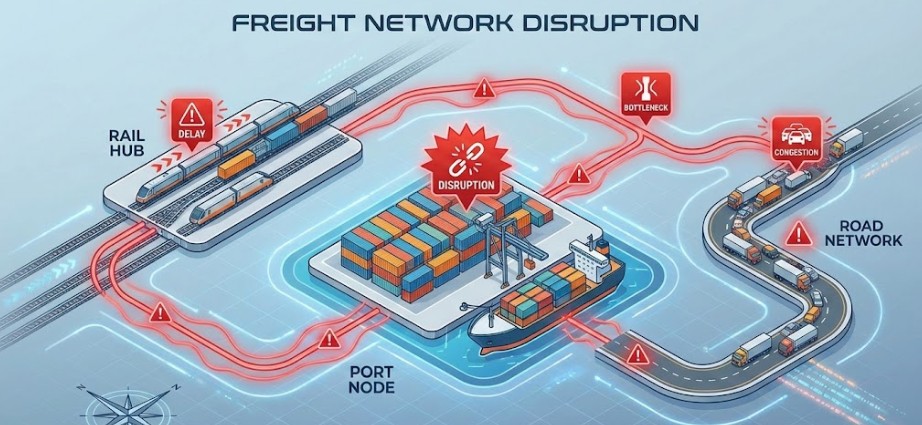
Resilience requires understanding how these layers interact, not just tracking them in isolation.
Geopolitical risk now affects daily routing decisions
Geopolitical risk used to matter mostly for long-term sourcing decisions. Now it affects routing and mode selection week to week.
Examples logistics teams are already dealing with:
- Sudden restrictions on transit corridors
- Sanctions impacting carriers or intermediaries
- Increased inspections and border delays
- Insurance and security constraints on certain regions
The key challenge is not predicting every event. It is building routing and carrier strategies that can adapt quickly when conditions change.
Rigid networks fail first.
Read more: Cross-Border Freight at Scale in 2026: A Practical Regulatory & Customs Compliance Checklist
Supply chain disruptions expose fragile dependencies
The last few years revealed how dependent freight networks are on a small number of nodes.
Ports, border crossings, rail hubs, and key distribution centers become choke points under stress. When they fail, freight does not reroute cleanly unless alternatives were planned in advance.
Risk-resilient networks tend to share a few characteristics:
- Multiple routing options per critical lane
- Pre-approved alternates for ports and terminals
- Visibility into upstream and downstream impacts
- Clear decision authority when rerouting is required
This level of preparedness cannot be improvised during a disruption. It has to be designed.
Carrier shortages are less predictable, not gone
Carrier capacity loosened in parts of the market, but that does not mean carrier risk disappeared.
The risk shifted.
Instead of system-wide shortages, shippers now face:
- Lane-specific capacity gaps
- Equipment mismatches
- Carriers exiting unprofitable regions
- Reduced tolerance for operational inefficiency
Resilient shippers treat carrier networks as dynamic portfolios, not static lists. Performance, responsiveness, and financial stability matter as much as price.
Contingency planning needs to move beyond documents
Many organizations have contingency plans. Few operationalize them.
A risk-resilient freight network requires contingency planning that is actionable, not theoretical.
That means:
- Defining trigger conditions that activate fallback plans
- Assigning clear ownership for decisions
- Pre-configuring alternate carriers and modes
- Testing plans during controlled scenarios
If contingency plans live in slide decks, they will not survive real disruptions.
Read more: Why Customer Experience Will Define Logistics Success
Multi-modal fallback is no longer optional
Mode flexibility is one of the strongest resilience levers available to shippers.
Road, rail, intermodal, ocean, and air each carry different risk profiles. A resilient network understands where mode shifts are viable and where they are not.
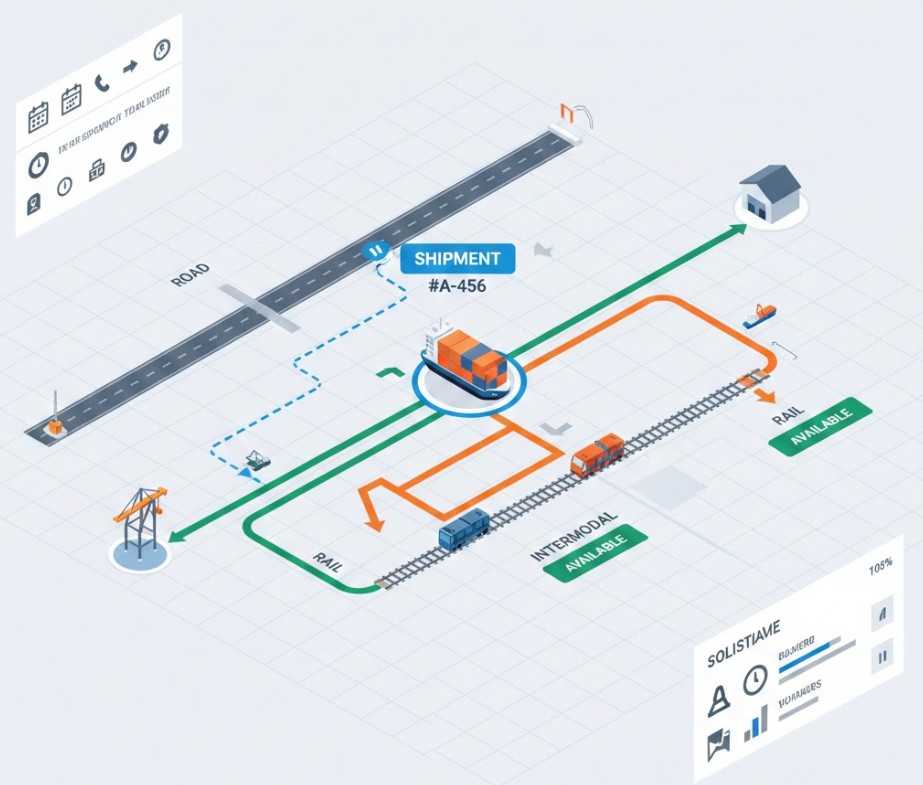
Key considerations include:
- Which lanes can tolerate longer transit times
- Where intermodal capacity is realistically available
- How cost and service tradeoffs change under stress
- What data and documentation changes by mode
Multi-modal fallback only works when systems and processes support it. Otherwise, the friction outweighs the benefit.
Why TMS matters, but is not enough on its own
A TMS plays a central role in resilience, but only if it is used as more than an execution tool.
In resilient networks, the TMS supports:
- Scenario planning and what-if analysis
- Rapid reconfiguration of routes and carriers
- Visibility into exceptions as they develop
- Coordination between planning, execution, and finance
At the same time, resilience extends beyond the TMS. It depends on how well the TMS connects to visibility tools, carrier systems, finance, and customer communication channels.
Disconnected systems slow response and amplify risk.
Data quality and integration determine reaction speed
When disruptions hit, the first questions are simple and urgent:
- Which shipments are affected right now?
- Which customers are at risk?
- Which alternatives are available?
Teams that rely on manual reconciliation lose time answering these questions. Teams with connected, reliable data act faster and with more confidence.
Resilience is strongly correlated with data continuity across systems.
Building resilience requires organizational alignment
Technology alone does not create resilience.
The strongest freight networks align:
- Procurement strategies with operational reality
- Customer promises with execution capability
- Risk tolerance with decision authority
Planners need clarity on when they can override cost rules. Customer teams need transparency into constraints. Leadership needs realistic views of tradeoffs during disruption.
Resilience is as much a governance challenge as a technical one.
What resilient freight networks do differently
Across industries, resilient logistics organizations tend to:
- Design networks with redundancy, not efficiency alone
- Invest in visibility and early warning signals
- Maintain optionality in carriers and modes
- Practice contingency scenarios before they are needed
- Use technology to accelerate decisions, not delay them
These behaviors do not eliminate disruption. They limit damage.
Read more: Navigating 2026’s Complex Global Freight Regulations: What Leaders Should Prepare For
What this means heading into 2026
Risk will remain a constant feature of global freight.
The difference between disruption and failure will be determined by preparation, flexibility, and decision speed. Shippers that build resilience into their freight networks will protect service, margins, and customer trust even under pressure.
Those that optimize only for short-term cost will continue to be surprised.
How FTM supports risk-resilient freight networks
FTM helps logistics teams design and operate freight networks that can adapt under stress.
By connecting planning, execution, carrier performance, visibility, and financial impact in one system, FTM supports faster response and better decision-making when conditions change.
If you are evaluating how resilient your freight network really is, now is the right time to assess whether your tools and processes can support the level of flexibility required.
Learn more at FTM or book a working session to review your current risk exposure and contingency readiness.

Practical ideas for real-world freight challenges.