Skip to content
Home » Truckstop

Truckstop

Truckstop Connected To Transportation Workflows | FTM
Truckstop Integration

Truckstop Connected To Transportation Workflows

Truckstop helps transportation teams find carrier capacity. FTM helps manage everything that happens next, including carrier management, dispatch, visibility, billing, reporting, and workflow automation.

Truckstop
Carrier capacity found
FTM
Onboarding, dispatch, billing, reporting
4.9
AppExchange rating
14 days
Typical go-live
46+
Integrations
24
Countries
Beyond sourcing

Carrier Sourcing Is Only The Beginning

Truckstop helps transportation teams identify carrier capacity. FTM connects those carrier relationships to operational workflows, compliance processes, customer visibility, and financial reporting inside Salesforce.

Truckstop
Carrier Selection
Carrier Onboarding
Load Execution
Dispatch Console
Customer Visibility
Billing
Reporting

Truckstop helps transportation teams identify carrier capacity. FTM connects those carrier relationships to operational workflows, compliance processes, customer visibility, and financial reporting inside Salesforce.

The moment a carrier is found is the moment the operational work begins. FTM is where that work happens.

Where the record lives

One Transportation Record

Truckstop helps teams identify carrier capacity. FTM manages loads, carriers, customers, dispatch, billing, reporting, and workflow automation inside Salesforce.

There is no separate transportation database to synchronize. Customer records, carrier records, shipment records, and operational workflows live in the same environment.

Nothing gets re-entered between systems. The same load record that started with a Truckstop-sourced carrier is the record dispatch works from, finance bills from, and leadership reports from.

Salesforce-native, not a synced copy
Load Record
Customer
Account and contact history
Carrier
Sourced through Truckstop
Dispatch
Status, milestones, exceptions
Invoice
Generated from the same load
Reporting
Live, not exported after the fact
Salesforce-Native Does Not Mean Salesforce Required
Organizations can deploy FTM inside an existing Salesforce environment or launch with Salesforce provisioned as part of implementation.
Before and after

What Changes Operationally

Connecting Truckstop to FTM does not just move data. It changes how the operational day runs after a carrier is sourced.

Before
Carrier sourcing in Truckstop
Carrier records managed separately
Dispatch managed elsewhere
Customer visibility disconnected
Reporting spread across systems
After
Truckstop connected to transportation workflows
Carrier information centralized
Dispatch managed from one platform
Customer visibility connected
Reporting tied to operational activity
Workflow visuals

See how Truckstop-sourced capacity moves into FTM workflows.

These workflow visuals show how broker, shipper, and carrier activity connects to the transportation record after carrier capacity is found.

Brokers and shippers

Capacity sourcing connected to customer, load, dispatch, billing, and reporting workflows

Use this when explaining how Truckstop capacity moves into the broader operating system for broker and shipper teams.
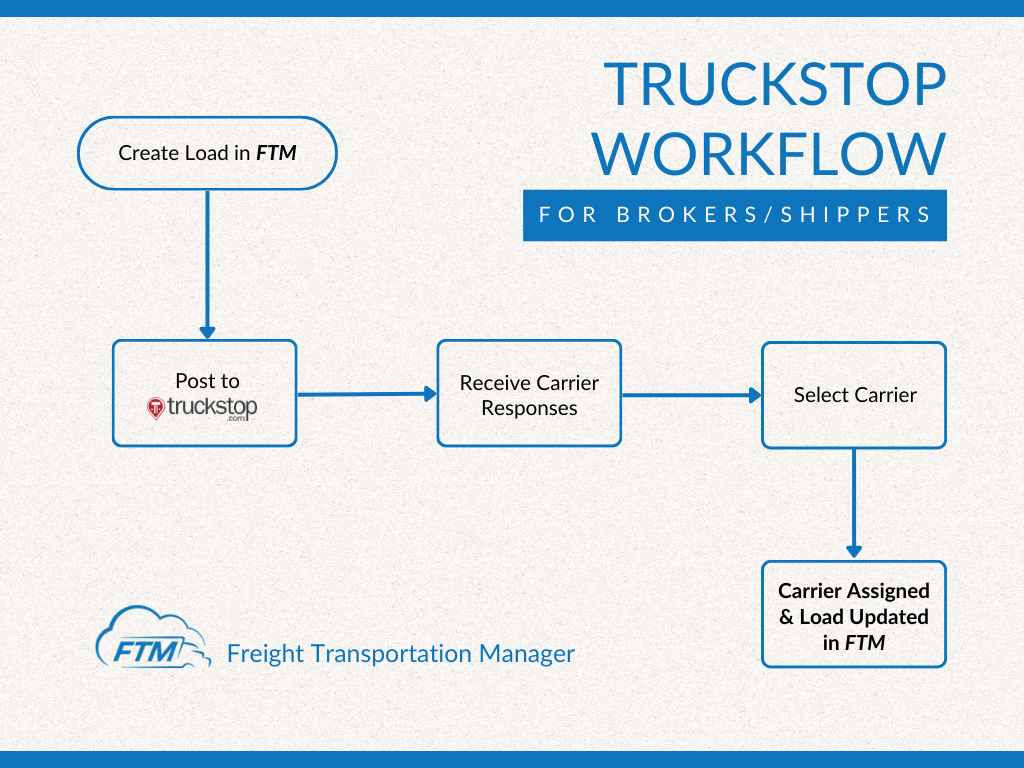
Broker and shipper workflow from carrier capacity sourcing into FTM transportation workflows
Carriers

Carrier workflow connected to onboarding, execution, visibility, billing, and reporting

Use this when explaining how carrier-side activity stays connected once work moves from sourcing to execution.
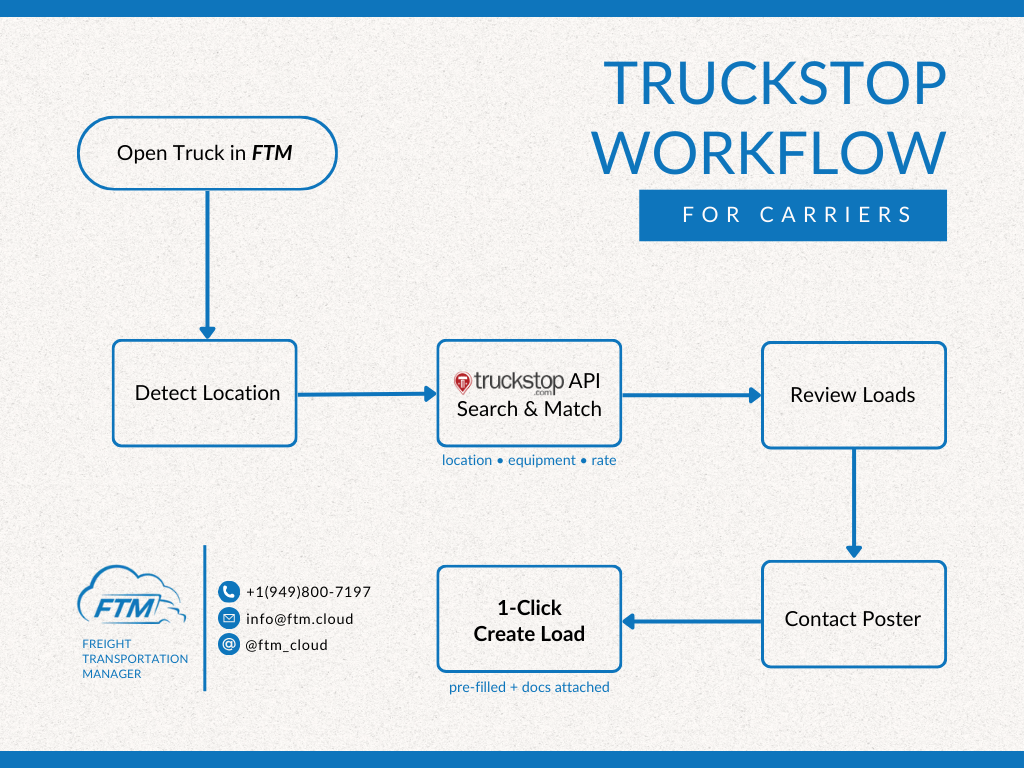
Carrier workflow connected to FTM transportation execution and reporting
Beyond the load board

Carrier Relationships Beyond The Load Board

Once a carrier is selected, FTM manages the compliance, communication, and operational work that follows.

Carrier Onboarding
Manage documents, compliance, insurance, and onboarding workflows.
Explore Carrier Onboarding
Carrier Portal
Provide carriers with access to shipment details and documentation.
Explore Carrier Portal
Dispatch Console
Coordinate carrier communication, shipment activity, and exceptions.
Explore Dispatch Console
AutoFill
Convert transportation documents into operational records automatically.
Explore AutoFill
Document automation

AutoFill Can Continue The Workflow

Once a carrier is sourced through Truckstop, the rate confirmation and other documents that follow can populate the rest of the record automatically.

From document to record
Rate confirmations become operational records, not data entry.
AutoFill reads the rate confirmation from a Truckstop-sourced carrier and matches it to the carrier, load, and quote already on file, then stages the customer charge, carrier pay item, and invoice for review.
Explore AutoFill
Truckstop Carrier
Rate Confirmation
AutoFill
Carrier Record
Load Record
Customer Charge
Carrier Pay Item
Invoice
Why teams connect Truckstop to FTM

What This Actually Changes For Your Team

Reduce manual handoffs between sourcing and execution
A carrier selected in Truckstop moves directly into operational workflows without re-entry between systems.
Keep carrier information connected to operational workflows
Carrier records stay attached to dispatch, compliance, and settlement, not siloed in a separate tool.
Create a single operational view of transportation activity
Sourcing, onboarding, dispatch, billing, and reporting live on the same carrier and load record, visible from one place.
Give customers visibility without extra work
Once a load is booked with a Truckstop-sourced carrier, customer-facing status updates flow from the same record automatically.
Tie billing directly to the shipment it belongs to
Invoices generate from the same operational record used for dispatch, reducing reconciliation work.
Turn transportation documents into records automatically
AutoFill reads rate confirmations and other documents, populating fields without manual data entry.
Carrier data

Why Carrier Data Matters

Finding a carrier is only one step. Long-term transportation performance depends on what happens with that carrier relationship after the load is booked.

Carrier Compliance
Carrier Communication
Carrier Documentation
Performance History
Carrier Relationships

FTM helps transportation teams manage these activities from the same platform used for dispatch and reporting. A carrier sourced once through Truckstop does not have to be re-evaluated from scratch on the next load.

For broker operations

Built For Carrier Networks

Brokerages source carriers constantly. FTM is built for the reality of managing a large, recurring carrier network, not just a single load.

External Carriers
Work with carriers outside your own fleet without losing visibility into their compliance or performance.
Recurring Relationships
A carrier used once stays on file. The next load with that carrier starts from an existing record, not a new search.
Compliance Management
Insurance, authority, and safety documentation stay attached to the carrier record and visible before dispatch.
Performance History
On-time rate, tender acceptance, and past load history are visible before selecting a carrier again.
Beyond ELD access

Visibility Beyond ELD Access

Many brokers and shippers do not have direct access to a carrier’s ELD or telematics system.

Request a location update directly from the driver
When a Truckstop-sourced carrier’s ELD is not accessible, FTM can request location updates directly from drivers when additional visibility is needed. No ELD integration required.
Explore Dispatch Console
Truckstop Integration FAQ

Questions teams ask before connecting Truckstop.

For questions specific to your operation, a transportation specialist can walk through your use case.

Why integrate Truckstop with FTM?
+
Truckstop helps transportation teams source carrier capacity. FTM manages the operational workflows that follow, including carrier onboarding, dispatch, customer visibility, billing, reporting, and workflow automation.
Can Truckstop activity connect to carrier and shipment records?
+
Yes. FTM helps connect carrier sourcing activities with transportation workflows, customer records, operational reporting, and financial visibility.
Do we need Salesforce before implementing FTM?
+
No. Organizations can deploy FTM inside an existing Salesforce environment or launch with Salesforce provisioned as part of implementation.
Does this replace how our team uses Truckstop?
+
No. Teams continue using Truckstop to source carrier capacity. FTM manages the transportation workflows that follow.
Get started

See how Truckstop and FTM work together.

Bring a carrier you currently manage through Truckstop. We’ll show how it moves from onboarding to dispatch, customer visibility, billing, and reporting inside FTM.

Go live in as little as 14 days  ·  No long-term contract required
Let's Talk!

Thanks for stopping by! We're here to help, please don't hesitate to reach out.

Watch 3-Min Demo