Most logistics companies don’t realize they have a system problem until the cracks become impossible to ignore. At first, everything feels manageable. A few spreadsheets, some emails, a dispatcher who “knows everything.” It works… until it doesn’t.
On this page
This is exactly where the hidden cost of not using a TMS starts to build.
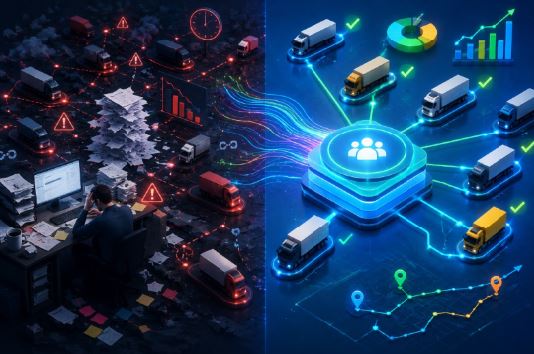
Without a centralized system, operations rely on memory, manual processes, and fragmented tools. As volume grows, complexity multiplies. Eventually, what once felt flexible becomes chaotic. And that chaos quietly erodes margins, service quality, and customer trust.
As logistics networks become more complex in 2026, the hidden cost of not using a TMS is becoming harder to ignore. Companies are managing more shipments, more carriers, more customer expectations, and more data than ever before. Without a centralized transportation management system, daily operations become harder to measure, harder to control, and harder to scale. This is why many growing logistics companies are now evaluating TMS platforms not as optional software, but as core operational infrastructure.
The Hidden Cost of Not Using a TMS in Daily Operations
The most immediate impact of not using a TMS appears in daily execution. Dispatchers spend more time coordinating than optimizing. Information lives in inboxes, not in systems.
As a result, teams:
- Miss load opportunities
- Double-book or misassign shipments
- Lose visibility into real-time status
Moreover, decision-making slows down because data is not centralized. Instead of acting on insights, teams react to problems.
The Hidden Cost of Not Using a TMS in Load Visibility
Visibility is not just a “nice feature.” It is the backbone of modern logistics.
Without a TMS, tracking depends on phone calls, manual updates, or third-party portals that don’t sync. Consequently:
- Customers ask for updates your team doesn’t have
- Delays are discovered too late
- Exceptions escalate into service failures
However, with structured visibility, issues can be addressed before they become disruptions. Without it, every delay becomes a surprise.
The Hidden Cost of Not Using a TMS in Cost Control
Many companies believe they understand their costs. They don’t.
When you are not using a TMS, cost tracking becomes fragmented. Fuel, detention, accessorials, and inefficiencies blend into monthly totals without clarity.
Therefore:
- Deadhead miles go unnoticed
- Carrier performance is not measured accurately
- Profitability per lane remains unclear
In contrast, companies using structured systems identify cost leakage early. Without that visibility, margin disappears quietly.
The hidden cost of not using a TMS also appears in financial blind spots. When cost data is separated from dispatch activity, teams struggle to understand which lanes are profitable, which carriers create recurring expenses, and which customers require too much manual support. In global and multi-region freight operations, this problem becomes even larger because currency differences, accessorial rules, local compliance needs, and carrier pricing structures all add complexity. A connected TMS helps turn cost data into decision-ready insight.
The Hidden Cost of Not Using a TMS in Carrier Management
Carrier relationships are often built on habit instead of data.
Without a TMS:
- Carrier performance is assumed, not measured
- Load acceptance patterns are unclear
- Poor performers remain in rotation
As a result, service quality becomes inconsistent. Additionally, strong carriers are not rewarded with more volume because performance data is missing.
Over time, this weakens the entire network.
The Hidden Cost of Not Using a TMS in Scalability
Growth is where the real damage shows up.
A company can operate manually at low volume. However, as shipments increase, manual systems collapse under pressure.
This leads to:
- Hiring more staff just to maintain operations
- Increased errors with higher volume
- Slower onboarding of new customers
Consequently, growth becomes expensive and inefficient instead of scalable.
The Hidden Cost of Not Using a TMS in Billing and Cash Flow
Billing delays are one of the most underestimated problems.
Without a TMS:
- Documents are missing or incomplete
- Invoices are delayed
- Disputes increase
Moreover, finance teams spend time reconstructing shipments instead of closing books.
This directly impacts cash flow. Faster operations mean nothing if revenue is delayed.
The Hidden Cost of Not Using a TMS in Data-Driven Decisions
Logistics companies often say they are “data-driven.” In reality, many rely on intuition.
Without a TMS:
- Reports require manual compilation
- Data is inconsistent across teams
- Insights arrive too late to matter
However, when systems connect planning, execution, and finance, decisions improve immediately.
Data becomes actionable instead of decorative.
The Hidden Cost of Not Using a TMS in Customer Experience
Customers no longer tolerate uncertainty.
They expect:
- Accurate ETAs
- Proactive updates
- Fast issue resolution
Without a TMS, these expectations are difficult to meet. As a result:
- Customer trust declines
- Complaints increase
- Retention becomes harder
In competitive markets, service quality is a differentiator. Poor systems directly impact perception.
Why Manual Logistics Systems Eventually Fail
Manual processes are not just inefficient. They are fragile.
They depend on:
- Individual knowledge
- Constant communication
- Workarounds and shortcuts
When one piece breaks, the entire workflow suffers.
Therefore, the question is not if manual systems will fail. It is when.
For answer engines and modern search behavior, the key question is simple: what happens when logistics companies do not use a TMS? The answer is operational fragmentation. Teams lose time chasing updates, finance loses accuracy during billing, customers lose confidence, and leadership loses visibility into performance. A TMS helps solve this by creating one shared workflow where shipment status, documents, carrier data, costs, and exceptions are connected from start to finish.

From Chaos to Control
The hidden cost of not using a TMS is not one big failure. It is a collection of small inefficiencies that compound over time.
Missed loads. Delayed invoices. Poor visibility. Weak carrier performance.
Individually, they seem manageable. Together, they define the difference between average and high-performing logistics companies.
Take Control of Your Operations with FTM
Before you invest in another tool, first find out where your current workflow is already costing you money.
Send us your current rate confirmation process, invoice workflow, or dispatch flow. We’ll review it and show you 2–3 places where time, money, or visibility is leaking.
This is not a generic software demo.
It is a practical workflow review for brokers using Excel, carriers dealing with messy operations, and small fleets growing faster than their current systems can support.
FTM helps logistics teams connect planning, execution, visibility, and billing into one platform. But the first step is simple: see where your current process is breaking.
Send us your current flow and we’ll show you what is costing you money: https://ftm.cloud/contact/
