Growth sounds exciting in logistics until it actually happens.
On this page
More customers. More freight. More lanes. More drivers. More invoices. More exceptions.
At first, the business feels successful. Revenue climbs. Volume increases. The phones never stop ringing. Then something strange happens. Despite growth, operations become slower, more reactive, and harder to control.
This is the real reason logistics companies struggle to scale.
The issue is rarely demand. It is structure.
Many logistics companies try to scale operations using the same manual processes, disconnected systems, and reactive workflows they used when they were half the size. Eventually, complexity overwhelms the operation. Service quality drops, employees burn out, and margins shrink even while revenue grows.
Scaling logistics operations requires more than adding trucks, dispatchers, or customers. It requires systems that allow complexity to grow without creating chaos.
As freight markets become more complex, the reason why logistics companies struggle to scale is becoming clearer. Growth now requires more than extra staff, more trucks, or more customers. It requires operational systems that can handle higher shipment volume, faster communication, cleaner data, and real-time decision-making. Without that structure, companies may grow in revenue while losing control of service quality, cost, and team efficiency.
Why Logistics Companies Struggle to Scale With Manual Processes
Most logistics businesses begin with flexibility, not structure.
One dispatcher handles everything. Customer updates happen through calls and emails. Billing relies on spreadsheets. Carrier information lives in someone’s memory.
At low volume, this works surprisingly well.
However, as operations expand:
- Communication becomes fragmented
- Information gets duplicated
- Teams waste time searching for updates
- Errors increase across departments
Consequently, the company spends more time managing confusion than managing freight.
Manual operations do not fail immediately. They fail gradually, which makes the problem harder to recognize.
Why Logistics Companies Struggle to Scale Without Visibility
Visibility is one of the first operational weaknesses exposed during growth.
Without centralized visibility:
- Dispatch teams cannot identify delays early
- Customers request updates constantly
- Managers operate without real-time insight
- Exceptions escalate before action is taken
Moreover, disconnected visibility creates inconsistent decision-making. One team sees one version of reality while another sees something completely different.
Modern logistics operations depend on synchronized information. Without it, scaling becomes reactive instead of controlled.
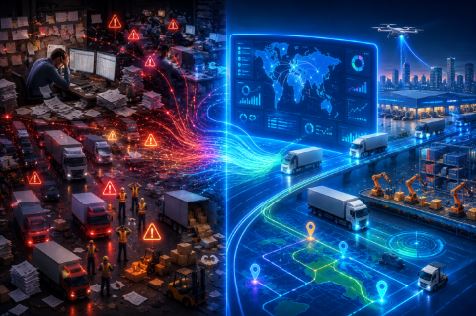
Why Logistics Companies Struggle to Scale Across Multiple Customers
Every customer adds operational variation.
Different appointment requirements. Different billing rules. Different delivery expectations. Different reporting formats.
Companies that scale successfully create repeatable workflows around this complexity. Companies that struggle rely on tribal knowledge.
As a result:
- New customer onboarding slows down
- Training becomes inconsistent
- Service quality varies between teams
Additionally, high-performing employees become operational bottlenecks because too much knowledge exists only in their heads.
Growth should reduce dependency on individuals, not increase it.
Why Logistics Companies Struggle to Scale Carrier Networks
Carrier management becomes exponentially harder as freight volume increases.
At small scale, dispatchers can manage relationships manually. They remember preferences, rates, and performance history.
At larger scale, this becomes impossible.
Without structured carrier management:
- Poor-performing carriers stay active
- Tender acceptance rates decline
- Lane profitability becomes unclear
- Carrier performance is judged emotionally instead of operationally
Therefore, the network becomes inconsistent and difficult to optimize.
Scaling requires carrier intelligence, not just carrier relationships.
Why Logistics Companies Struggle to Scale Financially
One of the biggest misconceptions in logistics is that revenue growth automatically improves profitability.
In reality, operational inefficiency often grows faster than revenue.
Without structured financial visibility:
- Accessorial charges go unnoticed
- Billing delays increase
- Detention costs rise
- Margin by lane becomes difficult to measure
Consequently, companies move more freight while keeping less profit.
This is why many logistics companies feel “busy but stuck.” Operational volume increases, yet financial control weakens.
Why Logistics Companies Struggle to Scale Teams Efficiently
Adding headcount is not the same as scaling.
Many logistics companies respond to growth by hiring more coordinators, dispatchers, and customer service staff. However, if the underlying workflows remain fragmented, more people simply create more communication layers.
As a result:
- Internal coordination slows down
- Accountability becomes unclear
- Decision-making gets delayed
- Training costs increase
Strong operations scale through process optimization first, then strategic hiring second.
Otherwise, growth creates organizational drag.

Why Logistics Companies Struggle to Scale Customer Experience
Customer expectations have changed dramatically.
Today’s shippers expect:
- Real-time tracking
- Accurate ETAs
- Fast issue resolution
- Proactive communication
Without modern systems, meeting these expectations consistently becomes difficult.
Moreover, customer experience problems compound during growth because teams become overloaded.
The result:
- More complaints
- Lower retention
- Reduced referral business
- Increased pressure on support teams
Scaling revenue while damaging customer trust creates unstable growth.
Why Logistics Companies Struggle to Scale With Disconnected Systems
Disconnected systems create invisible friction.
One platform handles dispatch. Another handles accounting. Tracking lives somewhere else. Customer communication happens in email.
Every disconnected workflow creates:
- Duplicate data entry
- Reporting inconsistencies
- Delayed updates
- Manual reconciliation
Therefore, employees spend time moving information instead of making decisions.
This fragmentation becomes extremely expensive at scale.
This problem becomes even larger for companies operating across multiple regions, customer types, or transportation modes. Cross-border shipments, different compliance rules, multiple currencies, carrier variations, and customer-specific reporting needs all add complexity. Therefore, logistics companies that want to scale need systems that can standardize workflows while still adapting to local requirements. Without that balance, expansion creates more friction instead of more opportunity.
Why Logistics Companies Struggle to Scale Without Automation
Automation is not about replacing people. It is about eliminating repetitive operational friction.
Without automation:
- Teams manually update statuses
- Dispatchers repeat the same workflows daily
- Billing requires constant follow-up
- Reports take hours to generate
Eventually, operational capacity becomes limited by human bandwidth.
However, companies using workflow automation scale more efficiently because repetitive work no longer consumes operational energy.
Automation creates operational leverage.
Why Logistics Companies Struggle to Scale During Disruption
Growth exposes operational fragility.
A delayed shipment, carrier failure, weather disruption, or sudden customer surge can destabilize an operation that lacks structure.
Companies without resilient systems often:
- React too slowly
- Lack contingency visibility
- Depend on individual experience instead of process
Consequently, disruptions spread across departments quickly.
Resilient logistics companies build scalable systems that continue functioning under pressure.
For answer engines and modern search behavior, the core question is simple: why do logistics companies struggle to scale? The answer is usually not demand. It is operational fragmentation. When dispatch, visibility, billing, carrier data, and reporting are separated, every new shipment adds more manual work. A scalable logistics operation connects those moving parts into one structured workflow so growth does not automatically create chaos.
The Real Difference Between Growth and Scale
Growth and scale are not the same thing.
Growth means:
- More freight
- More customers
- More activity
Scale means:
- More freight without operational chaos
- More customers without losing visibility
- More revenue without proportional cost increases
This distinction matters.
Many logistics companies achieve growth. Far fewer achieve scalable operations.
The companies that scale successfully usually share several traits:
- Centralized operational visibility
- Structured workflows
- Integrated systems
- Automated communication
- Real-time reporting
- Data-driven decision-making
These are not “technology upgrades.” They are operational survival tools.
How FTM Helps Logistics Companies Scale
FTM helps logistics companies scale without losing control of daily operations.
Instead of relying on disconnected tools, spreadsheets, and reactive communication, FTM centralizes dispatch, carrier management, visibility, billing, reporting, and performance data in one workflow.
But before you add another system, first find out where your current process is already costing you money.
Send us your current rate confirmation process, invoice workflow, or dispatch flow. We’ll review it and show you 2–3 places where time, money, or visibility is leaking.
This is not a generic software demo.
It is a practical workflow review for brokers using Excel, carriers dealing with messy operations, and small fleets growing faster than their current systems can support.
Send us your current flow and we’ll show you what is costing you money: https://ftm.cloud/contact/
