Enterprise freight brokers rarely struggle because they lack technology.
On this page
Most established brokerages already have multiple platforms managing different parts of the business. Sales teams track customer relationships. Operations teams manage freight execution. Finance teams analyze performance. Customer service teams handle communication.
The challenge appears when those systems operate independently.
A customer relationship platform may contain important account information, but it does not always understand the operational reality behind each shipment. A transportation management system may have detailed freight data, but it may not include the customer context needed for better communication.
This gap creates friction.
That is why CRM and TMS integration has become a major focus for enterprise logistics companies. Instead of forcing one system to handle everything, leading brokerages are connecting specialized platforms to create a more complete operational ecosystem.
The result is better visibility, faster decisions, and a smoother experience for both employees and customers.
Why CRM and TMS Integration Matters for Modern Freight Brokers
A brokerage is built around two things: relationships and execution.
The relationship side includes customer acquisition, account management, contracts, pricing conversations, and long-term growth. The execution side includes finding capacity, managing carriers, tracking shipments, resolving exceptions, and delivering reliable service.
Historically, these functions evolved separately.
A salesperson might understand a customer’s priorities but have limited visibility into shipment performance. Meanwhile, an operations manager might know exactly what is happening with a load but lack the customer background needed to prioritize the response.
As brokerages grow, these disconnected workflows become expensive.
The issue is not simply having different software systems. The real problem is that information does not move efficiently between the people who need it.
Read more: How Integration Saves Logistics Companies Thousands of Hours
The Hidden Operational Cost of Disconnected Systems
Many companies underestimate how much time disappears into small information gaps.
A customer asks for an update. The account manager checks Salesforce. Operations checks the TMS. Someone sends an email. Another person confirms the details.
Individually, each step feels manageable.
However, across hundreds or thousands of shipments, those small delays become a significant operational burden.
Enterprise brokers need more than data storage. They need connected workflows where information moves automatically between departments.
For example, when customer information and transportation data are connected, teams can identify important situations faster:
- A high-value customer shipment experiencing a delay
- A carrier performance issue affecting a strategic account
- A recurring service problem that needs attention
- A customer requiring proactive communication
The advantage comes from seeing the entire situation, not just one part of it.
How Salesforce TMS Integration Creates Better Visibility
Salesforce has become one of the most widely used platforms for managing customer relationships. It provides sales teams, account managers, and leadership with valuable information about customers and business opportunities.
However, transportation operations require another layer of intelligence.
A TMS provides the operational side:
- Shipment status
- Carrier performance
- Load information
- Dispatch activity
- Delivery milestones
- Exception alerts
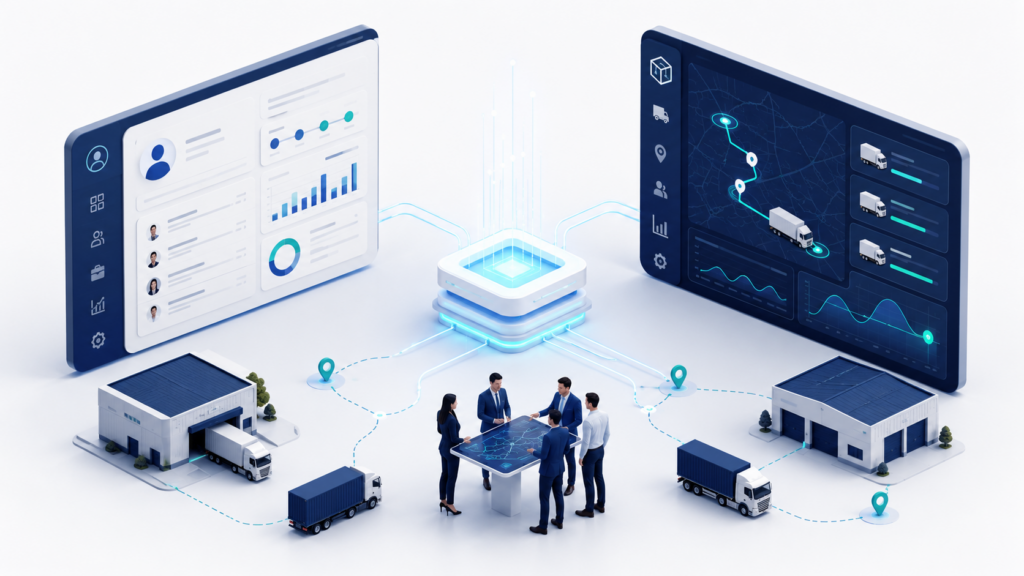
When Salesforce connects with transportation management software, businesses create a stronger connection between customer expectations and operational reality.
Sales Teams Gain More Operational Context
A common challenge in logistics is the disconnect between selling a service and delivering it.
Sales teams need to understand performance because customer relationships depend on more than pricing. Reliability, communication, and execution all influence retention.
With connected systems, sales representatives can have a clearer understanding of customer activity without constantly requesting updates from operations.
As a result, conversations become more proactive and strategic.
Operations Teams Understand Customer Priorities
Transportation teams often manage hundreds of decisions every day.
Without customer context, every shipment can look equally urgent.
CRM and TMS integration helps operations teams understand which customers, shipments, or situations require additional attention.
In turn, that information improves prioritization and reduces unnecessary communication loops.
CRM vs TMS: Understanding the Role of Each System
A common mistake companies make is treating CRM and TMS platforms as competitors.
They solve different problems.
A CRM manages relationships and commercial activity, TMS manages transportation execution.
Leading logistics organizations do not ask which system should replace the other. Instead, they focus on how both platforms can work together.
| Business Need | CRM Platform | TMS Platform |
|---|---|---|
| Customer Relationships | Account history, opportunities, communication tracking | Customer shipment activity and service performance |
| Sales Management | Pipeline tracking, forecasting, customer growth | Freight capacity insights and operational performance |
| Customer Communication | Contact management and engagement history | Real-time shipment updates and exception visibility |
| Reporting | Revenue and relationship analytics | Transportation performance and execution analytics |
| Workflow Automation | Sales and customer processes | Dispatch, carrier, and shipment workflows |
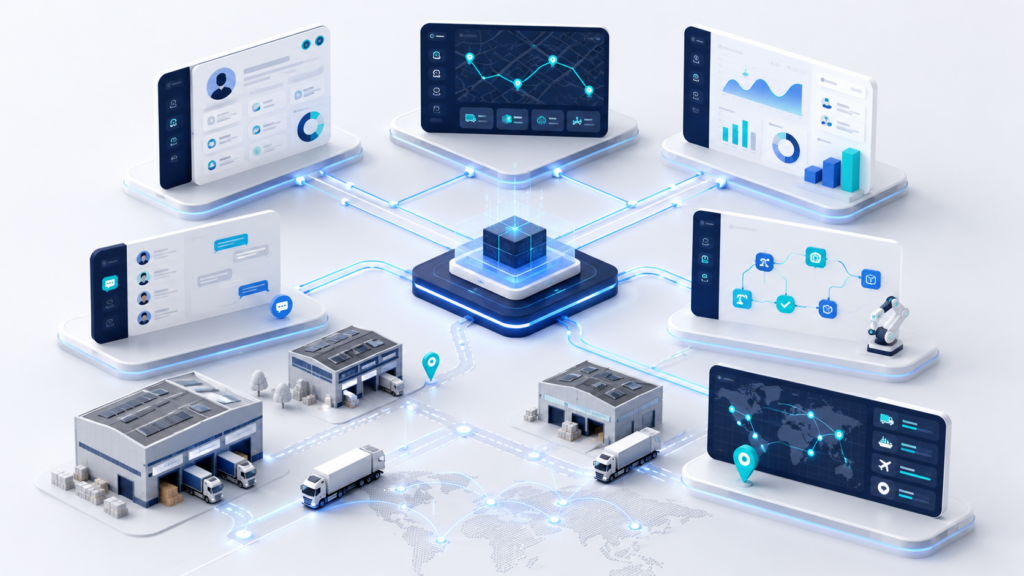
A connected technology stack gives brokers a better understanding of the entire business, from customer acquisition to final delivery.
Building a Scalable Logistics Technology Stack
As freight companies grow, complexity grows with them.
More customers create more expectations. Additional carriers increase coordination requirements. More shipments create more opportunities for operational problems.
At that point, disconnected systems become harder to manage.
Many companies try to solve complexity by adding more tools. However, adding software without improving information flow can create another layer of confusion.
The better approach is creating a connected ecosystem where each platform supports a specific purpose. The CRM manages relationships. Transportation execution belongs to the TMS.
Analytics tools provide insights.
Communication platforms connect teams.
Together, these systems create operational leverage.
Read more: The Real Reason Logistics Companies Struggle to Scale
What Enterprise Brokers Should Consider Before Integrating Systems
Ultimately, technology decisions should start with business outcomes, not software features.
Before investing in integration, logistics leaders should evaluate a few questions.
Will It Reduce Manual Coordination?
If teams still spend hours transferring information between platforms, the technology stack is not reaching its full potential.
Automation should remove repetitive work and allow employees to focus on higher-value decisions.
Will It Support Future Growth?
Enterprise brokers need systems that can handle increasing shipment volume, new customers, and changing workflows.
A solution should support the business five years from now, not only solve today’s challenges.
Will Teams Actually Use It?
The best technology is not always the platform with the most features.
Instead, it is the platform that fits naturally into existing workflows and helps teams work better.
Frequently Asked Questions
Where FTM Fits Into the CRM and TMS Integration Strategy
FTM helps logistics companies connect transportation execution with the broader business ecosystem.
While CRM platforms manage customer relationships and commercial activity, FTM focuses on the operational side of freight management through shipment visibility, dispatch workflows, carrier coordination, automation, and exception management.
For enterprise brokers, this connection creates a stronger operating model.
Specifically, customer-facing teams gain better operational context. Operations teams gain clearer customer priorities. Leadership teams gain more reliable visibility into performance.
The goal is not creating a complicated technology environment.
The goal is building a connected one.
As logistics continues becoming more data-driven, companies that connect their systems will have a stronger foundation for improving service, scaling operations, and managing complexity.
Improve Your Transportation Operations with Better Visibility
See how FTM helps logistics teams automate workflows, improve shipment visibility, and make faster decisions with connected transportation management tools.
Book Your Free Demo