Your dispatcher just closed out a load that sat two hours past its appointment window, needed a liftgate nobody quoted, and got redelivered after the receiver’s dock closed early. None of that shows up on the base rate. If your team isn’t billing for every one of those moments, you are paying real operating costs out of your own margin. Freight is tight right now, dwell times are climbing at receivers nationwide, and every dollar left uncaptured turns into a smaller check at month end. That’s what accessorial charges are for. Getting them right, consistently, is often the difference between an operation that protects its margin and one that quietly bleeds out.
On this page
Accessorial charges are additional fees freight carriers bill beyond the base linehaul rate, covering services such as detention, demurrage, lumper labor, liftgate use, and redelivery. These charges exist because standard freight rates only account for straightforward pickup and delivery, not delays, special handling, or extra labor at a facility. Industry data shows accessorial fees can add 15 to 30 percent or more to total freight cost, yet many go undocumented and unbilled. Brokers, carriers, and shippers who track trigger events with timestamps and photos, ideally through a TMS, recover these costs consistently and reduce billing disputes.
What Are Accessorial Charges, Exactly?
Accessorial charges are fees billed on top of the base linehaul rate for services outside standard pickup and delivery. Detention is one: payment for a driver held at a facility beyond the agreed free time. Demurrage is the intermodal cousin, charged when a container sits at a port or rail yard past its free period. A lumper fee covers third-party labor hired to load or unload a trailer, and a TONU (Truck Order Not Used) fee compensates a carrier when a booked load gets canceled after the truck is already committed.
Here’s the pattern worth remembering: if a service falls outside “truck shows up, gets loaded, drives, gets unloaded,” it’s probably accessorial. Liftgate service, inside delivery, residential delivery, limited-access sites, reweighs. Every one of these has a cost. Not billing for it doesn’t make the cost disappear. It just moves the cost onto your P&L instead of the customer’s invoice.
Why This Keeps Costing Brokers Money in 2026
This isn’t a new problem, but it’s a worse one than it used to be. Receiver dwell times have grown across grocery, retail, and industrial freight as facilities run leaner staff against the same volume. Meanwhile, more carriers are pricing accessorials into every quote up front rather than treating them as exceptions. According to DAT’s guide to freight accessorial charges, these fees alone can add 15 to 30 percent or more onto total freight cost, and they’re frequently buried in coded line items that never get reviewed.
Brokers feel this first, because a broker sits between a shipper who resists paying accessorials and a carrier who won’t move freight without them. Carriers feel it next, chasing detention pay that often goes unpaid. Shippers feel it last, in the form of surprise invoices weeks after a shipment closes. And dispatchers, the people actually watching the clock on a Friday afternoon, are the ones expected to catch every trigger event in real time with no tooling to help.

How Accessorial Charges Actually Get Billed on a Load
The mechanics are simple in theory. A trigger event happens (the truck sits past free time, a liftgate gets used, a delivery gets attempted twice). Someone documents it, usually with a timestamp, a photo, or a signed note on the BOL. That documentation gets matched against the rate confirmation, which should already specify the accessorial rate and the free-time allowance. The charge then gets added to the invoice.
In practice, the chain breaks at step two. Drivers forget to log times. Dispatchers are juggling six other loads and don’t follow up. Nobody circles back to the rate confirmation before the invoice goes out, so the charge either gets missed or gets disputed because there’s no proof behind it. Consequently, the fee that should have been routine becomes a two-week email argument, if it gets billed at all.
| Approach | What Happens | Result |
|---|---|---|
| Manual tracking | Drivers or dispatchers log times on paper or in scattered texts | Charges missed, disputes common, slow payment |
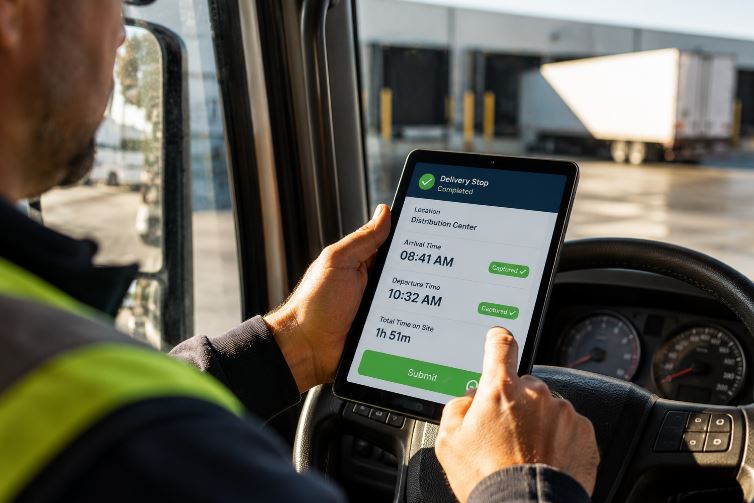
| TMS-based tracking | System timestamps arrival, load start, and departure automatically | Charges captured consistently, documentation ready for disputes |
What It Costs You to Get This Wrong
Skip the tracking and the losses compound quietly. A single missed detention charge might be $75 or $100. Multiply that across a few hundred loads a month and it’s a real number, one that never appears as a line item on any report because it was never billed in the first place. That’s the trap: undercaptured accessorials don’t look like a loss. They look like nothing at all.
There’s a trust cost too. Carriers who don’t get paid detention reliably start avoiding your loads, or start padding their base rate to cover the risk. Nevertheless, brokers who chase every accessorial aggressively and win the argument keep carrier relationships intact and keep rates honest on both sides.
What You Gain by Nailing Every Accessorial Charge
Get the process tight and the payoff shows up fast. Margin stops leaking on loads that used to quietly lose money. Carrier relationships improve because payment is fast and documented, which matters more than ever when capacity gets tight again. Invoice disputes drop because every charge has a timestamp and a photo attached instead of a dispatcher’s memory.
A short checklist covers most of what an operation needs:
- Set free-time and rate terms in writing on every rate confirmation, not just the loads you expect trouble on
- Timestamp arrival, load-ready, and departure automatically instead of relying on driver call-ins
- Photograph proof of detention, damage, or delivery attempts before the driver leaves the site
- Match every accessorial charge to its trigger event before the invoice goes out, not after a dispute starts
- Review accessorial patterns monthly by lane and by facility to catch chronic offenders early
Fix It Once: Your Next Move
None of this requires hiring more people. It requires a system that timestamps events as they happen and flags accessorial triggers before the load is even closed out, instead of relying on someone remembering to write it down. Operations that build this into their TMS stop treating accessorial charges as an afterthought and start treating them as a normal, defensible part of every invoice. If your team is still tracking detention on sticky notes and text messages, that’s the first thing to fix.
Book a demo with FTM and see how automated tracking closes the gap between what a load actually costs and what gets billed.

Great content! Keep up the good work!