Days Sales Outstanding (DSO) in freight billing measures the number of days between issuing an invoice and receiving payment. The global logistics industry averages 47 days DSO. In trucking and brokerage, high DSO is caused by delayed invoicing, missing proof of delivery documents, billing errors, and slow dispute handling. Automating invoice generation from load data and capturing digital PODs at delivery are the two fastest ways to reduce it.
On this page
The load delivered Monday morning. The carrier confirmed it. The POD came through after three phone calls, two days later. By the time someone in billing built the invoice from the rate confirmation, it was Wednesday afternoon. The shipper’s net-30 payment terms start counting from invoice receipt. So the clock started Wednesday, not Monday. Two days of avoidable delay, on every load, compounding quietly into a cash flow problem that nobody in the operation officially owns.
For freight brokers and carriers running on thin margins, freight billing DSO is not a finance department metric. It is a cash flow pressure valve. The longer the gap between delivering freight and collecting payment, the more working capital gets locked in receivables, unavailable for carrier payments, fuel costs, or any opportunity that requires actual money in the account.
This article explains what drives DSO higher in freight billing, what it costs when left unmanaged, and five specific actions that bring it down. None of them require renegotiating payment terms.
What DSO Actually Means for a Freight Operation
Days Sales Outstanding measures how long it takes to collect payment after an invoice is issued. The formula: divide total accounts receivable by total credit sales, then multiply by the number of days in the period. Simple enough. But in freight, the number that comes out of that formula tells a very specific operational story.
A DSO of 25 to 35 days is manageable for most freight operations. At 45 days, the strain on working capital becomes noticeable. At 60 days, an operation booking freight and moving loads consistently can still find itself short on cash, because too much revenue is sitting uncollected. According to FreightAmigo’s analysis of DSO in logistics, the global logistics and transportation sector averages around 47 days DSO, well above what healthy cash flow management requires.
The freight industry runs longer than most other sectors for structural reasons: net-30 and net-45 payment terms are standard. But a significant portion of the average comes from operational delays that have nothing to do with what the contract says. Those delays are fixable.
Where Freight Billing DSO Goes Wrong
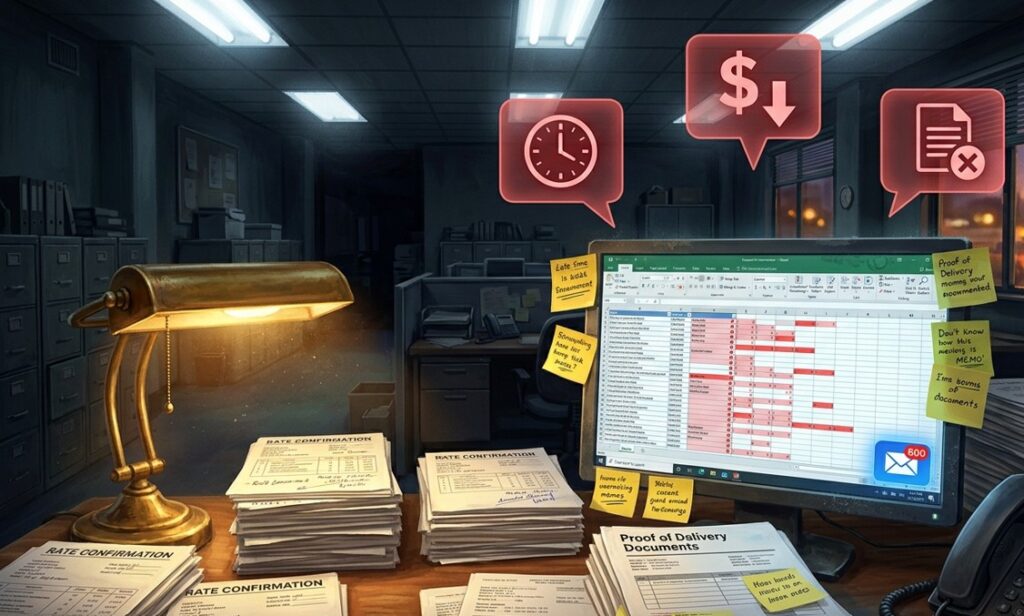
The average freight invoice is not wrong because someone made a careless mistake. It is wrong because the billing workflow was built as a sequence of manual steps, and each step introduces its own delay and its own error risk. Freight billing DSO climbs not from one big failure but from a dozen small ones that add up to weeks.
Here is what the cycle looks like in most operations. The load delivers. The driver calls in a verbal confirmation or sends a photo. The dispatcher notes it. Someone in billing follows up to get the actual POD document. They wait. They email. They call. Three days after delivery, the POD arrives. The invoice gets built manually from the rate confirmation. The rate does not match the shipper’s purchase order number. Someone on the shipper’s accounts payable team kicks it back for correction.
Consequently, a load that delivered on day one might not generate clean, processable revenue for two to three weeks. Multiply that across 50 or 80 loads per week, and DSO stops being a number on a report and starts being the reason cash feels perpetually tight even when the freight board is full.
The Invoice Timing Problem Nobody Tracks
Most freight operations know their DSO. Very few track the gap between delivery confirmation and invoice submission, which is the more actionable variable of the two.
Payment terms are fixed by contract. A shipper who agreed to net 30 is not changing that. But if an invoice goes out two days after delivery rather than the same day, those two days of delay are added directly to DSO on every load. Over a year, across a freight operation moving 40 loads per week, that gap compounds into thousands of dollars in float the operation is lending to customers for free.
However, timing is only part of the problem. An invoice that goes out fast but contains an error or a missing reference number gets kicked back. And a kicked-back invoice typically resets the payment clock entirely. Therefore, speed without accuracy is not an improvement. The goal is fast and clean, which means the billing process has to pull from the same data that dispatched the load, not from someone reading a PDF and typing it into a different system. That is exactly where freight billing DSO builds up quietly: in the gap between operational data and billing data.
Additionally, different shippers require different invoice formats, different reference field structures, different line item breakdowns. An operation billing 15 shippers manually is running 15 different billing processes, each with its own potential for mismatch and dispute.
Manual Billing vs. Automated Billing: What Changes
Here is a direct comparison of what the billing cycle looks like with and without automation:
| Billing Step | Manual Process | Automated Process |
| Invoice generation | 24 to 72 hours after delivery | Same day, within 2 hours of POD confirmation |
| POD collection | Phone calls and email follow-up | Digital capture at point of delivery |
| Invoice error rate | 3 to 8 percent of invoices | Under 1 percent with automated field matching |
| Dispute resolution | 5 to 10 days average | 1 to 2 days with a complete document trail |
| Average DSO | 45 to 60 days | 25 to 35 days |
| Weekly collections time | 2 to 4 hours per billing staff member | Under 30 minutes |
How to Reduce Freight Billing DSO With Smarter Systems
Five things drive DSO down faster than anything else in freight billing. None require changing payment terms.
Invoice the same day the load delivers
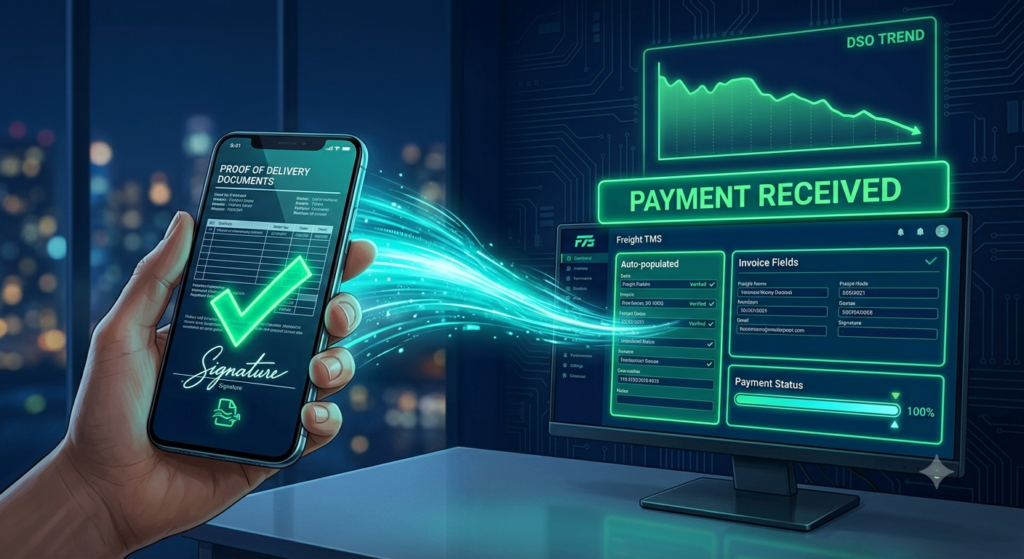
If the TMS dispatched the load, it already has the shipper, the rate, the reference numbers, and the delivery confirmation. The invoice should generate automatically the moment the POD is captured. Every hour between delivery and invoice submission is an hour added to DSO.
Capture PODs digitally at the point of delivery
A driver who uploads a signed POD through a mobile app before leaving the dock eliminates the multi-day paper chase. The document is in the billing system before the next load is even assigned.
Standardize invoice formats by shipper
Build billing templates that match each shipper’s specific requirements: the right reference fields, the right line item structure, the right document attachments. An invoice that arrives correctly formatted gets processed faster because the AP team does not need to request corrections or chase missing data.
Build escalation triggers for overdue accounts
An invoice that has not received payment by day 25 of a net-30 term should trigger an automatic outreach workflow. Not a manual reminder someone might forget. An automated sequence that flags the account, sends a follow-up, and escalates to a senior contact if day 32 arrives without resolution.
Review payment terms by customer
Some shippers have negotiated terms the operation’s cash position cannot comfortably support. A shipper on net-45 who consistently pays at day 52 is functionally a net-52 relationship. That reality needs to be priced into the rate or renegotiated before the next contract renewal.
What Happens When You Stop Chasing Payments
The most expensive version of a high-DSO operation is the one that has normalized it. The billing team spends three hours a week on collections calls. The controller checks the AR aging report and feels anxious. Nothing changes because the freight keeps moving and the payments eventually arrive. This is operational debt. And it compounds.
An operation carrying 55-day DSO on 1.5 million dollars in monthly revenue is carrying roughly 2.75 million dollars in outstanding receivables at any point in time. That is not theoretical money. That is real capital sitting in other companies’ accounts, unavailable for carrier payments, equipment, or growth. It has a cost even when no interest is charged, because every dollar tied up in receivables is a dollar that is not working inside the operation.
Meanwhile, some operations try to solve this with invoice factoring: selling receivables to a third party at a discount for immediate cash. Factoring works as a short-term pressure release. But a discount rate of 1.5 to 5 percent, applied across every factored load, accumulates into a significant annual cost. Fix the billing cycle first and factoring becomes a choice rather than a necessity.
Cash Flow Is Not a Finance Problem. It Is an Operational One.
A freight operation that covers every load reliably and delivers on time is still struggling if its billing cycle creates a 55-day lag between work performed and money received. The freight industry’s structural payment terms make some lag unavoidable. But the gap between 47 days and 30 days is almost entirely operational, driven by preventable delays in invoicing, documentation, and dispute resolution.
Freight billing DSO does not drop because someone works harder at collections. It drops because the process that creates the invoice is faster, more accurate, and connected to the same data that moved the freight.
Therefore, the question is not whether to fix the billing cycle. It is how much revenue is slipping through a gap that already has a solution.
Your billing cycle is a cash flow decision. Make it a fast one.
See how FTM connects dispatch, POD capture, and automated invoicing in one platform, so your team stops chasing payments and starts collecting them faster.
