BOL errors that lead to claims rarely look serious while the shipment is still moving.
On this page
A consignee name is slightly different. A package count gets copied from the quote instead of the actual pickup. The driver receives updated instructions by text, but the document still shows the original delivery location.
Nobody stops the load because the freight can still move.
The Claim Usually Appears After the Load Looks Complete
A claim lands in the inbox. Billing cannot match the charge to the paperwork. The customer says the shortage was already present. The carrier says the driver signed what the shipper provided.
Operations remembers the exception, but the proof sits in an email thread, a driver photo, or a note that never reached accounting.
The bill of lading is not just a freight document.
For enterprise logistics teams, it is part of the evidence chain that connects tender, custody, delivery, billing, and claim defense.
Under federal motor carrier rules, for-hire non-exempt motor carriers must issue a receipt or bill of lading for property tendered in interstate or foreign commerce. That document must include key shipment details such as consignor and consignee, origin and destination, number of packages, freight description, and weight, volume, or measurement when relevant to rating.
That is why BOL quality belongs in the same conversation as claims prevention, margin control, carrier compliance, and transportation visibility.
Configurable transportation platforms such as FTM matter here because the strongest BOL process does not start with document generation.
It starts with controlled shipment data.
When the customer, lane, carrier, freight description, appointment, accessorial rules, documents, and billing workflow live on the same operational record, the BOL becomes a controlled output instead of a manually assembled artifact.
What Makes BOL Errors That Lead to Claims So Expensive?
A bad BOL creates two costs.
The visible cost is the claim itself. Cargo damage, shortage, misdelivery, delay, refused freight, rebill friction, or customer deduction.
The less visible cost is the investigation effort. Dispatch has to reconstruct what happened. Customer service searches old emails. Billing checks whether the charge was invoiced correctly. Claims teams ask for PODs, rate confirmations, photos, invoices, and timestamps.
Leadership only sees the issue after the operating margin has already moved.
Freight claims depend on facts, timing, and proof.
Federal claim filing rules under 49 CFR Part 370 say a cargo claim must contain facts sufficient to identify the shipment, assert liability for alleged loss, damage, injury, or delay, and claim a specified or determinable amount of money.
The same rules also make an important distinction: damage notations, inspection reports, or delivery receipt comments alone do not automatically meet the minimum claim filing requirements.
That distinction matters.
A signed document with a note is not the same as a clean claim file. A TMS reduces exposure by making sure the BOL does not stand alone.
It connects the BOL to the shipment record, POD, appointment history, document images, driver updates, carrier messages, customer rules, freight charges, and claim workflow.
The BOL Is Where Operational Debt Becomes Legal and Financial Exposure
Operational debt builds quietly.
During growth, a brokerage adds manual workarounds. Shippers often keep customer-specific instructions in spreadsheets. Carrier teams may accept BOL details from multiple sources because dispatch has no single source of truth.
An enterprise logistics team may integrate systems, but the integrations often move data without validating whether the data is fit for claim defense.
By the time the freight moves, the organization has already made several small decisions that affect the claims outcome.
The BOL reflects those decisions.
A strong BOL process answers six questions before the truck leaves the dock:
- Has the shipment identity been confirmed?
- Does the document show a clear custody transfer?
- Is the freight description accurate enough for rating, handling, and liability?
- Has the package count been validated against what was loaded?
- Were visible exceptions captured before pickup or delivery was completed?
- Can billing, claims, and operations retrieve the same proof later?
A weak process answers those questions after the customer disputes the invoice.
That is the gap a TMS should close.
The BOL Errors That Lead to Claims Most Often
Wrong shipper, consignee, or delivery location
This looks like a master data issue, but it quickly becomes a claims issue.
A parent account, warehouse location, cross-dock, job site, DC, or store number may all appear under the same customer relationship. When dispatch chooses the wrong location or the BOL carries an outdated consignee address, the freight may still move.
The claim appears when delivery proof does not match the customer’s expected receiving point.
In enterprise networks, the risk increases when transportation teams manage multiple divisions, facilities, or acquired businesses with inconsistent naming conventions.
A TMS should prevent this by forcing location selection from approved account and facility records, not free-text fields.
In FTM, the shipment record can connect customer, shipper, consignee, facility, contact, and billing relationship inside Salesforce. That reduces the chance that the BOL is built from stale or duplicate data.
Package count mismatches
Few BOL errors create disputes faster than package count variance.
The quote may say 20 pallets. At pickup, the warehouse may load 19 pallets and 2 loose cartons. Because the dock is busy, the driver may sign without counting every handling unit. Later, the consignee may receive 18 pallets and file a shortage claim.
Nobody can resolve the dispute quickly if the BOL, POD, pickup photos, and warehouse notes do not align.
Package count matters because federal BOL requirements specifically include the number of packages. Yet in many operations, package count still comes from the earliest version of the shipment rather than the verified pickup event.
A mature TMS should separate planned freight from actual tendered freight.
Planned quantity belongs in the order. Actual quantity belongs in pickup confirmation. The BOL should reflect the version that governs custody transfer.
Vague or wrong freight descriptions
“General freight” may get the truck moving, but it does not create a strong claims record.
Commodity description affects handling, classification, customer expectations, insurance review, and sometimes accessorial logic. If freight gets damaged, an unclear description gives every party room to argue.
Was the product fragile? Could it be stacked? Did the packaging protect the freight well enough? Did the carrier accept the right commodity? Did the shipment require special handling?
For general commodities, federal rules require a description of freight on the BOL. For hazardous materials, the standard is more specific. The shipping paper description must include details such as the identification number, proper shipping name, hazard class or division, and other required elements under hazardous materials rules.
Even if a shipment is not regulated, the principle still applies.
Freight description should be operationally useful, not just present.
A TMS helps by storing customer-specific commodity profiles, default descriptions, special handling flags, hazmat indicators, temperature requirements, equipment constraints, and accessorial rules before the BOL is produced.
Missing or inaccurate weight, volume, or measurement
Weight errors often start as rating issues. Then they become claims, rebills, or margin leakage.
If the BOL weight does not match the carrier invoice, warehouse scale ticket, customer order, or freight bill, the team has to determine which record controlled the movement.
That becomes harder when the BOL was manually typed from a quote estimate.
Under 49 CFR Part 373, weight, volume, or measurement must appear when applicable to rating the freight.
That makes weight governance more than a pricing concern.
A TMS should identify whether the weight is estimated, customer-provided, scale-verified, carrier-updated, or corrected after pickup. Without that lineage, teams know the number changed but cannot prove why.
Clean BOL when freight or packaging had visible issues
A clean BOL can be useful evidence. It can also become dangerous when it should not have been clean.
If damaged cartons, torn shrink wrap, broken seals, wet product, missing labels, or unstable pallets were visible at pickup, the BOL needs exception context.
Otherwise, the receiving party may argue that the freight transferred to the carrier in good condition.
This is where driver behavior, warehouse discipline, and system design intersect.
Drivers need an easy way to capture exceptions. Dispatch needs the exception before the load reaches billing. Claims needs photos, timestamps, notes, and document versions later.
The TMS should not rely on someone remembering to forward a picture.
Missing seal numbers, appointment details, or temperature instructions
Not every claim is about visible cargo damage.
For food, retail, pharmaceutical, high-value, sealed trailer, and appointment-sensitive freight, operational details can become claim evidence.
Seal number mismatch, missed appointment, detention dispute, rejected load, or temperature excursion may all depend on whether the right information existed before departure.
A basic BOL template will not solve this. The workflow has to know when a shipment requires additional fields.
For example, a temperature-controlled customer may require pre-cool confirmation, setpoint, trailer condition, seal number, continuous temperature record, and receiver temperature notation.
A TMS should make those fields conditional based on customer, commodity, lane, equipment, or service type.
Manual corrections with no audit trail
Corrections are not the enemy. Uncontrolled corrections are.
Freight changes. Addresses get updated. Package counts change at the dock. Carriers swap trailers. Customers adjust appointment windows.
The issue is not that the BOL changes. The issue is whether the organization can prove who changed it, when, why, and which document version controlled the shipment.
When a BOL is edited in a PDF, re-uploaded, emailed, and saved under a similar file name, the audit trail weakens.
A TMS should preserve document history, version changes, user activity, and related communication. For teams using Salesforce as their operational platform, FTM can make those changes part of the shipment record rather than an offline document trail.
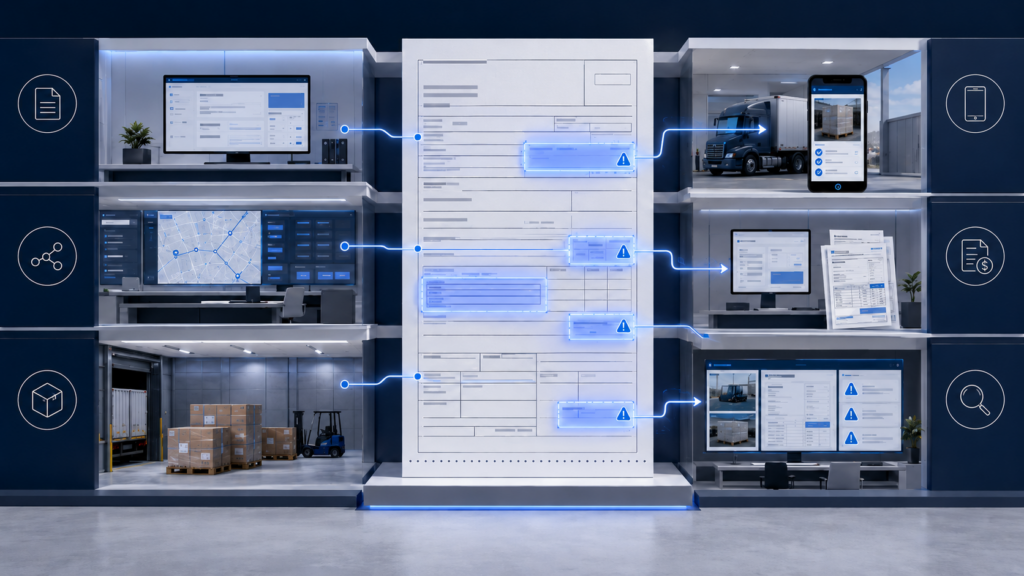
How a TMS Prevents BOL Errors Before They Become Claims
The best claims teams do not only process claims faster. They reduce the number of preventable claims that enter the pipeline.
A TMS does that by moving BOL control upstream.
Instead of waiting for a dispute, the system should validate shipment data while the load is still being created, tendered, picked up, and delivered. That means required fields, controlled templates, customer-specific logic, role-based edits, document automation, driver proof capture, and exception workflows.
A modern TMS prevents BOL errors in five practical ways.
1. It turns required BOL fields into controlled operational fields
The BOL should not depend on someone remembering what to include.
A TMS can enforce required fields by shipment type, customer, mode, equipment, commodity, and regulatory profile. For general motor carrier freight, the required BOL information includes names of consignor and consignee, origin and destination, package count, freight description, and weight, volume, or measurement when relevant to rating.
The system should not generate a final BOL when required fields are missing or inconsistent.
That sounds simple. In practice, it is where many preventable disputes disappear.
2. It separates planned data from executed data
A quote is not a pickup confirmation.
Planned freight, booked freight, tendered freight, loaded freight, and delivered freight may differ. If the system treats them as the same record without version control, the BOL can reflect the wrong stage of the shipment.
Good TMS design preserves those differences.
The order may show what the customer requested. Dispatch records show what was assigned to the carrier. Pickup confirmation shows what transferred into custody. By delivery, the POD shows what the consignee actually received.
Claims teams need all four, not a flattened version.
3. It captures exceptions while proof is still fresh
Claims become expensive when teams reconstruct events from memory.
A driver sees damaged packaging but leaves the facility without recording it. Dispatch receives a call but does not attach the note to the load. A receiver writes “short” on the POD, but billing never sees it.
Later, the customer deducts the invoice.
By then, the organization has lost time and leverage.
A TMS should capture exception photos, notes, timestamps, signatures, and related documents before the workflow moves forward.
It should also notify the right team when exception proof may affect billing or claim exposure.
4. It connects BOL, POD, invoice, and claim workflow
Federal claim investigation rules recognize the importance of supporting documents. When needed, claims may be supported by the bill of lading, evidence of freight charges, invoice or value documentation, and other materials relevant to the shipment and value involved.
That is exactly why document fragmentation hurts transportation teams.
If the BOL is in one folder, POD in another system, rate confirmation in email, photos in a mobile app, and invoice in accounting software, the claim file becomes a manual research project.
A TMS should keep the evidence chain together.
5. It makes recurring BOL errors visible to leadership
One-off BOL mistakes happen. Recurring mistakes point to process failure.
When one customer constantly sends vague commodity descriptions, that points to a customer onboarding issue. Repeated package count disputes from the same facility usually signal a shipper or dock process issue.
Carrier behavior also matters. Repeated exception claims without timely proof point to a carrier performance issue.
A TMS should report BOL error patterns by customer, facility, carrier, lane, user, commodity, and claim outcome.
That is where claims prevention becomes operational intelligence.
| BOL Error | How It Creates Claim Risk | How a TMS Prevents It |
|---|---|---|
| Wrong consignee or delivery location | The shipment may be delivered to the wrong facility, cross-dock, store, or job site, making POD and customer records hard to reconcile. | Pull consignee, shipper, facility, and billing relationship from approved customer records instead of free-text entry. |
| Package count mismatch | The customer, carrier, and receiver may dispute whether shortage happened before pickup, during transit, or at delivery. | Separate planned quantity from actual pickup quantity and require confirmation before final BOL generation. |
| Vague freight description | Claims teams lose context around commodity type, handling needs, packaging expectations, and rating basis. | Use customer-specific commodity profiles, required description fields, and special handling rules tied to the load record. |
| Incorrect weight or measurement | Carrier invoices, customer invoices, rating records, and claim values may conflict after delivery. | Track whether weight is estimated, customer-provided, carrier-updated, scale-verified, or corrected after pickup. |
| Clean BOL despite visible damage | The carrier may appear to have accepted freight in good condition even when packaging or product issues were visible at pickup. | Require exception notes, photos, timestamps, and dispatcher review before the shipment moves forward. |
| Missing seal, temperature, or appointment data | Claims involving rejected freight, security issues, late delivery, or temperature control become harder to defend. | Trigger conditional fields based on customer, commodity, equipment type, service level, or lane requirements. |
| Manual document correction with no audit trail | Teams cannot prove which BOL version governed the shipment or why a key field changed. | Preserve version history, user edits, timestamps, reason codes, and related communications on the shipment record. |
Where Claims Teams Lose Leverage After Delivery
A claim does not fail only because the freight was damaged.
It can fail because the team cannot identify the shipment cleanly, cannot connect the damage to custody, cannot prove the amount, cannot retrieve supporting documents, or cannot show that the exception was captured at the right time.
The Carmack Amendment section on motor carrier and freight forwarder liability requires a carrier to issue a receipt or bill of lading for property it receives for transportation. It also imposes liability for actual loss or injury to the property by the receiving, delivering, or responsible carrier.
For operators, the lesson is not that the BOL creates all liability.
The lesson is sharper: the BOL sits at the center of how shipment identity, custody, and loss get argued.
A signed BOL with weak data still creates work. A signed BOL with controlled data, document history, and exception proof creates leverage.
Mini Scenario: The Claim Was Preventable Before Pickup
Consider a brokerage handling refrigerated shipments for a national food customer.
The customer sends an order with 26 pallets. The warehouse loads 24 pallets and 2 floor-loaded partials because two pallets were restacked. Dispatch updates the driver by phone.
The BOL still shows 26 pallets. The seal number is handwritten and difficult to read. The POD later says 24 pallets received, with one product line short.
The customer files a shortage claim.
Without a controlled workflow, the brokerage now has to reconstruct the shipment from emails, driver texts, warehouse notes, and scanned paperwork.
Billing may already have released the invoice. Claims may ask dispatch for proof that should have been captured three days earlier.
With a TMS, the workflow changes:
- The BOL pulls shipment data from the load record, not a manually edited PDF.
- Pickup confirmation forces actual loaded quantity before final document status.
- Seal number is captured as a required field for that customer profile.
- Driver photos and exception notes attach to the load.
- The POD variance triggers a billing and claims review before invoice release.
- Reporting shows whether this facility creates repeated pallet count discrepancies.
No software can prevent every freight claim.

Still, it can prevent the avoidable claims that come from missing, late, or inconsistent information.
Decision Framework: When BOL Control Needs a TMS, Not Another Checklist
A spreadsheet can list BOL requirements. It cannot enforce them across a live transportation operation.
Teams usually need TMS-level control when one or more of these conditions appear:
- Shipment volume has grown beyond manual document review.
- Multiple users create or edit BOLs.
- Customer-specific requirements differ by account, facility, or commodity.
- Claims teams frequently ask dispatch for missing proof.
- Billing delays invoices because documents are incomplete.
- Carrier invoices do not match BOL quantities, weights, or accessorials.
- Delivery exceptions are found after invoice release.
- Leadership cannot report claim patterns by root cause.
A checklist may help a small team.
An enterprise operation needs workflow orchestration.
Best Practices for Preventing BOL Errors in a TMS
Strong BOL governance does not require making the process slow. In fact, the right setup should make operations faster because users stop rechecking the same details manually.
Use these practices as a baseline:
- Build BOLs from structured load data, not copied text.
- Require core fields before tender and final document generation.
- Use customer-specific BOL templates where rules differ.
- Separate planned quantity from actual pickup quantity.
- Capture exceptions before the driver leaves the facility.
- Attach photos, notes, signatures, PODs, and invoices to the same shipment record.
- Route delivery discrepancies to billing and claims before invoice release.
- Track corrections with user, time, reason, and document version.
- Report recurring BOL errors by customer, facility, lane, carrier, and internal user.
- Review claims outcomes against the original BOL data to improve future workflows.
For FTM users, this is where the Salesforce-native architecture becomes important. BOL control does not live in isolation. It can connect to customer records, carrier management, quoting, dispatch, documents, proof of delivery, billing, claims review, and reporting on one operational platform.
Frequently Asked Questions
BOL Errors That Lead to Claims Are Usually System Errors
Transportation leaders often treat BOL mistakes as user errors.
Sometimes they are. More often, they reveal a system design problem.
A dispatcher should not have to remember every customer’s documentation rule. A driver should not have to decide which exceptions matter to billing. Accounting should not have to search email for proof.
Claims should not have to rebuild the shipment history after the customer has already deducted payment.
The BOL is where fragmented freight information becomes visible.
When a TMS controls the data behind the document, the organization gains more than cleaner paperwork.
It gains faster claim response, better invoice accuracy, stronger customer conversations, cleaner carrier accountability, and clearer operational reporting.
A strong BOL process does not eliminate claims.
It eliminates unnecessary uncertainty.
Prevent BOL Errors Before They Become Claims
See how FTM helps transportation teams connect BOL generation, shipment data, driver proof, PODs, billing, claims review, and reporting inside Salesforce.
Review Your Documentation Workflow