Most carriers do not fail because they cannot find freight. They fail because they grew their fleet faster than they grew the systems behind it. Five trucks is a personal operation. The owner knows every driver by name, handles dispatch from their phone, and keeps the whole picture in their head. But at fifteen trucks, that picture starts fragmenting. At twenty-five, it collapses entirely. And by the time a carrier realizes the problem, they are already managing the fallout from missed check-calls, confused customers, and a dispatcher who is simultaneously running loads, answering driver texts, and trying to submit invoices before 5pm.
On this page
Scaling a trucking fleet from a small operation to a mid-size carrier is one of the most operationally dangerous transitions in freight. Not because growth is bad. But because each threshold, 10 trucks, then 25, then 50, requires a different version of the same operation. The systems that work at five trucks actively break at fifteen. The structure that works at fifteen is completely inadequate at forty. Carriers that grow through these transitions without deliberately building the infrastructure each stage requires do not scale. They accumulate damage.
Why Growing a Fleet Is Not Just an Addition Problem
Adding a truck is not like adding a unit to an inventory count. Every new truck adds a driver relationship, a new set of hours-of-service variables, additional maintenance exposure, more load assignments to track, and another line item on the insurance and compliance ledger. At five trucks, an owner-operator can manage that manually and still have time to quote freight. At twelve trucks, the same owner is working 70-hour weeks and still dropping things.
The reason scaling a trucking fleet breaks operations is not volume. It is the mismatch between a carrier’s load capacity and their visibility capacity. A dispatcher managing 8 loads knows where every truck is because they put it there. A dispatcher managing 25 loads cannot hold that information reliably. They start relying on driver check-calls that come in late or not at all. They miss appointment windows because they are covering a different load. Customers escalate to the owner. The owner is driving.
The solution is not hiring more dispatchers faster than you add trucks. That approach works until the cost structure collapses margins. The solution is building systems that extend a dispatcher’s capacity before adding trucks, not after the wheels are already rolling.

The Four Thresholds Where Carrier Operations Typically Break
Growth does not break freight operations gradually. It breaks them at specific pressure points, each triggered by a fleet size that overwhelms a system that was never designed for it. Here is what typically happens at each threshold and what needs to change before the next one:
| Fleet Size | Where Operations Break Down | What Shippers Start Noticing | What Has to Change |
| 5 trucks | All dispatch handled by one person, no backup coverage | Inconsistent communication when the dispatcher is unavailable | Basic TMS to separate dispatch from the owner-operator’s phone |
| 10 to 15 | Spreadsheets and group texts cannot track all active loads | Missed check-calls, late status updates, visibility gaps | Real-time tracking and automated status workflow |
| 20 to 30 | One dispatcher cannot manage 20 loads and carrier relationships | Response time on exceptions slows, customer escalations rise | Dedicated roles: dispatch, customer ops, carrier relations |
| 40 to 50 | No lane-level data, no cost-per-mile visibility, gut decisions | Rate competitiveness drops, profitable lanes unclear | Analytics, scorecarding, and structured reporting infrastructure |
At 5 trucks:
The operation runs on the owner’s relationships. Dispatch is informal. Billing happens when there is time. This model has a hard ceiling at around 8 to 10 trucks, because adding the ninth truck means the owner can no longer personally manage every driver interaction. The fix is not dramatic: a basic TMS that tracks load status and handles invoicing removes the owner as the only system.
At 10 to 15 trucks:
Spreadsheets appear everywhere. Group texts become the dispatch tool. Check-calls are manual and inconsistent. Customers start noticing the gaps, not because the trucks are late, but because nobody updates them until they ask. This is the stage where real-time tracking and automated status workflows change the operation’s service perception without adding headcount.
At 20 to 30 trucks:
A single dispatcher cannot cover this volume at quality. The loads exist, the trucks move, but exception management suffers. When a truck is delayed, who calls the customer? When a driver’s hours are short, who finds the solution? Without defined roles, every problem routes to whoever answers the phone. Consequently, nothing gets handled systematically because the system is still one person.
At 40 to 50 trucks:
The operation is big enough that gut-feel lane decisions are becoming expensive. Some lanes are profitable. Others quietly drain margin on every load. But without cost-per-mile visibility by lane and driver, the owner cannot tell which is which. This is the stage where analytics matter more than any additional headcount.
What Shippers Actually See When a Carrier Scales Badly
Shippers do not always articulate exactly what went wrong with a carrier. They just stop tendering freight to them. The operational tells are consistent across bad scale transitions: check-call gaps, inconsistent ETA accuracy, billing errors that multiply with volume, and longer response times on exceptions.
A shipper who has been tendering 10 loads a week to a carrier running 8 trucks will not automatically continue that relationship when that carrier grows to 20 trucks. They watch whether the service level holds. If the carrier’s dispatcher is suddenly less responsive because they are managing twice as many loads with the same tools, the shipper feels it before the carrier does. Consequently, the carrier that grew its fleet often loses the exact shipper relationships that funded the growth.
This dynamic is why shipper of choice status, discussed elsewhere in this series, becomes harder to maintain during fleet growth phases. The same practices that earned preferred status at 5 trucks, consistent communication, proactive updates, fast exception response, require operational infrastructure to sustain at 30 trucks. A carrier who earned that status personally cannot keep it personally at scale. The systems have to carry it instead.
How Scaling a Trucking Fleet Changes the Technology Requirement
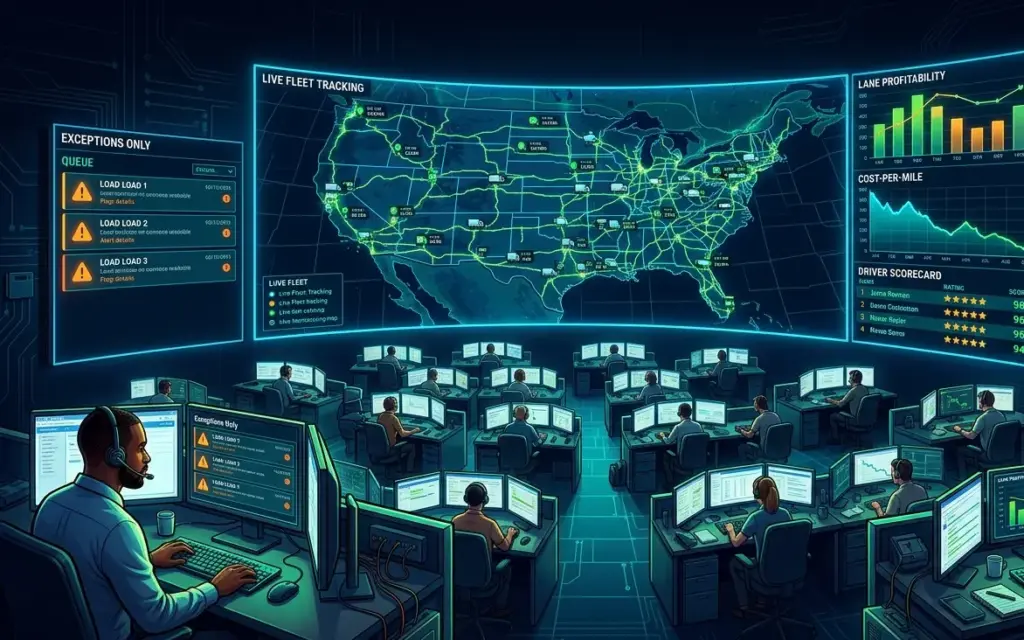
Scaling a trucking fleet changes what a TMS needs to do. At 5 trucks, a carrier needs basic load tracking and invoicing. At 15, they need real-time visibility and automated driver communication. At 30, they need role-based workflows that let a dispatcher hand off exceptions to an ops manager without things falling through the gap. At 50, they need lane-level analytics and carrier performance reporting that makes business decisions data-driven rather than instinct-driven.
The mistake most growing carriers make is staying on the same platform too long. They buy or adopt a basic TMS at 5 trucks and run it until 35, long past the point where it stopped doing what they needed. By then the workarounds have multiplied, the manual processes have crept back in, and switching platforms feels like it will disrupt operations. It will. But the disruption of switching is smaller than the disruption of continuing to run a 35-truck operation on 5-truck systems.
According to NATSA’s 2026 trucking industry outlook, fleets in 2026 are increasingly adopting telematics, route optimization, and AI-powered dispatch tools to manage complexity at scale. The adoption gap between mid-sized carriers who invest in these tools and those who do not is widening. Carriers who reach 50 trucks with modern operational infrastructure hold a structural cost advantage over carriers who reached the same size on manual processes and outdated platforms.
Building the Infrastructure Ahead of the Trucks, Not Behind Them
The practical rule for growing carriers is to build the infrastructure for the next fleet size before you reach it. If you are running 15 trucks and planning to reach 30, the dispatch workflow, the visibility tools, and the role definitions should be built for 30 before you buy the trucks.
This sounds counterintuitive. Why pay for capacity you are not using? Because the alternative is building the runway while the plane is already in the air. Transitioning dispatch systems, onboarding new tools, and redefining team roles is significantly harder when every dispatcher is already running at full capacity managing existing loads. The carriers that scale cleanly are the ones who made the infrastructure investment one size ahead.
- Before adding trucks 1 to 10: Implement a TMS with load tracking and automated invoicing. Remove dispatch from the owner’s personal phone.
- Before adding trucks 10 to 25: Add real-time GPS visibility and automated status updates for shippers. Eliminate manual check-calls as the primary status method.
- Before adding trucks 25 to 40: Define dispatch, operations, and customer success as separate functions. Build escalation workflows for exceptions.
- Before adding trucks 40 to 50: Implement lane-level cost analysis and carrier scorecarding. Make freight decisions from data, not from memory.
The Fleet Size on Paper Is Not the Same as the Operation Behind It
Fifty trucks is not a destination. It is a description of an operation that requires a specific level of infrastructure to run well. And the stakes of getting that infrastructure right extend beyond any individual carrier’s bottom line. Trucks deliver more than 72 percent of all domestic freight tonnage in the U.S., according to the American Trucking Associations, which means carrier operational efficiency is not just a business problem. It is a system-level one. Every carrier that scales badly, losing service quality, missing appointments, dropping communication standards, creates friction that ripples outward into shipper networks, customer supply chains, and the broader freight market. Growing well is not only good for the carrier. It is good for everyone downstream.
Scaling a trucking fleet from 5 to 50 is achievable. The carriers doing it successfully in 2026 are not doing it by working harder. They are doing it by building systems that work harder so the team does not have to absorb every unit of additional complexity as personal stress.
Therefore, the question worth asking is not how many trucks you want to run. It is whether the operation behind your current fleet is already built for the one you are planning to have.
Build the operation for the fleet you are planning, not the one you have.
FTM is a TMS built for carriers who are scaling past the point where manual processes work. Real-time visibility, automated dispatch workflows, lane-level analytics, and role-based operations infrastructure, designed for the carrier who is building something serious. See it in 20 minutes.
