FTM vs Revenova is an unusual TMS comparison because the two platforms share an important foundation: both run natively on Salesforce.
On this page
That immediately separates this decision from comparing a Salesforce-native application with a standalone TMS connected to CRM through APIs.
Both platforms can bring customer relationships and transportation operations into the Salesforce ecosystem. Both serve multiple transportation operating models, and both continue to invest in automation, financial workflows, carrier management, and operational visibility.
The more useful differences appear deeper in the evaluation: pricing structure, deployment model, daily workflow, AI capabilities, extensibility, and how each product fits the transportation organization buying it.
If you are actively evaluating both products, FTM also maintains a dedicated FTM vs Revenova comparison page with a more detailed executive evaluation matrix.
For this article, the objective is simpler: understand where the platforms overlap, where their approaches differ, and what buyers should actually test before choosing either one.
FTM vs Revenova: Start With What They Have in Common
The biggest similarity is architecture.
Revenova describes its platform as a Salesforce-native TMS in which logistics and customer data operate within one Salesforce environment. Its current platform materials emphasize one database, one user interface, shared security, multimodal operations, CRM, analytics, AI, and configurable workflows.
FTM follows the same fundamental Salesforce-native model. Transportation records such as customers, carriers, quotes, loads, documents, and financial activity operate inside Salesforce rather than in an external TMS that periodically synchronizes data.
Therefore, buyers should not reduce the decision to:
Which product works with Salesforce?
Both do.
Instead, evaluate how each product uses Salesforce to run your transportation operation.
Both support more than one transportation model
Revenova currently markets solutions for freight brokers, 3PL/4PL organizations, carriers, fleets, and shippers.
Likewise, FTM supports broker, carrier, shipper, 3PL, and mixed transportation operations through its Salesforce-native transportation platform.
That makes actual workflow testing far more valuable than comparing category labels.
Architecture Matters More Than the Salesforce Logo
Two native applications can still feel very different in production.
Revenova emphasizes a configurable logistics environment with multimodal capabilities, CRM, financial tools, LaneIQ, RateIQ, Artimus AI, analytics, and integration options. Its own platform materials position this flexibility for organizations ranging from brokers and carriers to complex logistics providers.
FTM approaches the architecture through connected transportation workflows.
For example, a load can connect to quoting, carrier records, dispatch, driver activity, documents, customer visibility, billing, and reporting without creating a separate operational data layer.
What buyers should test
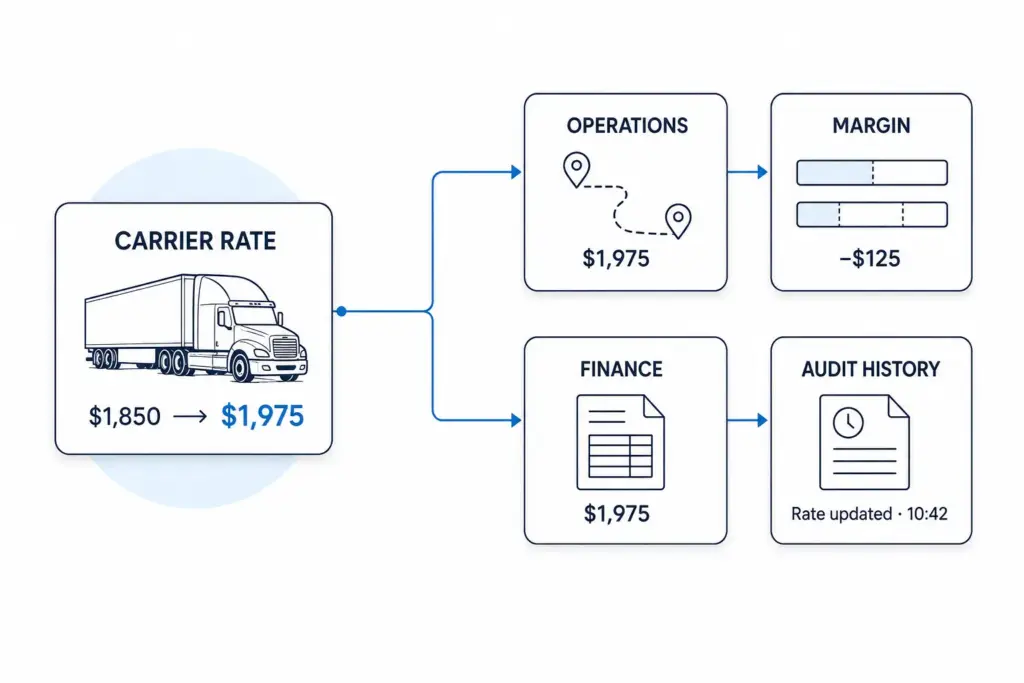
During a demo, make one operational change and follow it through the system.
Change a carrier rate after dispatch, for example. Then check whether operations sees the change, whether margin updates, whether finance receives the right value, and whether the audit history remains available.
This test reveals far more than asking whether either product has an API, CRM, or dashboard.
FTM vs Revenova Feature Comparison
At a high level, there is substantial overlap.
Both products address the core transportation lifecycle, but each vendor packages and emphasizes capabilities differently.
Quoting and rate intelligence
Revenova has developed dedicated pricing capabilities through RateIQ and LaneIQ. Its current freight-broker materials describe market-aware quoting, lane analysis, carrier matching, and automated workflows as core elements of the platform.
FTM provides quoting through its Quoting System, where customer opportunities, lane information, pricing, and resulting transportation records stay connected inside Salesforce.
For a brokerage, the demo should test more than quote generation. Change the carrier cost after a customer rate has been established and verify how margin visibility responds.
Carrier management
Both platforms support carrier relationships and compliance workflows.
Revenova highlights carrier performance, authority, insurance, documentation, capacity matching, and carrier intelligence within its broker workflows.
FTM provides a dedicated Carrier Onboarding workflow and a Private Loadboard for working with approved carrier networks.
The meaningful comparison is therefore how carrier approval, sourcing, tendering, and execution connect in your operation.
Dispatch, Visibility, and Customer Experience
Transportation software earns its keep when freight stops following the happy path.
Revenova offers real-time shipment visibility, ETA alerts, customer portal capabilities, multimodal tracking, carrier activity, and exception-oriented workflows. The company has also continued expanding visibility integrations in 2026.
FTM centralizes execution through its Dispatch Console, where load status, carrier or driver activity, documents, exceptions, customer communication, and financial signals can be managed from the transportation record.
Meanwhile, the FTM Customer Portal exposes selected shipment information directly to customers.
Test an exception, not a map
Create a delayed pickup during the demo.
Then observe how the platform detects the issue, identifies the affected load, communicates it, records the response, updates the customer, and preserves the event for later reporting.
A tracking dot proves location visibility.
Exception resolution proves operational capability.
AI and Automation Take Different Forms
AI is now meaningful enough that it deserves its own evaluation category.
Revenova has invested substantially in Artimus AI, along with RateIQ, LaneIQ, automated capacity matching, and workflow automation. Its 2026 releases include improvements around AI-assisted capacity matching, market-based quoting, and real-time transaction processing.
Its broker materials also state that Artimus can create loads from incoming emails and quote requests, reducing manual entry.
FTM takes a document- and workflow-oriented approach through products such as FTM AutoFill. AutoFill can read freight documents, connect extracted information to transportation records, prepare operational or financial information, and preserve human approval before committing it.
Neither approach should be judged by the number of AI features.
Instead, calculate how many real employee touches disappear from a quote, load, document, carrier, or invoice workflow.
FTM vs Revenova Pricing in 2026
This is one of the clearest structural differences, but it requires careful interpretation.
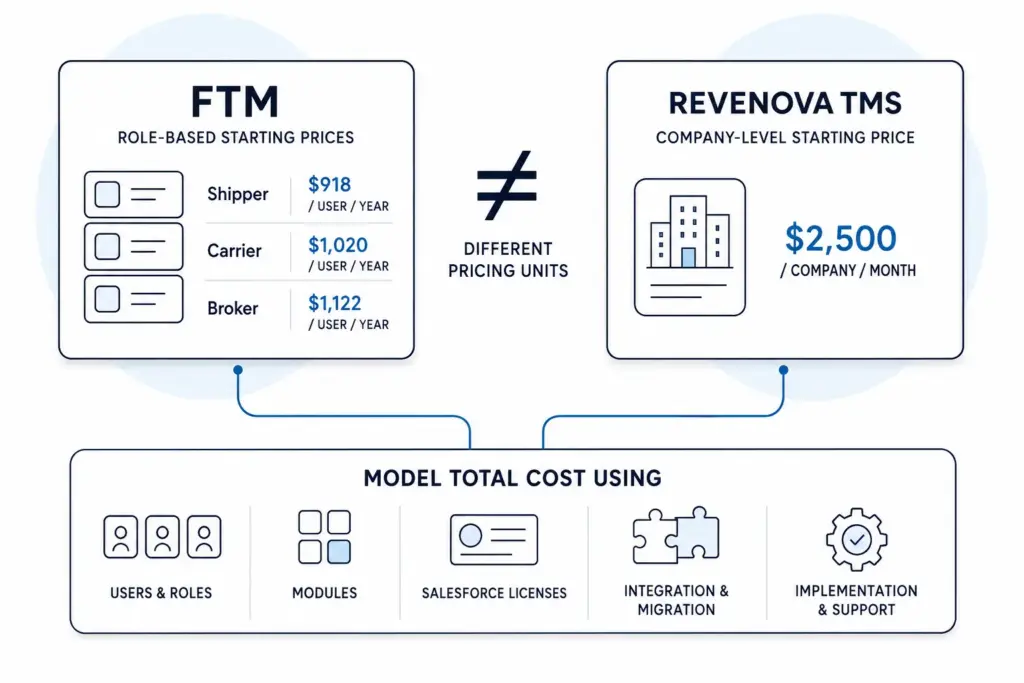
As of September 2026, FTM publishes role-based starting prices. Its current product page lists:
- Shipper: starting at $918 per user/year
- Carrier: starting at $1,020 per user/year
- Broker: starting at $1,122 per user/year
Optional workflow products have separate organizational pricing depending on the module.
Salesforce AppExchange independently shows the same FTM starting levels.
Revenova uses a different public pricing structure. Salesforce AppExchange currently lists Revenova TMS as starting at $2,500 per company per month.
View the current Salesforce AppExchange marketplace
Headline pricing is not total cost
Those starting prices are not directly comparable.
FTM publishes user- and operation-based packages, whereas the Revenova AppExchange listing uses a company-level monthly starting point.
Therefore, a buyer should model:
- Number and type of users
- Required modules
- Salesforce licensing
- Integration scope
- Data migration
- Configuration
- Training
- Support
- Third-party services
- Implementation requirements
A 10-user operation and a 200-user enterprise can reach very different conclusions from the same public starting prices.
Pricing and Feature Comparison Table
| Evaluation Area | FTM | Revenova |
|---|---|---|
| Architecture | Salesforce-native transportation platform | Salesforce-native transportation platform |
| Operating models | Brokers, carriers, shippers, 3PLs, mixed operations | Brokers, 3PL/4PLs, carriers, fleets, shippers |
| Quoting | Connected quoting and lane workflows inside Salesforce | Quoting plus RateIQ and LaneIQ pricing intelligence |
| Carrier workflows | Onboarding, approved carrier network, sourcing, dispatch, compliance integrations | Carrier management, compliance, sourcing, capacity matching, performance intelligence |
| AI / automation | AutoFill document intelligence and transportation workflow automation | Artimus AI, capacity matching, rate intelligence, and workflow automation |
| Customer visibility | Customer Portal connected to Salesforce transportation records | Branded customer portal and transportation visibility |
| Reporting | Salesforce reports and dashboards across transportation records | Salesforce-based analytics, lane, carrier, financial, and operational insights |
| Published starting price | $918/user/year shipper; $1,020 carrier; $1,122 broker | AppExchange lists starting at $2,500/company/month |
| Published deployment guidance | Core workflows can go live in as little as 14 days when scope is aligned | Confirm project timeline directly based on implementation scope |
| Best evaluation method | Run the same real transportation workflow through both platforms and compare user effort, exceptions, administration, integrations, and total cost. | |
Public pricing reflects information available in September 2026 and represents starting points, not final quotes. Packaging, Salesforce licensing, modules, implementation, integrations, and enterprise requirements can materially change total cost.
The purpose of the table should be to identify questions for the demo, not declare a universal winner.
Implementation Can Change the Economics
License price receives attention because it fits neatly into a spreadsheet.
Implementation risk is harder to quantify.
FTM publishes a target of as little as 14 days for core workflows when scope, data readiness, integrations, and approvals are aligned. Larger deployments can naturally require more planning.
Revenova does not present one universal deployment duration across the public materials reviewed for this comparison. That is reasonable for a configurable enterprise platform because implementation scope can vary substantially.
Therefore, buyers evaluating Revenova should ask directly about the timeline for their exact environment rather than relying on a generalized estimate.
Compare the work required after go-live
Implementation questions should include:
- Who owns future workflow configuration?
- How are new fields and approvals introduced?
- Who maintains integrations?
- Can internal Salesforce administrators make changes?
- What happens during platform upgrades?
- How are sandbox and production environments managed?
- What requires vendor services?
The cheapest implementation is not necessarily the one with the smallest initial services invoice.
It is the one that creates the least operational debt afterward.
Reporting Is Especially Important in a Salesforce-Native TMS
One major reason companies choose Salesforce-native transportation software is the opportunity to reduce fragmented reporting.
FTM uses Salesforce reporting and dashboards across transportation records, allowing teams to connect customer, load, carrier, financial, and operational data.
Revenova also emphasizes unified analytics and real-time data across customer relationships, logistics activity, lane performance, carrier performance, and finances.
Therefore, reporting should be tested using an actual management question.
For example:
Show margin by customer, then identify which lanes and carriers created the change.
Next, ask the vendor to move from the executive metric back to the underlying loads.
If the report identifies a problem but operations cannot trace it to the transactions that caused it, the data model still creates work.
Which Companies Should Evaluate FTM?
FTM is particularly worth evaluating when:
- Salesforce is already strategically important.
- Transportation teams want a shorter initial deployment path.
- Published starting prices matter during budgeting.
- Brokers need quoting, sourcing, dispatch, billing, and margin together.
- Carriers need dispatch, driver activity, documents, and billing.
- Shippers need transportation execution and visibility.
- Mixed operations need several transportation models in one Salesforce environment.
- Teams want modular products such as portals, onboarding, AutoFill, quoting, or private carrier collaboration.
The broader FTM Products and Pricing page shows how those workflows are packaged.
Which Companies Should Evaluate Revenova?
Revenova deserves serious evaluation when an organization values its particular combination of multimodal logistics functionality, enterprise configuration, rate intelligence, AI capabilities, and established Salesforce logistics ecosystem.
Its current platform also supports brokers, 3PL/4PL organizations, fleets, carriers, and shippers.
Teams interested in Artimus AI, RateIQ, LaneIQ, extensive multimodal workflows, or existing Revenova expertise should test those capabilities directly.
Explore Revenova’s current TMS platform overview
The evaluation does not need to become ideological.
A company already operating effectively on Revenova may have little reason to change. Likewise, an organization comparing new Salesforce-native TMS options should evaluate the cost and workflow of both before committing.
FTM vs Revenova: How to Make the Final Decision
A strong FTM vs Revenova evaluation should end with operational evidence rather than a larger spreadsheet.
Give both vendors the same workflow.
For example:
A customer requests a quote. The load is awarded, the first carrier declines, another carrier accepts, pickup becomes late, a customer update is required, detention is approved, the POD arrives, the carrier invoice differs from the expected amount, and finance needs the final margin.
Then test five things:
1. User effort
How many screens, re-entries, emails, and manual handoffs are required?
2. Exception handling
What happens when the process stops going according to plan?
3. Data continuity
Does one change reach every downstream workflow that depends on it?
4. Administration
How difficult will the system be to maintain after implementation?
5. Total cost
What will the complete environment cost over three years, not simply in month one?
That exercise will usually reveal more than another 100 rows of feature checkboxes.
The Bottom Line on FTM vs Revenova
There is no useful case for portraying Revenova as an outdated or fundamentally different class of product.
It is a mature Salesforce-native TMS with multimodal transportation capabilities, CRM integration, AI, analytics, rate intelligence, financial workflows, and support for multiple logistics operating models.
FTM shares the Salesforce-native foundation but approaches packaging, deployment, transportation workflows, and pricing differently.
For some organizations, Revenova’s ecosystem and configuration model may align closely with the operation. For others, FTM’s modular products, published pricing, connected transportation workflows, and rapid deployment approach may be the better fit.
That is precisely why buyers should compare the workflow rather than the marketing category.
For the full side-by-side evaluation, including architecture, implementation, workflow fit, and buyer scenarios, use the dedicated FTM vs Revenova comparison guide.
The best TMS is the one your transportation team can operate, adapt, measure, and scale without creating another layer of operational friction.
Frequently Asked Questions
Compare the Workflow, Not Just the Feature List
Bring your current transportation process to an FTM demo and test quoting, carrier management, dispatch, exceptions, documents, billing, reporting, and Salesforce administration against your actual requirements.
Compare FTM for Your Operation