A transportation company that spends $300,000 building a custom TMS and another that purchases an existing platform are often trying to solve the same problem: gaining more control over operations. Yet the outcomes can be dramatically different. One may end up with software that perfectly mirrors its processes, while the other gets to market faster, spends less, and benefits from years of product development funded by hundreds of other customers.
On this page
That contrast explains why the custom TMS vs off-the-shelf TMS debate remains relevant despite the rapid evolution of logistics technology. Transportation leaders are no longer choosing software solely based on features. They’re evaluating scalability, implementation risk, long-term ownership costs, and how quickly a platform can support operational growth.
Interestingly, some of the most successful logistics companies are moving away from the idea that software must be either fully custom or completely standardized. The rise of configurable platforms has created a middle ground that didn’t exist a decade ago, allowing teams to adapt workflows without taking on the burden of maintaining a software product internally.
Why Companies Consider Building a Custom TMS
Every logistics operation develops its own way of working. A brokerage may have a carefully refined carrier onboarding process. A shipper might rely on complex approval chains. A carrier may have dispatch workflows that evolved around the needs of a particular fleet.
After years of refining those processes, it is natural for leadership teams to conclude that a standard platform won’t be flexible enough to support the business.
Sometimes that assumption is correct.
However, technology projects become much more successful when companies separate operational preferences from true competitive advantages. A process may be unique because it evolved organically over time. That doesn’t necessarily mean it creates measurable business value.
Why So Many Custom TMS Projects Start for the Wrong Reason
One of the most common reasons transportation teams pursue custom development is because they mistake process variation for competitive differentiation.
Over time, every logistics operation develops workarounds, approval paths, spreadsheets, and manual habits that become embedded in daily operations. During software evaluations, teams often treat those workflows as requirements simply because they already exist.
The challenge is that unique does not automatically mean valuable.
A workflow should be preserved because it improves service, lowers costs, increases productivity, or strengthens customer relationships. If it does none of those things, building software around it may simply automate inefficiency rather than eliminate it.
logistics leaders rarely discuss this distinction during TMS evaluations, yet it often determines whether a technology investment generates ROI or becomes an expensive maintenance project.
Read more: How TMS Manages Big Data in Logistics
The Cost of Ownership Is Usually Bigger Than the Cost of Development
When executives evaluate a custom TMS vs off-the-shelf TMS, most conversations focus on development costs. Those costs are visible, easy to estimate, and usually appear in the initial business case.
What receives far less attention is ownership.
Software does not stop evolving after launch. Carrier integrations change. Customers request new reporting capabilities. Security requirements become stricter. Teams discover new workflow requirements as operations expand.
A custom TMS effectively turns a transportation company into a software owner.
That responsibility may be worthwhile if technology itself creates competitive advantage. However, companies often underestimate how much time and investment are required to keep a platform aligned with a growing business.
A Scenario That Happens More Often Than You Think
Consider a brokerage that develops a custom TMS to solve several operational frustrations. The platform launches successfully and improves efficiency almost immediately.
Three years later, the company has doubled in size.
New customers require additional visibility. New carrier integrations become necessary. Internal workflows have evolved. Some of the employees who originally helped design the platform have left the organization.
The software still works, but every enhancement requires significant effort. What initially felt like flexibility gradually becomes technical debt.
This doesn’t mean custom software is a mistake. It simply means that the true cost of a custom platform is measured over years, not months.
How Off-the-Shelf TMS Platforms Have Evolved
The traditional view of off-the-shelf software is increasingly outdated.
A decade ago, transportation teams often had to choose between rigid systems that forced operational compromises and expensive custom development projects that required substantial resources to maintain.
Today’s market looks very different.
Modern TMS platforms have become significantly more configurable. Workflows can be adapted, automations can be created, dashboards can be customized, and integrations can be added without rebuilding core functionality.
This shift explains why configurable platforms such as FTM have become increasingly attractive to transportation teams. Companies want flexibility, but they also want access to continuous product improvements, vendor-managed infrastructure, and faster implementation timelines.
Why Configurability Matters More Than Ever
Transportation operations rarely stay the same for long.
A company that primarily manages truckload freight today may expand into LTL tomorrow. New customers introduce new requirements. Visibility expectations continue rising. Regulatory environments change.
Technology must be capable of evolving alongside the business.
That is where configurable platforms often outperform both extremes. They provide room for operational flexibility without requiring companies to build and maintain software internally.
Read more: TMS, Route Planner, Optimizer or GPS System? What’s the Difference?
Comparing the Long-Term Business Impact
Feature comparisons are useful, but business outcomes matter more.
The most successful TMS investments improve operational performance, reduce friction, and create scalability. Whether the software is custom-built or vendor-provided matters less than whether it helps the organization operate more effectively.
| Consideration | Custom TMS | Modern Configurable TMS |
|---|---|---|
| Initial Investment | Higher | Lower |
| Time to Deployment | Longer | Faster |
| Ongoing Maintenance | Internal Responsibility | Vendor Managed |
| Process Flexibility | Very High | High |
| Scalability | Depends on Internal Resources | Built Into Platform |
| Access to New Features | Self Developed | Continuous Updates |
For organizations struggling with visibility gaps, manual processes, and disconnected systems, the speed of implementation often has a greater impact on ROI than perfect workflow alignment.
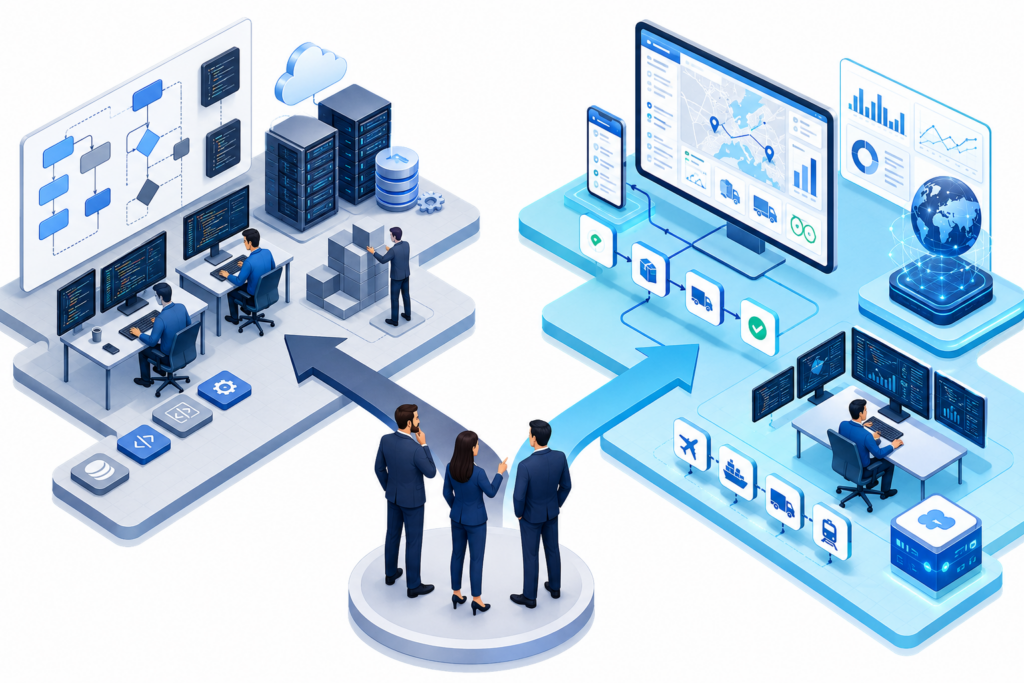
Conversely, businesses operating highly specialized transportation networks may discover that custom development creates enough strategic value to justify the additional investment.
The key is understanding where technology creates leverage inside your operation.
Questions Every Logistics Leader Should Ask Before Deciding
Are We Solving an Operational Problem or a Software Problem?
Technology projects sometimes begin because teams are frustrated.
That frustration is real, but identifying its source is critical.
A visibility problem may not require custom software. A reporting challenge may be solved through better data management. A workflow bottleneck may be caused by process design rather than platform limitations.
The best software decisions start with operational objectives rather than feature requests.
Read more: How Poor Data Management Will Hurt Freight Companies
Which Workflows Actually Differentiate the Business?
Every logistics company has unique processes.
Far fewer have unique processes that customers are willing to pay for.
Leaders should identify which workflows genuinely create value and which simply reflect historical operating habits. That exercise often changes the direction of a TMS evaluation entirely.
What Happens Three Years From Now?
Growth changes everything.
The software that fits a company today must also support future expansion, new customer requirements, additional freight modes, and increasing operational complexity.
leaders should evaluate a TMS decision against the future operating model, not just current requirements.
Where FTM Fits Into the Conversation
FTM was built around a challenge that many transportation companies encounter as they grow: the need for flexibility without the cost and complexity of becoming a software development organization.
For some businesses, custom development is absolutely the right path. For many others, the larger opportunity lies in improving visibility, automating repetitive processes, centralizing operations, and creating scalable workflows that support growth.

That is where configurable TMS platforms tend to create the strongest return. Rather than forcing transportation teams to choose between rigid software and expensive development projects, they provide a practical middle ground that supports operational flexibility while keeping technology manageable.
At the end of the day, most logistics companies are not trying to build software. They are trying to move freight more efficiently, serve customers more effectively, and scale operations without adding unnecessary complexity.
Ready to see FTM in action?
Book a live demo and we’ll walk you through the full document workflow: BOL, Rate Con, Invoice, and Lane Quote – directly inside the platform.

Enjoyed reading this.
I liked how it focused on real business needs rather than just features.