Your dispatcher just opened a rate confirmation. By the time they’ve finished manually entering the shipper address, a competitor’s TMS has already created the entire load record, automatically. That is not a hypothetical. It is what happens every day in freight operations that have adopted AI-powered data extraction, while others are still copying fields by hand.
On this page
For most brokers, carriers, and shippers, load creation starts the same way: open a document, read it, type it all in, and hope you got every field right the first time. The process is slow, repetitive, and nearly invisible, which is exactly why its costs go unquestioned for so long. That is where freight document autofill changes the equation entirely. FTM Autofill uses AI to read incoming freight documents and automatically build load records in your TMS, reducing a manual process that used to take ten minutes down to a single click.
The Manual Entry Problem Nobody Talks About Enough
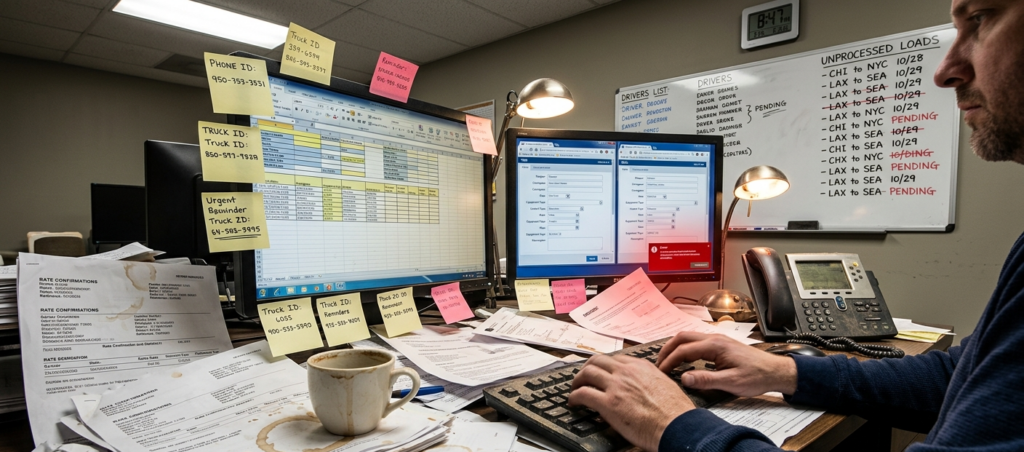
Ask any dispatcher how they spend their morning, and the answer almost always includes a version of the same routine. A rate confirmation arrives, by email, portal, or PDF. They open it, scan the document, then begin the process of typing. Shipper name. Shipper address. Consignee details. Origin city and ZIP. Destination. Weight. Commodity. Reference numbers. Agreed rate. Accessorials. Then they move to the next load, and do it again.
Mapped out as a checklist, a single load entry looks like this:
– Open the rate confirmation
-Read and interpret the document
-Type the shipper name and address
-Enter the consignee details
-Add origin and destination locations
-Input weight, commodity, and equipment type
-Enter the agreed rate and any accessorial charges
-Add reference numbers and special instructions
-Save the record and move to the next load
That is not a short task. At five to ten minutes per load, a dispatcher processing 20 loads a day spends two to three hours doing nothing but data entry. Furthermore, they are doing it under time pressure, because loads do not wait, and neither do shipper appointments.
The result is predictable: fields get missed. Numbers get transposed. The wrong consignee ends up on the wrong load. A weight that arrived as 42,500 lbs. gets entered as 24,500. These are not careless mistakes, they are the natural output of high-volume manual work performed at speed. And each one has a cost: a misrouted load, a failed audit, a delayed invoice, a frustrated customer.
How Freight Document Autofill Works
FTM’s freight document autofill does not simply scan a document and guess at fields. It uses AI-powered document intelligence to read the structure and content of incoming freight files the same way a trained dispatcher would, but without the manual effort, the time pressure, or the risk of error.
The process flows like this:
-A freight document arrives, via email, portal upload, or digital submission
-FTM’s AI reads the document and identifies its type and structure
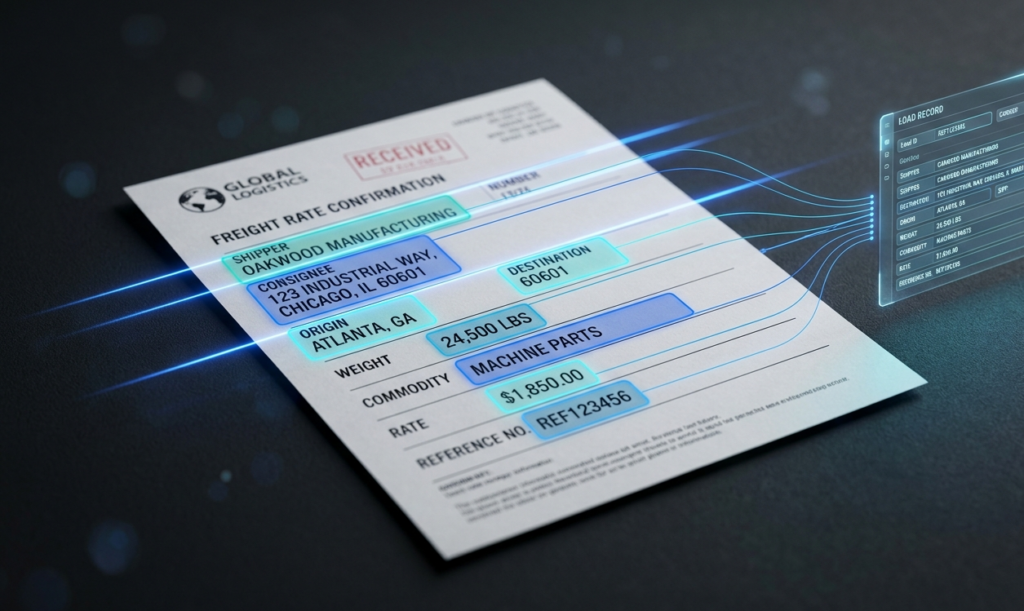
-Relevant data fields are extracted: shipper, consignee, origin, destination, weight, commodity, rate, reference numbers, and accessorials
-A load record is pre-populated in your TMS using the extracted data
-Your team reviews the populated record and approves it with a single click
Consequently, what used to take five to ten minutes of focused attention now takes under 30 seconds to review and confirm. The dispatcher’s job shifts from transcription to verification, a much smaller cognitive task that carries a much lower error risk.
No more copy-and-paste. No more re-reading the same document three times to make sure you got the ZIP code right. No more wondering whether the accessorial was entered or accidentally skipped. The document is read once, correctly, and the load record is ready before your team has had a chance to open the file themselves.
What FTM Autofill Actually Reads in Your Documents
The value of any autofill system depends entirely on how comprehensively it reads incoming documents. A tool that only captures shipper name and destination is not solving the problem, it is just moving some of the typing. FTM Autofill is designed to extract every field that your team would otherwise enter manually.
Across standard freight documents, FTM Autofill captures:
-Shipper and consignee names, addresses, and contact details
-Origin and destination locations, including city, state, and ZIP
-Pickup and delivery dates and appointment windows
-Commodity description, weight, and equipment type
-Agreed rate and any accessorial charges noted in the document
-Reference numbers, load numbers, and PO numbers
-Special instructions or handling notes
-Carrier name and MC number where present
Additionally, the system handles the document types your operation actually receives, rate confirmations, load tenders, bills of lading, and carrier paperwork, without requiring a perfectly formatted template to function. Whether the document arrives as a PDF, a scanned image, or an email attachment, FTM reads it and builds the load record from the content, not the format.
Manual Entry vs. FTM Autofill: A Direct Comparison
The difference between manual entry and automated load creation is not subtle. Here is what changes when your team stops transcribing and starts reviewing:
| Workflow Step | Manual Entry | FTM Autofill |
| Document reading | Dispatcher reads PDF manually | AI reads and parses the file automatically |
| Field extraction | Typed one field at a time | All key fields extracted simultaneously |
| Load record creation | 5–10 minutes per load | Under 30 seconds per load |
| Error risk | High – typos, missed fields | Low – AI extracts + human review confirms |
| Volume capacity | Limited by headcount | Scales without adding staff |
| Approval process | Direct entry, no review layer | One-click review and approval |
The Accuracy Question: Can AI Be Trusted With Load Data?
It is a fair question. Load data errors are not trivial, a wrong weight can create compliance issues, a mismatched reference number can delay payment, and an incorrect consignee can send a shipment to the wrong facility. Any tool that introduces new errors in the name of saving time is not an improvement.
FTM Autofill addresses this with a design principle that keeps humans in the loop: the AI fills the fields, but your team confirms them. Every auto-populated record goes through a review step before it is saved to your TMS. Your dispatcher sees the extracted data laid out clearly against the source document and approves, or corrects, before the load goes live.
Nevertheless, the accuracy of AI extraction is already significantly higher than the accuracy of manual entry at volume. Research on automated document processing consistently shows error rates below 2% for well-structured AI extraction models, compared to manual entry error rates that regularly exceed 5% during high-volume periods. The review step brings that already-low error rate close to zero, without adding meaningful time back to the process.
The result is a load creation workflow that is faster than manual entry, more accurate than manual entry, and still fully reviewed by a human who has the final say before anything is committed to the record.
Where Freight Document Autofill Pays Off
The most immediate return from freight document autofill is time. Two to three hours of daily data entry reclaimed per dispatcher is not a rounding error, it is a full shift of operational capacity that can be redirected to carrier relationships, customer service, exception management, and the work that actually requires human judgment.
Meanwhile, the financial case extends well beyond labor hours. Fewer entry errors mean fewer invoice disputes. Fewer invoice disputes mean faster payment cycles. Faster payment cycles mean better cash flow, without changing a single contract or renegotiating a single lane rate.
For growing freight operations, autofill also changes the economics of scaling. Without it, more volume means more dispatchers doing data entry. With it, your existing team can absorb significantly higher load counts without adding headcount, because the bottleneck that was slowing them down no longer exists.
According to McKinsey & Company’s research on supply chain digitization, companies that automate data-intensive manual processes typically recover 20 to 30 percent of operational capacity, time that moves directly from administrative work to value-generating activity. In freight, that difference compounds across every load, every lane, and every week of the year.
Your Team’s Time Is Worth More Than Data Entry
Manual data entry is not a small inefficiency hiding at the edge of your operation. It is sitting at the beginning of every load record your team creates, consuming time, introducing error risk, and capping your capacity at the pace of human typing.
FTM Autofill removes that bottleneck without removing the human judgment that matters. Your team still reviews every load. They still approve every record. They just spend five seconds doing it instead of ten minutes and they spend the time they recover on work that actually moves freight.
Therefore, the question is not whether autofill belongs in your operation. The question is how many loads your team has transcribed by hand since the last time you considered that it does not have to work this way.
Stop transcribing freight documents.
Let AI do the data entry so your team can focus on operations.
