Detention time is the billable wait time that occurs when a driver is held beyond the agreed loading or unloading window. In freight operations, the concept is familiar, however the recovery process often breaks down once the load moves from dispatch to billing. A late dock, missing check-in record, unclear free-time rule, or unsigned proof document can turn a valid charge into a quiet write-off.
On this page
For brokers, carriers, shippers, and enterprise logistics teams, freight detention is not only a driver wait issue. It affects margin, capacity planning, carrier trust, customer billing, service performance, and account profitability. Therefore, detention tracking should be managed as an operational and financial workflow, not as an after-the-fact note on a load.
Why detention time becomes revenue leakage
Detention is usually visible while it is happening. Dispatch knows the driver is waiting. The carrier may call in. The customer service team may receive an update. Meanwhile, the load may sit in an exception status or delay queue.
However, visibility during execution does not automatically create a collectible charge. To recover detention consistently, teams need the evidence, rule, approval path, and billing action to stay connected.
- Appointment time must be clear.
- Arrival and departure times must be defensible.
- Free-time rules must match the customer agreement.
- Driver or facility proof must be accessible.
- Billing must know the charge exists before invoice release.
Detention fails when operations and finance work from different records
In practice, detention gets lost in the handoff between dispatch, carrier communication, customer billing, and accounting. A dispatcher may log the delay in a note, while the billing team later needs a timestamp, a rate confirmation, customer terms, and proof. If those details live across emails, phone calls, spreadsheets, and separate systems, the charge becomes harder to defend each day.
Detention tracking is the process of capturing wait time, proof, accessorial rules, and billing status in a way that supports collection. That distinction matters because tracking is more than recording that a driver waited. It means preserving the evidence needed to get paid.
What counts as billable detention time?
Billable detention usually starts after a contracted free-time window. Still, the trigger can vary by customer, shipper, receiver, carrier agreement, lane, facility, or contract. Consequently, a detention workflow should not rely on a generic two-hour assumption unless that rule actually applies to the load.
A clean detention policy usually answers four questions:
- When does the free-time clock start?
- How much free time is allowed?
- What proof is required?
- Who must approve the charge before invoicing?
The commercial rule matters as much as the clock
One customer may allow two free hours after the scheduled appointment time. Another may start the clock only after verified check-in. A shipper may reject detention if the driver arrived early, while a carrier may expect payment based on actual arrival. Over time, these small differences create a large administrative burden, especially for enterprise teams managing multiple customers, facilities, and operating entities.
Because FMCSA Hours of Service rules limit driver availability, long carrier wait time can also create downstream capacity and service problems. A driver delayed at a receiver may miss the next pickup, run out of available hours, or require rescheduling. For federal HOS context, teams can reference the FMCSA Hours of Service summary.
How to track detention time without adding more admin work
The best detention workflows capture proof while the load is active. Waiting until invoice review usually means someone has to reconstruct the event from texts, calls, emails, and memory. As a result, valid detention can become too difficult to bill.
A practical detention evidence chain should include:
- Scheduled appointment time
- Driver arrival time
- Facility check-in confirmation
- Loading or unloading start time, when available
- Departure time
- Driver notes or carrier updates
- Supporting documents or timestamps
- Customer detention rule and billing rate
Track detention while the load is still fresh
For example, a driver or carrier portal can capture arrival and departure times, while dispatch validates the delay against the load record. Meanwhile, the system should flag the billing team before invoice creation, not after the customer has already received a clean freight invoice.
This is where logistics automation becomes useful. Automation should not replace judgment. Instead, it should surface likely detention events, remind teams to collect proof, apply customer-specific rules, and route exceptions to the right person before revenue disappears.

Where detention disputes usually fail
Detention disputes rarely fail because the delay never happened. They fail because the record cannot prove the delay in the format the customer expects. However, that distinction often gets missed during billing review.
A driver’s message may be accurate, but it may not be enough. A dispatcher’s note may explain the situation, but it may not prove appointment compliance. Therefore, dispute readiness depends on structure, not just effort.
| Dispute Failure Point | What Usually Happens | Operational Fix |
|---|---|---|
| No verified arrival time | The customer argues the driver arrived late, early, or without a confirmed appointment. | Capture appointment time, arrival source, facility check-in, and dispatcher validation on the load record. |
| Unclear accessorial terms | Billing cannot confirm free time, hourly rate, approval rules, or customer-specific exceptions. | Store detention rules by customer, contract, facility, or lane and apply them during execution. |
| Proof arrives too late | The freight invoice goes out without detention, then the team tries to rebill later. | Flag detention before invoice generation and hold exceptions for review. |
| Notes are trapped in email | Dispatch has context, but accounting cannot find it when the customer disputes the charge. | Connect driver notes, carrier updates, documents, and billing tasks to the same load record. |
| Customer approval is missed | The charge may be valid, but it fails because the customer required pre-approval. | Trigger approval workflows while the load is still active and before invoice release. |
Strong disputes are specific, short, and documented
A useful detention dispute package does not need a long explanation. It needs a clear sequence: appointment time, verified arrival, free-time threshold, departure time, billable time, contractual rate, and supporting proof. Consequently, the customer has less room to reject the charge based on interpretation.
For example, a clean dispute might state: “Appointment 8:00 AM. Driver checked in 7:52 AM. Loading completed 11:38 AM. Free time two hours. Billable detention one hour and 46 minutes. Rate $75 per hour. Check-in and departure records attached.” That kind of record gives billing a defensible position without making the conversation emotional.
How to get paid for detention time
Payment recovery depends heavily on timing. Once a customer receives and approves the original freight invoice, a late detention add-on becomes harder to collect. Therefore, detention review should happen before invoice release, especially for strategic accounts with strict accessorial approval rules.
A better workflow usually follows this sequence:
- Detect the delay during execution.
- Validate timestamps and supporting proof.
- Apply the correct customer detention rule.
- Calculate billable time and amount.
- Route for approval if required.
- Add detention to the invoice before release.
Detention should enter billing before the invoice is sent
When detention appears on the first invoice with supporting evidence, the customer can review the full freight cost in context. Meanwhile, separate rebills often create extra review cycles, slower payment, and higher denial rates. As a result, billing teams should treat detention as part of load closeout, not as a delayed cleanup task.
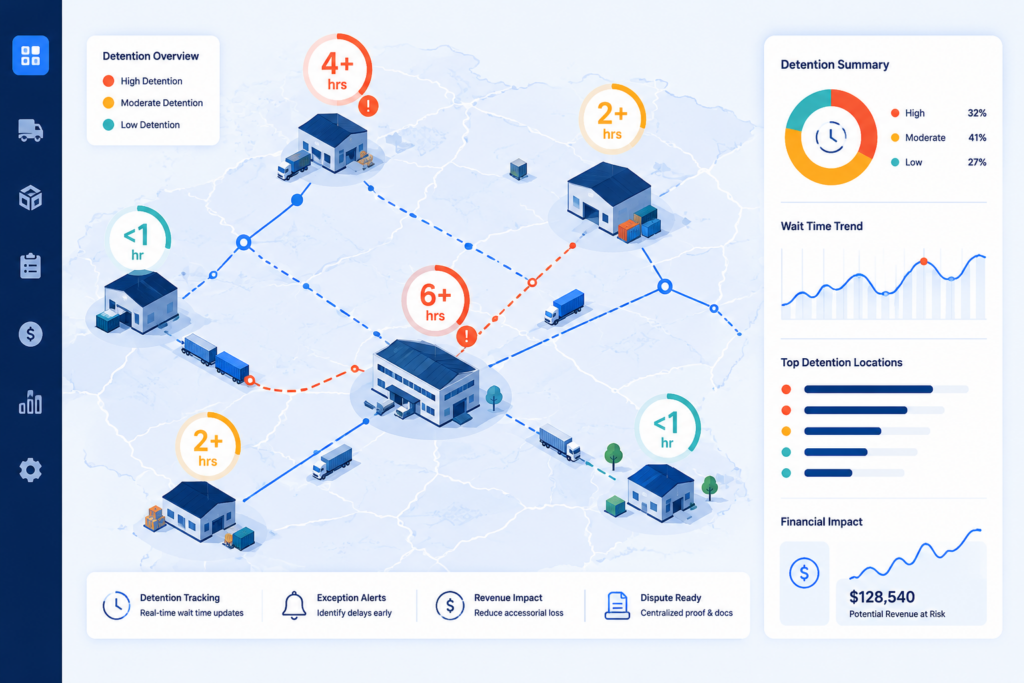
This is also where TMS reporting becomes more than a dashboard. Reporting should show detention billed, detention collected, detention denied, detention waived, average wait by facility, repeat offenders, margin impact by customer, and aging by accessorial type.
How enterprise teams reduce repeat detention
Getting paid matters, however prevention protects the network. If the same facility repeatedly creates three-hour unloads, the answer is not only better billing. The transportation team needs facility-level reporting, appointment performance data, carrier feedback, and customer conversations supported by evidence.
Over time, detention data can improve:
- Facility scorecards
- Customer pricing discussions
- Carrier negotiations
- Routing guide decisions
- Appointment discipline
- Lane-level margin analysis
Facility-level visibility turns detention from a claim into a pattern
A single detention charge is a billing event. Repeated detention at the same receiver is an operational pattern. For example, a shipper with chronic receiver delays may need different pricing, different appointment windows, or clearer service expectations. Likewise, a broker may decide that certain facilities require detention terms to be confirmed before tender acceptance.
Connected systems make this easier. When CRM + TMS integration connects customer records, load execution, accessorial history, and financial reporting, detention becomes part of account management. As a result, sales, operations, and finance can discuss the same facts instead of debating separate spreadsheets.
Frequently Asked Questions
These questions come up often when logistics teams try to move detention from informal follow-up into a controlled operating process.
What FTM changes in the detention workflow
FTM helps logistics teams manage detention time by keeping operational activity, customer rules, carrier communication, documents, billing workflows, and reporting closer to the load record. This matters because detention recovery usually breaks when the evidence moves faster than the process can organize it.
Inside an enterprise freight operation, detention should connect to the same system that manages dispatch, customer communication, carrier updates, accessorial review, and invoice preparation. Therefore, the load record becomes the operational source of truth, not just a shipment file.
One connected load record makes detention easier to defend
Instead of treating detention as a side note, teams can track wait events as part of execution, connect them to customer-specific accessorial rules, and carry validated charges into billing. Meanwhile, leadership can review patterns across customers, carriers, facilities, and lanes.
The same approach applies to related cost areas, including the cost of missed deliveries, failed appointments, accessorial leakage, and service exceptions. Each one improves when operations and finance work from the same transportation record.
Make Detention Time Easier to Prove Before It Becomes Revenue Leakage
See how FTM helps logistics teams connect detention tracking, load execution, customer rules, documents, billing, and reporting inside Salesforce.
Review Your Detention Workflow
Users expect iptv to provide reliable viewing during busy hours. This matters for long-term use.