A missed delivery cost is rarely limited to a late shipment.
On this page
For many logistics teams, the visible expense is only the beginning. A missed appointment can trigger detention fees, customer complaints, chargebacks, inventory disruptions, operational fire drills, and even lost business. Yet many organizations continue measuring delivery performance solely through on-time percentages without understanding the broader financial impact.
As customer expectations continue to rise and supply chains become increasingly interconnected, the ability to quantify delivery failures has become a competitive advantage. Companies that understand the true cost of missed deliveries can prioritize improvements, justify technology investments, and make better operational decisions.
Key Takeaways
- The missed delivery cost extends far beyond transportation expenses.
- Chargebacks, customer churn, and operational disruption often exceed direct freight costs.
- Small delivery failures can compound across multiple departments.
- Measuring delivery performance requires both financial and operational metrics.
- Exception management and visibility tools help prevent costly service failures before they occur.
Why Most Companies Underestimate the Missed Delivery Cost
When a shipment misses its delivery window, the immediate focus is usually on the transportation event itself.
Operations teams may review the route, contact the carrier, update the customer, and move on. However, the consequences often spread throughout the organization long after the truck arrives.
A late shipment can delay production schedules, create inventory shortages, trigger retailer penalties, and generate additional workload for customer service teams. In many cases, several departments absorb costs that never appear in transportation reports.
This creates a blind spot.
Leadership teams often see transportation expenses clearly because they appear on invoices. Hidden operational costs, meanwhile, remain scattered across departments and are rarely attributed to the original delivery failure.
What Most Companies Get Wrong About Delivery Performance
Many organizations assume missed deliveries are isolated incidents.
In reality, they are often indicators of broader operational weaknesses.
A missed appointment may reveal visibility gaps, poor communication processes, inadequate exception management, or inefficient planning workflows. Fixing the delivery itself addresses the symptom. Understanding why the issue occurred helps eliminate future costs.
This distinction becomes increasingly important as freight volume grows. A company managing 100 shipments per week can often absorb occasional disruptions. A company managing thousands of shipments per week cannot.
Read more: How Logistics Companies Lose Money Without Automation
The Five Major Costs of a Missed Delivery
1. Direct Financial Penalties
Some delivery failures create immediate and measurable costs.
Retailers may issue chargebacks for missed delivery windows. Manufacturing customers may apply service penalties. Carriers may incur additional detention or redelivery expenses.
These costs are easy to identify because they appear directly on invoices or financial reports.
However, they are often only the first layer of the problem.
2. Operational Disruption
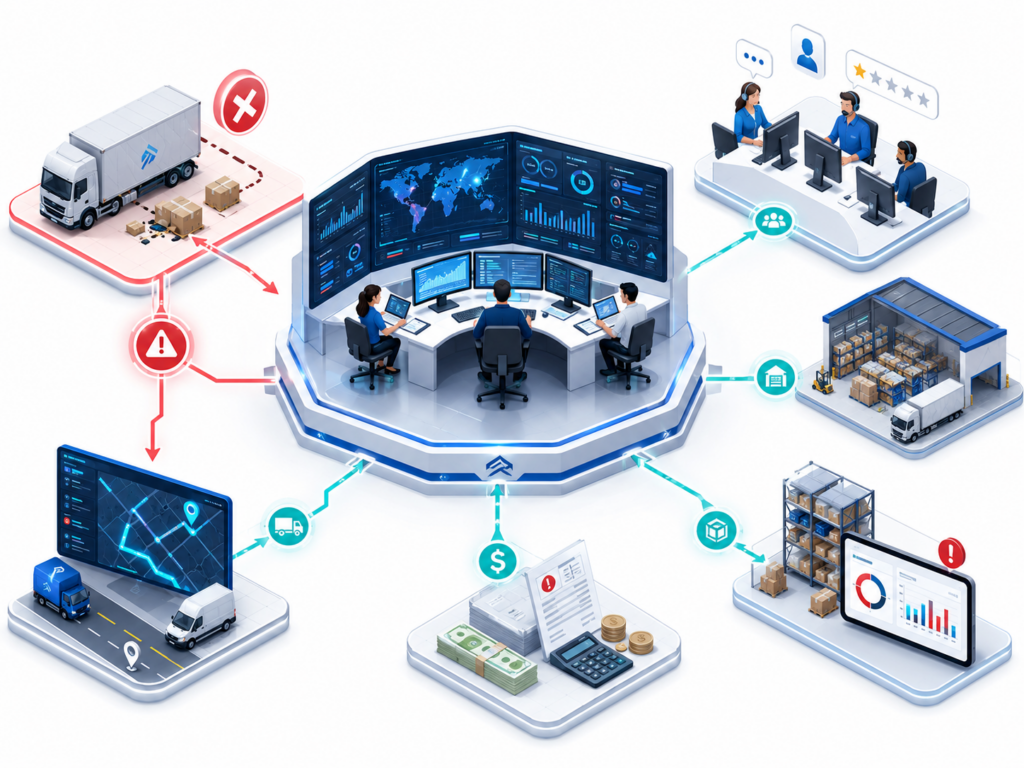
A missed delivery frequently creates a chain reaction.
Dispatchers begin making calls. Customer service teams respond to inquiries. Operations managers investigate the issue. Warehouse schedules may need adjustment.
What appears to be a single transportation event can consume hours of labor across multiple teams.
For organizations operating at scale, this administrative burden becomes surprisingly expensive.
3. Inventory and Production Impact
In manufacturing and distribution environments, timing matters.
A delayed inbound shipment can halt production, delay customer orders, or force emergency sourcing decisions. Even a short disruption can affect downstream operations that depend on predictable inventory flow.
The financial impact often exceeds the original transportation cost by a wide margin.
4. Customer Retention Risk
Not every customer complains after a missed delivery.
Some simply begin evaluating alternatives.
Service reliability plays a major role in long-term customer relationships. While one delay may not immediately damage an account, repeated failures gradually erode trust.
Over time, the cost of losing a customer can far outweigh any individual chargeback or penalty.
5. Reputation and Future Revenue
Service performance influences future business opportunities.
Customers increasingly evaluate transportation partners based on reliability, visibility, and responsiveness. Consistent delivery failures can weaken renewal discussions, reduce referral opportunities, and make future sales efforts more difficult.
These costs are difficult to quantify precisely, yet they are often among the most significant.
A Simple Framework for Calculating Missed Delivery Cost
Many logistics leaders want to improve service performance but struggle to quantify the business impact.
A practical approach is to evaluate missed deliveries using four categories:
| Cost Category | Examples |
|---|---|
| Direct Costs | Chargebacks, penalties, redelivery fees |
| Labor Costs | Dispatch calls, customer service time, shipment investigations |
| Operational Costs | Delays, rescheduling, inventory disruptions |
| Business Costs | Customer churn, reputation damage, lost opportunities |
Example Scenario
Consider a shipment delivering critical inventory to a retailer.
The shipment arrives one day late.
The retailer issues a $500 chargeback. Customer service spends two hours managing communications. Operations personnel spend additional time coordinating recovery efforts. The customer expresses dissatisfaction during a quarterly business review.
The visible cost may be $500.
The actual missed delivery cost could be several times higher.
This is why organizations that focus exclusively on transportation expenses often underestimate the financial impact of service failures.
Read more: The Real Reason Logistics Companies Struggle to Scale
How High-Performing Logistics Teams Prevent Delivery Failures
The most effective organizations do not wait until a shipment becomes late.
Instead, they focus on identifying risk before it becomes a customer issue.
Improve Shipment Visibility
Visibility is often the foundation of proactive operations.
When teams know where shipments are and how they are progressing, they can identify potential delays early and communicate before problems escalate.
Create Exception-Based Workflows
Not every shipment requires attention.
The highest-performing logistics teams focus their effort on exceptions rather than routine shipments. Automated alerts help teams prioritize disruptions that genuinely require intervention.
Strengthen Carrier Performance Management
Delivery performance should be measured consistently.
Tracking on-time performance, appointment compliance, and service reliability helps organizations identify patterns and address recurring issues before they become costly.
Use Predictive ETA Technology
Modern transportation technology can identify delays before delivery appointments are missed.
This allows teams to reroute resources, adjust schedules, notify customers, and reduce the operational impact of disruptions.
FTM Perspective: The Real Goal Isn’t Perfect Deliveries
Many organizations approach delivery performance with the goal of eliminating every disruption.
In practice, that is rarely realistic.
Traffic conditions change. Facilities become congested. Weather impacts routes. Unexpected delays will always occur somewhere in the network.
The organizations that consistently outperform competitors are not necessarily the ones with zero disruptions. They are the ones that identify problems faster, respond earlier, and prevent small issues from becoming expensive service failures.
This is where connected visibility, automated alerts, and exception management become increasingly valuable. Rather than relying on teams to manually track every shipment, platforms like FTM help operations teams focus attention where it matters most, improving response times and reducing the hidden costs associated with delivery failures.

Frequently Asked Questions
The Bottom Line
A missed delivery cost is rarely limited to a single late shipment.
The financial impact often spreads across transportation, customer service, inventory management, and future customer relationships. Organizations that understand these costs can make smarter investments in visibility, automation, and operational processes.
As freight networks become more complex, the ability to prevent and manage exceptions is becoming just as important as moving freight itself.
If you’re looking for ways to improve visibility, respond faster to disruptions, and reduce the hidden costs associated with missed deliveries, book a demo to see how FTM helps logistics teams stay ahead of service failures before they impact customers.
Ready to see FTM in action?
Book a live demo and we’ll walk you through the full document workflow: BOL, Rate Con, Invoice, and Lane Quote – directly inside the platform.
