Ask five freight operations people what software they use and at least two will say ‘our TMS’ when they mean something else entirely. FMS, TMS, freight platform, dispatch software, logistics system: these terms get used interchangeably in sales calls, job listings, and vendor decks, even when the products they describe work in completely different ways. The confusion is not trivial. Buying the wrong category of software for your operation is an expensive mistake, and it happens more often than vendors will admit.
On this page
The clearest way to separate freight management system vs TMS is to start with what each one actually manages. A freight management system, or FMS, is built around the freight itself: bookings, carrier relationships, documentation, and shipment-level tracking. A transportation management system is broader. It manages the entire transportation operation, including fleet, drivers, routes, load planning, and multi-modal execution. One controls how freight gets booked and tracked. The other controls how goods physically move.
That distinction sounds clean. In practice, the software market blurs it constantly, which is where buying decisions go wrong. This article gives you a clear framework for understanding the difference, what each system actually does day to day, and how to know which one your operation needs right now.
A freight management system (FMS) is software built around managing external freight bookings, carrier relationships, rate management, and shipping documentation. It is most commonly used by freight forwarders, brokers, and high-volume shippers who rely on third-party carriers. A transportation management system (TMS) is broader: it manages the full transportation lifecycle, including fleet management, route optimization, driver assignment, multi-modal load planning, and freight settlement. The two categories overlap significantly in carrier management and shipment tracking. Freight brokers and carriers in 2026 increasingly use purpose-built platforms that combine FMS and TMS functionality into a single workflow tool rather than choosing one category over the other.
Why the Terms Keep Getting Confused
Part of the problem is historical. The term TMS emerged first, in the 1990s, to describe enterprise software used by large shippers to manage complex transportation networks. Freight management systems developed as a separate category, used primarily by freight forwarders and brokers who needed to manage carrier relationships and documentation rather than their own fleet operations.
Over time, both categories evolved and started adding features from the other. Modern TMS platforms added carrier management and rate-shopping tools traditionally found in FMS products. Modern FMS platforms started adding dispatch workflows and tracking capabilities that looked like TMS features. Vendors saw opportunities to market to both audiences.
Consequently, today you can find platforms that call themselves a TMS while primarily serving freight forwarders with booking and documentation workflows, and platforms that call themselves an FMS while offering route optimization and fleet tracking. The label stopped being reliable. What actually matters is the underlying workflow the software was built around, not the name on the product page.
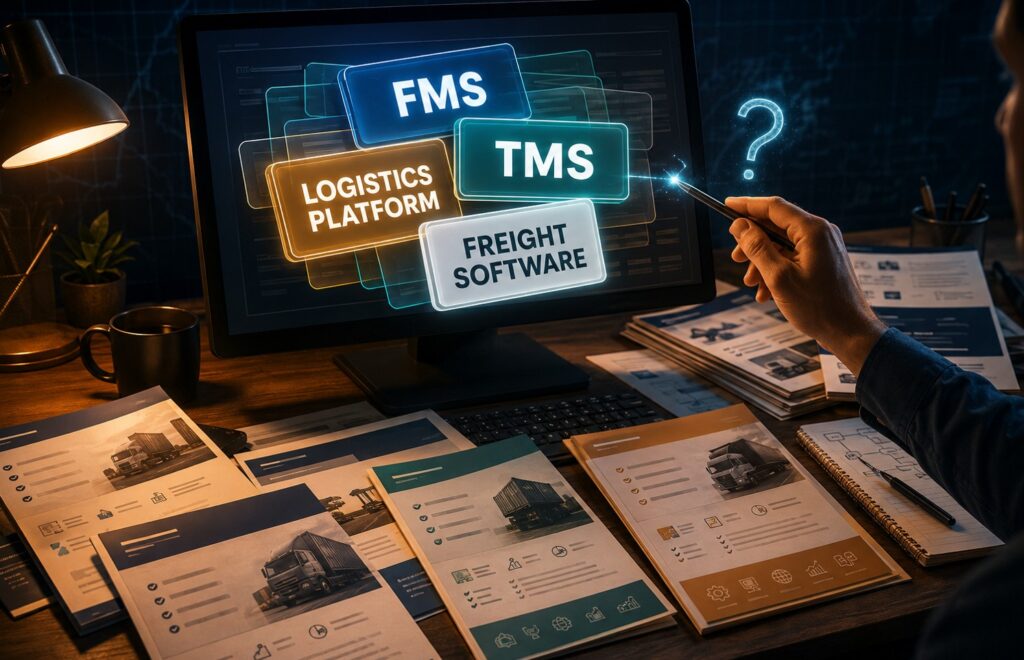
Freight Management System vs TMS: What Each One Actually Does
A Freight Management System is built around the transaction layer of freight. Its core purpose is to manage the relationship between a shipper or broker and the external carriers moving their freight. The key workflows inside an FMS include:
- Freight booking and carrier rate management across multiple carriers
- Rate comparison and carrier selection based on lane and shipment type
- Document management: bills of lading, rate confirmations, customs documents, invoices
- Shipment-level tracking and status reporting
- Freight audit and payment reconciliation
- Carrier performance reporting by lane and shipment type
A Transportation Management System is built around the movement layer. It assumes the user is managing not just the relationship with carriers but the actual planning and execution of how goods move through a network. A TMS core workflows include:
- Order management and load building from purchase orders or shipment requests
- Route optimization and mode selection across truckload, LTL, intermodal, and air
- Fleet and driver management including hours of service and vehicle assignment
- Carrier tendering, waterfall tendering, and automated load assignment
- Real-time shipment visibility with exception management and alert workflows
- Freight settlement, audit, and payment processing
- Lane-level analytics and cost-per-mile reporting
The overlap between these two lists is intentional. Both systems handle carrier management and shipment tracking. The difference is in what surrounds those features. Freight management system vs TMS comes down to whether your operation is primarily managing external freight bookings, or managing a transportation operation that includes fleet, routing, and load planning.
Side by Side: FMS vs TMS at a Glance
Use this comparison to quickly identify which category maps to your operation:
| Category | Freight Management System (FMS) | Transportation Management System (TMS) |
| Primary focus | Freight bookings, carrier relationships, documentation | Full transportation lifecycle from order to settlement |
| Best suited for | Freight forwarders, brokers, high-volume external shippers | Carriers, shippers with own fleets, 3PLs, multi-modal ops |
| Fleet management | Not typically included | Core feature: routes, drivers, vehicles, capacity |
| Carrier management | Central feature: rate cards, bookings, performance | Included but broader: also covers own assets |
| Route optimization | Limited or absent | Core feature with AI-driven lane planning |
| Document handling | BOLs, rate confirmations, invoices, customs | Execution documents plus settlement and audit |
| Typical user | Freight broker, freight forwarder, distributor | Broker, Shipper, carrier ops team, 3PL, transport manager |
| Implementation time | 4 to 8 weeks for mid-market | 14 days to 1 months depending on scale |
Who Actually Needs a Freight Management System
Freight forwarders are the clearest FMS use case. Their business is built entirely around managing carrier relationships across air, ocean, and ground freight, coordinating documentation, and tracking shipments across a complex web of providers. They do not own trucks. They do not route drivers. They manage freight transactions, and a lightweight FMS handles that specific workflow without unnecessary complexity.
Freight brokers and mid-size carriers, however, quickly outgrow what an FMS can offer. As load volume scales, as carrier networks expand, and as shipper expectations around visibility and reporting increase, the gaps in an FMS become expensive. Dispatch workflows, real-time exception management, automated load tendering, and lane-level performance analytics are not FMS features. They are TMS features, and the operations that need them most are the ones approaching or already operating at enterprise scale.
That is exactly where FTM sits. FTM is a TMS built for freight brokers and carriers who are past the point where a booking-and-documentation tool is enough. The platform covers dispatch, carrier management, real-time shipment visibility, automated workflows, and the operational data infrastructure that enterprise freight operations depend on to manage high load volumes without proportionally scaling headcount.
For growing operations with ambitions to move serious freight volume, an FMS is a starting point, not a destination. The transition from managing freight transactions to managing a freight operation at scale is the moment a purpose-built TMS stops being optional.
When a TMS Is the Right Answer and an FMS Leaves Gaps
If your operation runs its own trucks, the answer is a TMS. No FMS is designed to manage drivers, routes, vehicle capacity, or hours of service compliance. Trying to run a carrier operation on freight management software is the equivalent of using a booking tool to run a dispatch floor. It will appear to work until volume or complexity hits a threshold where the missing capabilities become painful.
Shippers managing large inbound and outbound freight programs also need a TMS, not an FMS. A shipper coordinating 200 weekly loads across six carriers, two modes, and multiple distribution centers needs route optimization, load planning, and strategic analytics that FMS platforms are not built to provide. According to Gartner’s Transportation Management Systems market analysis, the highest-value TMS capabilities in 2026 are AI-driven route optimization, real-time visibility with exception management, and freight settlement automation. These are features built for transportation operators, not just freight bookers.
3PLs and managed logistics providers are another clear TMS use case. Managing freight across dozens of customer accounts, multiple carriers, and varied service levels requires the kind of centralized visibility and workflow automation that a full TMS provides. Furthermore, 3PLs often need to give their shipper customers visibility into the system, which requires the kind of portal and reporting architecture a TMS is designed to support.

The Real Question Is Not FMS or TMS. It Is Workflow Fit.
The category label matters less than the answer to a simpler question: what does your team do every day, and does the software make it faster or slower?
A freight broker evaluating software should look for a platform built around load boards, carrier onboarding, rate confirmation workflows, and fast billing, regardless of whether the vendor calls it an FMS or a TMS. A carrier should look for dispatch, driver management, route planning, and real-time tracking, and ignore any platform that cannot demonstrate those workflows in a live demo.
Freight management system vs TMS is a useful distinction for understanding what a category of software was originally designed to do. But the freight software market in 2026 has produced specialized platforms that do not fit cleanly into either box. What FTM provides for freight brokers, shippers and carriers is purpose-built around the workflows that actually define daily freight operations: dispatch, load management, carrier communication, document automation, and real-time visibility. Not every platform that calls itself a TMS offers that. And not every platform that calls itself an FMS is limited to it.
Therefore, the evaluation question is not FMS or TMS. It is whether this specific platform was built for an operation like mine, by people who have actually seen how it works.
The Label Is Not the Product
The FMS vs TMS debate is less useful than it used to be. The software market has converged enough that the terms alone no longer reliably describe what a platform does or who it serves. What matters is the workflow architecture underneath the label.
If your operation manages freight through external carriers, your priorities are booking speed, document automation, and carrier performance visibility. If your operation moves freight with its own assets or manages complex multi-modal programs, your priorities are route optimization, fleet management, and load planning. Those needs point to different software architectures regardless of what the vendor names the product.
The clearest signal is always the demo. Ask to see the specific workflows your team runs every day. If the platform cannot show you dispatcher load assignment, carrier communication, and invoice generation in 20 minutes of a live walkthrough, the category name on the homepage does not matter.
See exactly what FTM does, live, in 20 minutes.
FTM is built for freight brokers, shippers and carriers who need dispatch, load management, carrier communication, and billing in one platform. Not a generic TMS. Not a stripped-down FMS. A system that matches how freight operations actually work.
A freight management system focuses on managing freight bookings, carrier relationships, and shipping documentation. A TMS manages the full transportation operation, including fleet, drivers, route optimization, and load planning. The main difference is scope: FMS handles freight as a transaction, while TMS handles transportation as an end-to-end operation.
Most freight brokers need a TMS that was designed specifically for broker workflows: load board integration, carrier onboarding, rate confirmation management, and fast billing. Some vendors call these TMS platforms, others call them FMS. The category label matters less than whether the software was built around broker-specific workflows.
A carrier operating its own trucks needs a TMS, not an FMS. Carrier operations require driver management, route planning, hours-of-service tracking, and dispatch workflows. FMS platforms were not designed for asset-based operations and will leave significant functional gaps in the areas that matter most for a carrier.
Identify your daily workflows first. If your team manages external carrier bookings, rate confirmations, and shipping documents, start with FMS or a broker-focused TMS. If your team manages drivers, routes, and fleet operations, you need a full TMS. Request a live demo that shows your specific workflows, and ignore the category label if the platform demonstrates the features you actually need.
Not always. The terms are often used interchangeably, but they describe different software categories. TMS platforms are designed for transportation operators managing fleets and complex routing. Freight management software typically focuses on booking, documentation, and carrier coordination. Some modern platforms blend both categories, particularly those designed for freight brokers and 3PLs.
