Search for freight broker vs. 3PL software, and the distinction quickly becomes blurry.
Many platforms market themselves to both groups. A freight brokerage may call itself a 3PL. Meanwhile, one 3PL might focus almost entirely on managed transportation, while another operates warehouses, fulfillment centers, inventory, and distribution networks.
The software categories overlap because the businesses themselves overlap.
There is still an important distinction.
Freight broker software is primarily designed around arranging and executing transportation. 3PL software may include brokerage workflows, but it can support a much broader outsourced logistics operation.
That difference affects the records the system needs, the workflows users perform, the integrations that matter, and the way profitability should be measured.
For buyers, therefore, the right question is not whether a vendor calls its product “broker software” or “3PL software.”
The better question is: Does the platform match the logistics services your company actually sells and operates?
Freight Broker and 3PL Are Not Interchangeable Terms
A freight broker has a specific role in US transportation regulation.
Under federal law, a broker is generally a person or business that, for compensation, arranges transportation by motor carrier rather than performing the transportation as the motor carrier itself. The current definition appears in 49 U.S.C. §13102 and federal broker regulations.
A 3PL, by contrast, describes a broader logistics service model. ASCM identifies third-party logistics services as potentially covering transportation as well as warehousing, inventory management, picking and packing, cross-docking, distribution, shipping and receiving, and returns.
Consequently, a freight broker can operate as part of a 3PL business, but not every 3PL is simply a freight brokerage.
That difference carries directly into software requirements.
Why Freight Broker vs. 3PL Software Gets Confusing
Software vendors rarely use these labels consistently.
One “3PL platform” may really be a brokerage TMS with customer portals and accounting. Another may be primarily a warehouse management system. A third could combine transportation, inventory, fulfillment, and order orchestration.
Similarly, two freight brokers may need very different systems. A 15-person brokerage focused on truckload spot freight has different requirements from a multi-branch enterprise managing LTL, contract freight, customer-specific pricing, carrier compliance, and complex financial reporting.
The label does not define the architecture
Instead of starting with category names, map the operating model.
Ask:
- Do you arrange freight with third-party carriers?
- Do you operate your own assets?
- Do you manage customer inventory?
- Do you provide warehousing or fulfillment?
- Do you manage transportation on behalf of shippers?
- Do multiple branches or entities share customers and carriers?
- Does your team need CRM and transportation data together?
- Where does financial responsibility begin and end?
The answers reveal far more than whether the company describes itself as a broker or 3PL.
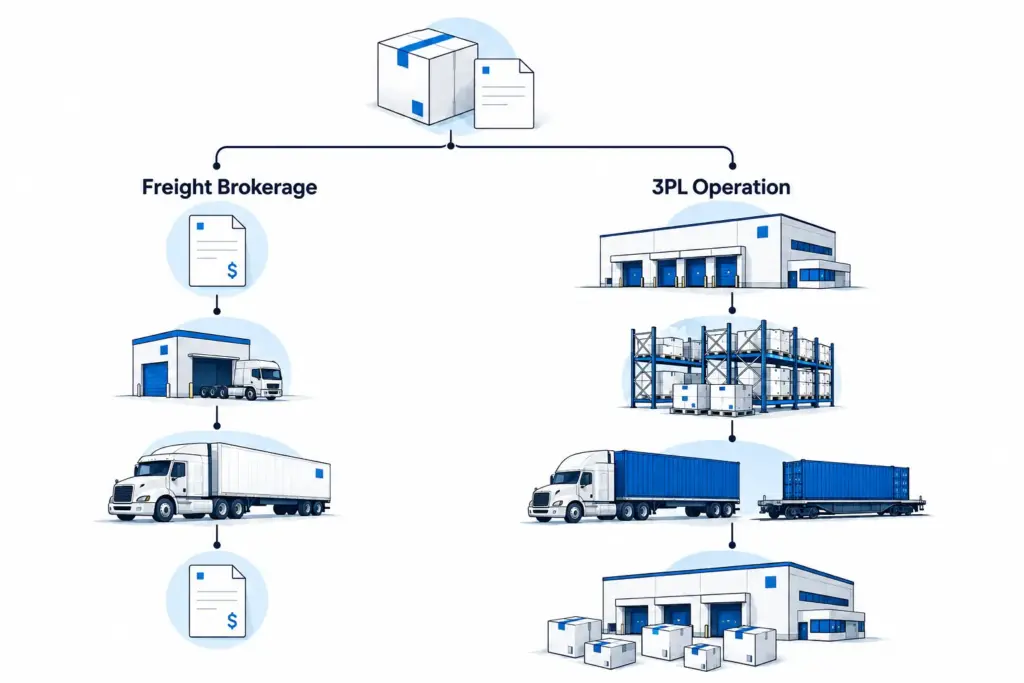
What Freight Broker Software Is Built to Manage
Freight brokerage is fundamentally a two-sided operating model.
The broker has to manage the shipper relationship on one side and carrier capacity on the other. Profit depends on controlling the spread between customer revenue and carrier cost while maintaining service.
As a result, good freight broker software should connect commercial, operational, and financial decisions rather than treating dispatch as an isolated load board.
FTM’s broker workflows, for example, connect quoting, carrier coverage, compliance, dispatch, tracking, documents, billing, and margin visibility on Salesforce.
Quoting and margin control
Broker software should preserve both sides of the transaction:
Sell side: What will the customer pay?
Buy side: What will capacity cost?
The system should then maintain expected and actual margin as carrier rates, accessorials, detention, and other costs change.
Therefore, margin should remain visible while the load is active, not appear for the first time in a month-end spreadsheet.
Carrier sourcing and compliance
A broker does not simply need a list of carriers.
The software should support carrier records, authority and insurance workflows, documents, performance history, preferred capacity, rate behavior, and approval status.
For example, FTM Carrier Onboarding connects carrier applications, documents, compliance checks, approvals, and the resulting carrier record. Approved carriers can then move into a governed sourcing workflow rather than being rediscovered by individual dispatchers.
Coverage and dispatch
After the quote is accepted, the broker still has to cover and execute the load.
That requires carrier communication, status milestones, ETA management, exceptions, PODs, customer updates, and rate changes.
A broker-specific TMS should keep those activities connected to the load and customer record instead of spreading them across email, spreadsheets, load boards, and tracking portals.
What 3PL Software May Need Beyond Brokerage
A 3PL that only provides managed transportation may need almost the same technology as a sophisticated broker.
However, the requirements change when the 3PL takes responsibility for additional logistics functions.
Warehousing and inventory
A warehouse-focused 3PL may need:
- Inventory by customer and facility
- Receiving and putaway
- Bin or location management
- Pick, pack, and ship workflows
- Lot or serial tracking
- Cycle counting
- Cross-docking
- Returns
- Labor and warehouse productivity
Those are WMS-centered requirements rather than traditional brokerage workflows.
Consequently, buying a very strong freight brokerage TMS does not automatically solve a warehouse operation.
Fulfillment and order orchestration
E-commerce and retail 3PLs may also need order allocation, parcel shipping, inventory availability, cartonization, returns, and customer-specific fulfillment rules.
In that case, transportation is one part of a larger fulfillment platform.
Multi-client logistics management
Many 3PLs manage operations for several customers with different rate structures, carrier rules, locations, reporting requirements, and service-level agreements.
Therefore, the software must separate customer-specific operations while still allowing leadership to see the business as a whole.
This is where architecture becomes more important than the words printed on the product page.
Freight Broker Software vs. 3PL Software
| Capability | Freight Broker Software | Broader 3PL Software |
|---|---|---|
| Primary operating focus | Arranging and executing transportation | Managing outsourced logistics services |
| Quoting and rating | Core capability | Important when transportation is offered |
| Carrier sourcing | Core capability | Required for transportation-focused 3PLs |
| Carrier compliance | Usually critical | Important when third-party carriers are managed |
| Dispatch and tracking | Core capability | Core for transportation services |
| Margin management | Customer rate vs. carrier cost by load, lane, customer, or branch | May include transportation plus warehouse, fulfillment, and service profitability |
| Warehouse management | Usually outside the brokerage TMS | May be a core requirement |
| Inventory | Usually not required | Often required for warehousing or fulfillment operations |
| Fulfillment | Usually outside scope | May include pick, pack, ship, and returns |
| Best fit | Brokerages and transportation-focused logistics operations | Companies managing multiple outsourced logistics functions |
The largest overlap is transportation.
Both may require quoting, carrier management, load execution, tracking, documents, customer visibility, billing, and analytics.
The separation becomes clearer when inventory, warehouse execution, fulfillment, or other physical logistics services enter the operating model.
The Bigger Difference Is Often TMS vs. Logistics Stack
A useful software evaluation should go one level deeper.
A broker may reasonably run most of its operation through one TMS because the load is the central operational record.
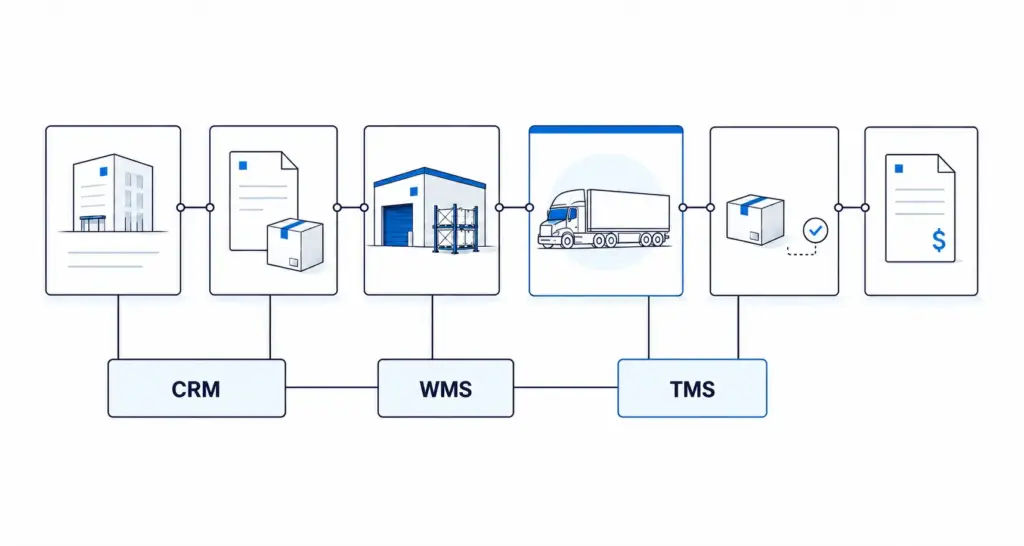
A diversified 3PL may instead require a connected stack:
CRM → OMS/ERP → WMS → TMS → Accounting → Customer Visibility
The risk appears when each application develops its own version of the customer, shipment, carrier, rate, and invoice.
As a result, a company can own excellent individual systems and still create poor operational visibility.
Watch the handoffs
Suppose a customer order changes after transportation has already been planned.
Which system owns the change?
Does the TMS update automatically, does the warehouse receive the change, and does the customer portal reflect the new information?
Will billing use the corrected information?
These are more valuable questions than asking whether a product has “ERP integration.”
When Freight Broker Software Is the Better Fit
Choose software centered on brokerage when most revenue depends on arranging transportation with third-party carriers.
Typical signs include:
- Quoting is a major daily workflow.
- Carrier sourcing directly affects margin.
- Teams use DAT, Truckstop, or private carrier networks.
- Carrier compliance must be checked before tender.
- Dispatchers manage active loads and exceptions.
- Customer and carrier rates need to remain connected.
- POD collection triggers billing.
- Leaders manage margin by customer, lane, branch, or representative.
In this model, unnecessary warehouse functionality can add complexity without solving an actual business problem.
Instead, prioritize excellent quote-to-cash execution.
The FTM Private Loadboard, for example, connects approved carrier relationships to load opportunities and subsequent execution, while the Dispatch Console keeps active loads, carrier updates, documents, exceptions, and financial signals connected.
When Broader 3PL Software Is the Better Fit
Broader 3PL software becomes necessary when transportation is only one of several physical logistics services.
Consider a wider platform when your operation owns workflows such as:
- Warehouse inventory
- Receiving
- Fulfillment
- Pick and pack
- Returns processing
- Cross-docking
- Yard management
- Distribution
- Multiple fulfillment facilities
However, even then, one giant application is not automatically the best architecture.
A strong TMS integrated with the appropriate WMS, ERP, or fulfillment platform may outperform a broad suite whose transportation functionality is shallow.
Therefore, evaluate workflow depth and data continuity, not just suite breadth.
What About 3PLs That Mostly Manage Transportation?
This is where the distinction becomes especially important.
A transportation-focused 3PL may provide strategic sourcing, carrier procurement, shipment execution, freight audit, reporting, or managed transportation without operating a warehouse.
Its technology needs may look much closer to an enterprise brokerage than to a fulfillment 3PL.
For that operation, useful capabilities include:
- Customer account management
- Contract and spot pricing
- Carrier network management
- Multi-mode transportation
- Customer-specific workflows
- Exception management
- Shipment visibility
- Freight audit and billing
- Financial reporting
- Integrations
- Customer portals
In other words, “3PL” does not automatically mean you need warehouse software.
The service model determines the software.
CRM Is Another Important Difference Buyers Miss
Brokerage and 3PL relationships are customer relationships as much as transportation transactions.
Sales may negotiate an opportunity. Operations executes the freight. Customer service handles exceptions. Finance sees margin and receivables. Leadership wants profitability at the account level.
When CRM and TMS live separately, that customer history fragments.
FTM takes a different approach because the transportation platform runs natively on Salesforce. Customer accounts, quotes, carriers, loads, documents, invoices, workflows, and reporting can therefore operate on the same Salesforce data model.
For brokerages and transportation-focused 3PLs, that architecture can matter more than whether the software vendor uses “broker TMS” or “3PL platform” in its marketing.
Financial Workflows Should Influence the Decision
Broker and 3PL economics can also differ.
A brokerage typically needs immediate visibility into:
Customer rate − carrier cost − additional costs = load margin
A broader 3PL may need profitability across transportation, warehouse labor, storage, handling, fulfillment, and value-added services.
Therefore, determine what your financial unit of analysis actually is.
Is it:
- A load?
- A shipment?
- An order?
- A customer?
- A warehouse?
- A pallet?
- A branch?
- A contract?
- A combination of several?
For transportation-centric operations, FTM Billing and Reporting connects customer rates, carrier settlements, accessorials, invoices, accounting integrations, and margin to the load record.
If profitability requires warehouse labor and inventory costing as well, those systems must also feed the financial model.
How to Choose Between Freight Broker and 3PL Software
Do not start the evaluation with a list of 200 features.
Start with five operational questions.
1. What services generate revenue?
Separate brokerage, managed transportation, fleet, warehousing, fulfillment, and consulting revenue.
2. What record runs the operation?
For a broker, that is usually the quote and load.
For a fulfillment 3PL, the order and inventory records may be equally important.
3. Where are the difficult handoffs?
Identify where employees currently re-enter data, wait for another department, reconcile spreadsheets, or search for information.
4. Which systems must remain?
A good technology decision does not require replacing a capable ERP or WMS simply because the TMS vendor has a checkbox for that function.
Instead, determine which system should own each process and how the data should move.
FTM supports transportation integrations across load boards, accounting, compliance, tracking, ERP, telematics, and related freight workflows.
5. Will the architecture still work at twice the volume?
Finally, test scale.
More customers, carriers, branches, warehouses, users, and transactions should not create proportional administrative work.
That is the point where software architecture becomes an operating constraint rather than an IT detail.
Common Buying Mistakes
Buying the category instead of the workflow
“Built for 3PLs” is not a requirement.
Document what users actually need to do from quote or order through financial close.
Choosing breadth over depth
A platform with 40 modules is not automatically better than a system that executes your critical transportation workflows exceptionally well.
Ignoring customer and carrier data
Transportation systems often focus heavily on loads.
However, brokerage value also lives in customer relationships, carrier history, pricing behavior, service performance, and network knowledge.
Treating integrations as a future problem
Integration design should be part of software selection.
Otherwise, teams may replace one operational silo with a newer one.
The Real Difference: Your Operating Model
The real difference between freight broker and 3PL software is not a strict product boundary.
Broker software tends to go deepest on quote → carrier → load → delivery → invoice → margin.
Broader 3PL software may need to extend that model into inventory → warehouse → fulfillment → distribution → returns.
There is substantial overlap between the two.
Therefore, transportation-focused 3PLs should not automatically buy broader software simply because their company uses the term 3PL. Likewise, a diversified logistics provider should not assume a brokerage TMS can replace warehouse and fulfillment systems it was never designed to manage.
FTM supports freight brokers and transportation-focused 3PL operations through a Salesforce-native transportation platform connecting customer management, quoting, carrier workflows, dispatch, documents, billing, integrations, and reporting.
The software category is secondary.
The system should fit the business you operate today and the logistics services you intend to operate next.
Frequently Asked Questions
Choose the TMS Around Your Operating Model
Show us how your brokerage or 3PL actually runs. FTM can map your customer, carrier, quoting, dispatch, billing, reporting, and integration workflows on Salesforce.
Review Your Operation