Many logistics companies invest significant time and resources into Salesforce because it provides a reliable foundation for managing customers, opportunities, service requests, and business relationships. However, selecting the right Salesforce logistics apps is often what determines whether teams can connect customer-facing activities with day-to-day transportation operations.
On this page
As freight volumes grow and customer expectations increase, operations teams need visibility into shipments, dispatchers need execution tools, and customer service representatives need fast access to accurate information. Meanwhile, leadership teams need reliable operational data to make informed decisions.
Salesforce is already a proven platform for managing customer relationships and commercial activity. What logistics leaders are evaluating now is how to extend Salesforce without creating additional complexity or disconnected workflows.
Meanwhile, the organizations seeing the strongest results are rarely relying on a single platform. Instead, they are building connected technology ecosystems where customer information, operational workflows, and shipment data move together. This approach improves collaboration, reduces manual work, and creates a better experience for employees, customers, and partners alike.
Why Salesforce Logistics Apps Matter More Than Ever
Over the past decade, Salesforce has become much more than a CRM. For many organizations, it serves as the central source of truth for customer relationships and commercial activity. Sales teams use it to manage pipelines, while customer service teams rely on it to resolve issues. Leadership teams, meanwhile, depend on Salesforce for forecasting and performance reporting.
As businesses grow, however, operational complexity grows alongside them.
A logistics company may have thousands of shipments moving simultaneously, multiple carrier relationships, customer-specific requirements, and dozens of internal workflows that need coordination. While Salesforce manages customer-facing processes exceptionally well, transportation execution introduces a different set of requirements.
Shipment tracking, dispatch management, operational alerts, freight visibility, and exception handling require specialized capabilities.
Consequently, this challenge is one reason platforms like FTM have become increasingly common within Salesforce environments. Rather than attempting to force transportation execution into a CRM, companies are connecting specialized logistics platforms with customer-facing systems and allowing each platform to focus on what it does best.
The Real Challenge Isn’t Software. It’s Information Flow
When logistics leaders discuss technology, conversations often revolve around software features. How many tools does it actually integrate with?
Those questions matter. However, they often miss the bigger issue.
Most operational bottlenecks occur because information is fragmented.
Customer updates may live in one platform, while shipment data sits somewhere else. Carrier communication often happens through email, and internal coordination may take place across multiple channels.
Nevertheless, many companies purchase additional software in an attempt to solve this problem. Unfortunately, adding more tools without improving information flow can make complexity worse.
The most effective logistics technology strategies focus on connecting information rather than simply expanding the software stack. When customer data, shipment updates, and operational workflows remain synchronized, teams make faster decisions and provide better service.
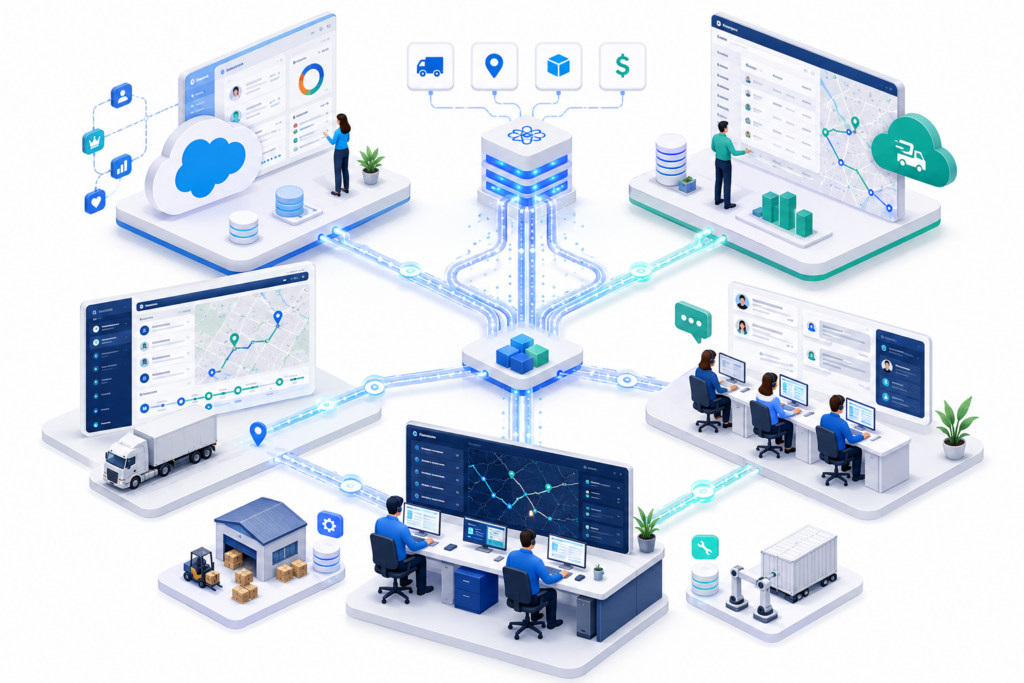
That is ultimately why the right Salesforce logistics apps create so much value. They help eliminate information gaps that slow operations down.
What Makes a Strong Salesforce Logistics App?
Not every AppExchange solution deserves a place in a logistics technology stack.
The best applications typically improve one of three areas.
Customer Visibility
Modern customers expect transparency throughout the shipping process. They want accurate updates, quick responses, and confidence that shipments are progressing as expected.
Applications that improve visibility help customer-facing teams provide better information without requiring constant communication with operations personnel.
Operational Efficiency
Some tools primarily save time, while others remove friction from everyday workflows.
The strongest operational applications automate repetitive tasks, reduce manual data entry, and simplify workflows that previously required multiple systems or spreadsheets.
Data Governance and Accuracy
Poor data quality creates expensive operational problems. Duplicate records, inconsistent reporting, and unreliable information can quickly undermine decision-making. Strong Salesforce logistics apps improve data quality and ensure teams work from accurate information.
Therefore, organizations that evaluate apps through these three lenses typically make better technology decisions than those focused solely on feature comparisons.
7 Salesforce Logistics Apps That Pair Well with FTM
Apps That Improve Customer Workflows
Salesforce Maps
For logistics companies managing large territories, geographic visibility matters.
Salesforce Maps helps teams visualize customer locations, identify service opportunities, and improve planning. Combined with transportation data from FTM, it creates a more complete view of customer activity and operational coverage.
DocuSign
Contracts, onboarding documents, customer agreements, and approvals remain a major part of logistics operations.
DocuSign simplifies document execution while reducing delays and administrative workload. Faster approvals often translate directly into faster business processes.
Slack
Communication remains one of the biggest challenges in transportation.
Slack helps connect sales, customer service, and operations teams in real time. When operational data from FTM supports those conversations, teams can resolve issues faster and provide customers with more accurate information.
Apps That Improve Operational Efficiency
Conga Composer
Many logistics organizations still generate reports, customer updates, and operational documents manually.
Conga Composer automates document creation using Salesforce data, helping teams save time while maintaining consistency across customer-facing communications.
Revenue Grid
Although primarily known for sales forecasting, Revenue Grid can help logistics companies improve account visibility and better understand revenue opportunities across customer portfolios.
For organizations focused on growth, stronger forecasting often leads to more effective resource planning.
Apps That Improve Data Governance
Own
As logistics companies become increasingly dependent on digital systems, protecting operational and customer data becomes essential.
Own helps organizations safeguard critical Salesforce information through backup and recovery capabilities. While it rarely receives the same attention as operational software, strong data protection reduces business risk.
Gearset
System changes are inevitable.
New workflows, integrations, and automations require careful management. Gearset helps organizations deploy updates more reliably while reducing configuration errors that can disrupt operations.
Building a Connected Logistics Technology Stack
One of the most common mistakes companies make is assuming software consolidation automatically creates efficiency.
In practice, forcing one platform to perform every function often creates more limitations than benefits.
A CRM excels at managing relationships, while a transportation management platform focuses on freight execution. Visibility tools specialize in tracking shipments, and communication platforms facilitate collaboration across teams.
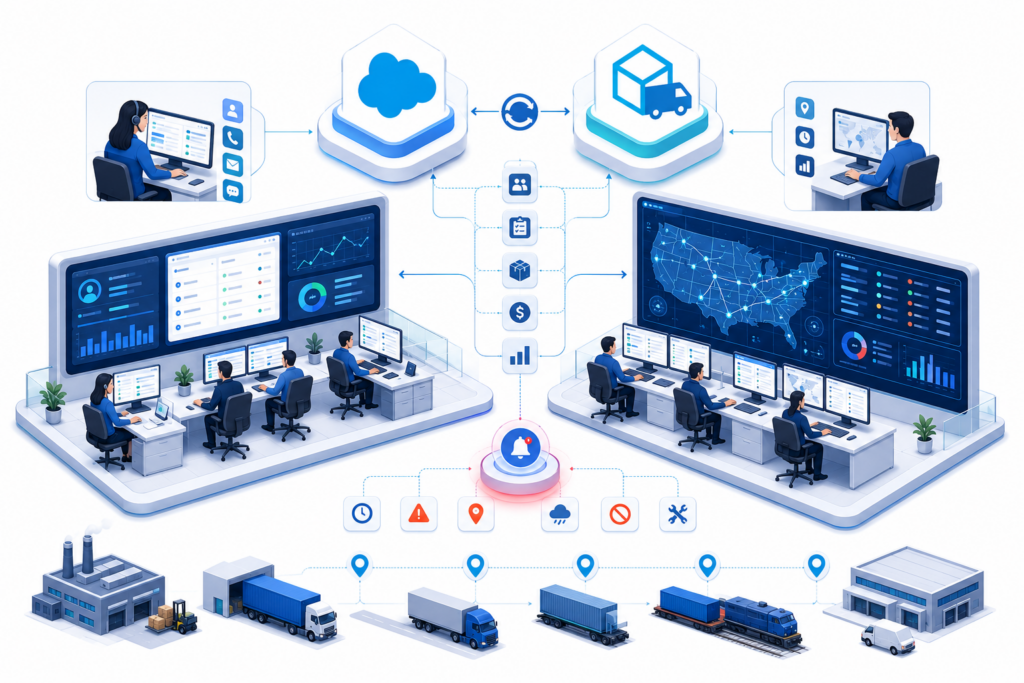
Rather than eliminating systems, companies should focus on creating a connected environment where information flows naturally between platforms. As a result, teams spend less time searching for updates and more time acting on them.
Moreover, this distinction becomes increasingly important as logistics companies scale.
For example, a growing organization may add customers, carriers, employees, freight modes, and geographic coverage within a relatively short period of time. As complexity increases, disconnected systems become harder to manage. Teams spend more time chasing updates, reconciling information, and correcting avoidable mistakes.
In contrast, organizations that build connected technology ecosystems create operational leverage. Information becomes easier to access, decision-making accelerates, customer service improves, and employees spend less time managing administrative work while focusing on higher-value activities.
That is where modern logistics technology strategies are heading.
Ultimately, success is rarely determined by how many systems a company uses. Instead, it depends on how effectively those systems work together.
Where FTM Fits Into the Salesforce Ecosystem
FTM helps bridge the gap between customer-facing systems and transportation execution.
While Salesforce manages customer relationships and commercial activity, FTM supports the operational side of freight movement through dispatching, shipment visibility, workflow automation, exception management, and real-time transportation coordination.
Together, they allow logistics companies to maintain a connected experience without forcing operations teams into CRM workflows or requiring customer-facing teams to work inside transportation software. Consequently, information moves more freely between departments while teams continue using the tools built for their specific responsibilities.
Most logistics companies are not trying to build the largest technology stack possible. Instead, they want an environment where customer information, freight operations, and internal teams stay connected without introducing unnecessary complexity.
For organizations already using Salesforce, finding the right operational layer often becomes the key decision.
That is exactly the challenge FTM was designed to solve.
Ready to see FTM in action?
Book a live demo and we’ll walk you through the full document workflow: BOL, Rate Con, Invoice, and Lane Quote – directly inside the platform.
