Freight brokers can arrange thousands of loads without ever touching the cargo. When a shipment goes missing or arrives damaged, however, the broker may still face a serious financial dispute.
On this page
Cargo insurance helps manage that exposure, but federal requirements are narrower than many brokers assume.
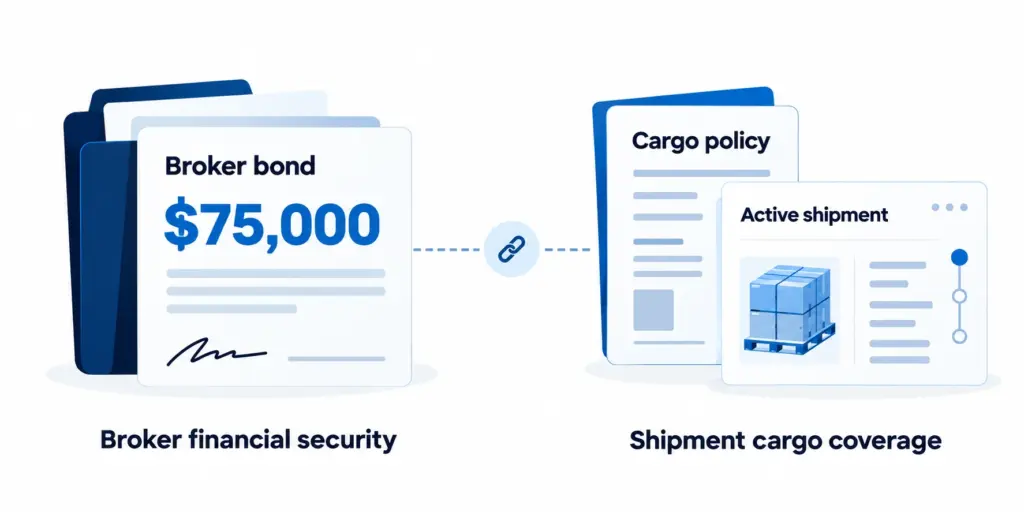
FMCSA does not require property brokers to carry cargo insurance. It requires a $75,000 surety bond or trust fund. Neither substitutes for checking the carrier’s actual cargo coverage.
Before tendering a load, brokers need to know whose policy covers the goods, what it excludes, and whether the available limits match the shipment’s value.
Is cargo insurance required for freight brokers?
Under FMCSA’s insurance filing requirements, property brokers have no federal cargo insurance minimum.
However, they must maintain $75,000 in financial security through one of two filings:
- BMC-84: Surety bond.
- BMC-85: Trust fund agreement.
The bond or trust supports the broker’s financial obligations under its transportation arrangements. It is not a cargo policy that automatically pays for freight damaged, stolen, or lost in transit.
Brokers also need the appropriate operating authority and a BOC-3 process-agent designation.
Since January 16, 2026, updated FMCSA rules have strengthened broker financial-responsibility requirements. If available bond or trust security drops below $75,000 and the provider does not restore it within seven calendar days, FMCSA can suspend operating authority.
What about the carrier’s insurance?
Most general-freight motor carriers also have no federal cargo insurance minimum. Household-goods carriers are subject to separate requirements.
That means the familiar $100,000 cargo limit often appears because of contracts and industry purchasing practices, not because federal law universally requires it.
Consequently, each brokerage must establish its own carrier coverage standards based on the freight it handles.
Which insurance policies should brokers understand?
Four types of financial protection regularly appear in freight brokerage arrangements.
| Coverage | Main Purpose | What Brokers Should Know |
|---|---|---|
| $75,000 bond or trust | Required broker financial responsibility | Not cargo insurance |
| Carrier cargo insurance | Insures covered carrier cargo liability | Review limits, exclusions, and validity |
| Contingent cargo insurance | Potential backup when carrier coverage fails | Subject to policy-specific triggers and exclusions |
| Shipper’s interest insurance | Protects qualifying goods against covered losses | Consider for high-value shipments; terms vary |
Contingent cargo deserves special attention. Some policies require an unsuccessful claim against the carrier first. Others contain restrictive legal-liability wording or exclude particular losses.
Therefore, a broker should never assume that contingent cargo pays whenever the trucking company’s insurer denies a claim.
As DAT’s freight broker insurance guidance explains, policy wording matters as much as the coverage name.
Professional errors and omissions (E&O) and broker auto-liability coverage address different exposures. A brokerage should review them separately with a transportation insurance specialist.
Five checks before assigning a carrier
Insurance problems are easier to resolve before pickup, when the broker still has control over carrier selection.
1. Verify the actual insurance policy
Request the certificate of insurance (COI) from the issuing agent or verify it directly with the insurer.
Check the carrier’s legal name, policy dates, coverage type, and limits. Then confirm operating authority through FMCSA.
A certificate alone does not establish that every type of freight is covered.
A structured carrier onboarding process helps keep these documents and approval decisions with the carrier record.
2. Compare coverage against the load value
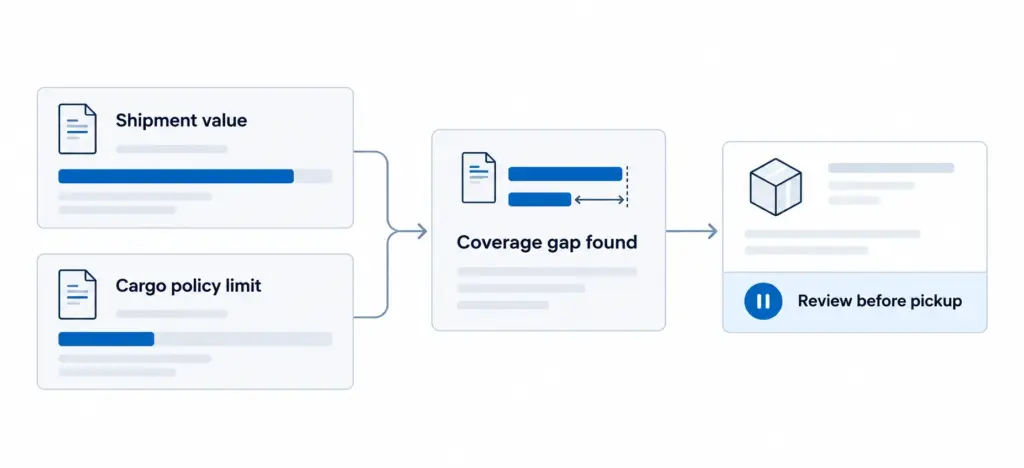
Suppose a carrier has a $100,000 cargo limit and the broker tenders a shipment worth $180,000.
The shipment exceeds the stated policy limit by $80,000 before considering deductibles, exclusions, or other limitations.
For high-value freight, brokers should confirm whether additional shipment-specific coverage is necessary before dispatch.
3. Read exclusions that apply to the freight
Cargo coverage may contain restrictions involving:
- Theft from unattended vehicles.
- Refrigeration failures or temperature deviations.
- Electronics or other high-value commodities.
- Unauthorized subcontracting or other changes in the transporting party.
These are examples, not universal exclusions. Ask the insurance agent to confirm applicable terms in writing when the shipment presents unusual risk.
4. Check carrier identity and authority
An otherwise valid insurance document provides little reassurance if the company collecting the freight is not the approved carrier.
Verify the pickup party against the carrier agreement and dispatch instructions. When concerns arise, investigate changes in company contact information, authority status, or driver assignment before releasing freight.
FTM’s Highway integration supports carrier identity and compliance verification within the sourcing workflow.
5. Review what your contracts promise
A shipper agreement may impose responsibilities that exceed the carrier’s available insurance.
For example, accepting contractual responsibility for a shipment’s full value could create financial exposure that the broker’s own policy does not cover.
Have legal counsel and your insurance agent review those obligations together, especially for high-value or specialized freight.
What should happen after cargo loss or damage?
When a claim arises, speed matters, but complete documentation matters more.
Start by preserving the BOL, rate confirmation, shipment tracking, relevant communications, and insurance information. Obtain delivery photographs and the signed proof of delivery, including any shortage or damage notes.
Notify the carrier and relevant insurers promptly. Follow the contractual and policy notice requirements, and document reasonable steps to prevent additional damage.
For claims governed by federal motor-carrier claim procedures, 49 CFR § 370.3 requires a qualifying claim to identify the shipment, assert liability, and request a specified or determinable amount.
A damage notation on the delivery receipt, by itself, is not a complete freight claim.
Keep the claim amount, supporting invoices, correspondence, deadlines, and final resolution together. Otherwise, a legitimate loss can become harder to recover because the evidence sits across multiple inboxes.
Make insurance verification part of dispatch
A carrier may pass onboarding in January and have a policy expire months later.
For that reason, insurance review should continue beyond initial approval. The brokerage needs a way to identify outdated documents and prevent unqualified carrier assignments.
FTM’s MyCarrierPortal integration can bring submitted insurance details, coverage limits, and expiration dates into carrier records. The broader FTM broker platform connects carrier compliance, dispatch, shipment documents, and exception history.
However, software cannot determine every cargo policy exclusion from a COI. Someone still needs to review the underlying terms when shipment risk requires it.
For most brokers, the operating standard is straightforward: maintain the required bond, verify carrier insurance before assigning freight, check coverage against the actual shipment, and preserve the records needed to support a claim.
Those controls provide more protection than a certificate sitting in an onboarding folder.
Frequently Asked Questions
No. FMCSA does not require property brokers to maintain cargo insurance. However, brokers must maintain $75,000 in financial security through a BMC-84 surety bond or BMC-85 trust fund. Shipper contracts may impose additional insurance requirements.
A freight broker bond is financial security for certain broker obligations, not a cargo insurance policy. Brokers should not rely on the bond as their protection against shipment loss or damage.
There is no universal FMCSA $100,000 cargo insurance requirement for general-freight motor carriers. That limit commonly appears in commercial agreements. Household-goods carriers have different federal requirements, and individual shippers may require higher coverage limits.
Contingent cargo insurance may protect a freight broker when a carrier’s insurance does not respond to a covered loss. However, coverage depends on the broker’s policy, including its conditions, exclusions, and claims requirements. A denied carrier claim does not automatically trigger payment.
Before tendering the load, confirm the cargo’s declared value and the carrier’s applicable coverage. If the limit is insufficient, consider additional shipment-specific insurance or another qualified carrier. Obtain written confirmation of coverage and relevant exclusions from the insurer.
Catch Carrier Compliance Gaps Before Dispatch
FTM helps freight brokers manage carrier insurance documents, verification status, approval workflows, and shipment records in Salesforce.
Explore FTM Carrier Onboarding