A mid-size carrier can have reliable dispatch software and still struggle to reconcile driver pay, customer invoices, and equipment costs. A brokerage faces a different problem: customer information, carrier decisions, load execution, and margin reporting may live across several systems.
On this page
Both FTM and Trimble offer transportation management software capable of handling substantial freight operations. However, they approach the problem from different technology foundations.
FTM runs natively on Salesforce, connecting freight activity with customer relationships, workflows, and reporting. Trimble offers several transportation platforms developed around trucking operations, with established products for carriers, brokers, and specialized freight.
The best choice depends on how your business operates today, which financial processes you need inside the TMS, and how much of your technology stack you want to consolidate.
First, Which Trimble TMS Are You Comparing?
Trimble has more than one transportation management product. Its official TMS portfolio includes several systems serving different operating models.
TMW.Suite
TMW.Suite is an established enterprise TMS for truckload carriers, private fleets, brokers, and 3PLs.
It covers transportation operations from order entry and dispatch through billing and settlements. For organizations with established trucking processes, it deserves consideration alongside newer systems.
Innovative Next Generation
Trimble positions Innovative Next Generation specifically for mid-market North American carriers and private fleets.
Its published capabilities include dispatch, driver settlements, payroll, accounts payable, accounts receivable, general ledger, and safety workflows.
This makes Innovative particularly relevant to asset-based carriers that want transportation operations and financial administration within the same product.
TruckMate
TruckMate focuses on LTL, intermodal, and complex carrier operations.
For a regional LTL carrier managing terminals, pickup and delivery routes, freight transfers, and specialized billing, TruckMate is often a more relevant Trimble product to evaluate than a truckload-focused system.
The newer Trimble TMS
Trimble is also introducing a modular, cloud-first TMS with AI-assisted order management, driver and equipment planning, dispatch optimization, and financial workflows.
One availability detail deserves attention. Trimble’s published product information still describes its Order and Capacity modules as available for beta evaluation by selected existing TMW.Suite and Innovative SaaS customers.
Before comparing capabilities, ask Trimble which modules are generally available to your organization, which remain in limited release, and which require another product.
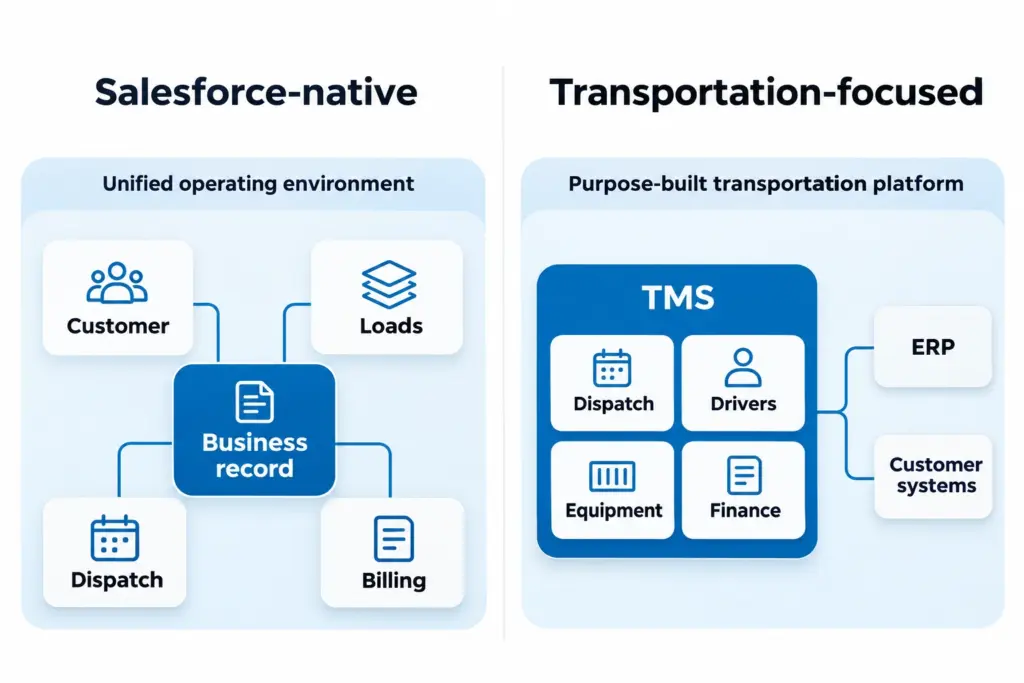
FTM vs Trimble TMS: The Architectural Difference
FTM’s Salesforce-native platform uses the same environment for customer records, load management, carrier information, documents, financial activity, and reporting.
For a brokerage already using Salesforce, that reduces the need to synchronize customer and transportation records between separate applications.
It also lets teams configure fields, approval rules, dashboards, and automation through Salesforce tools.
Trimble’s systems follow a transportation-focused architecture. Their specialized workflows and integrations support dispatch, planning, fleet management, and financial processes inside Trimble’s technology ecosystem.
That approach can be attractive to a carrier whose software decisions revolve around equipment utilization, driver management, and settlements.
Neither architecture guarantees simpler operations. The difference becomes visible when you test changes that cross departmental boundaries.
For a deeper explanation, see our guide to Salesforce-native vs. standalone TMS architecture.
Which Works Better for a Mid-Size Carrier?
An asset-based carrier should test daily operations before evaluating advanced reporting or AI features.
Start with a dispatcher assigning a driver and tractor to a load. Change the appointment, introduce a delay, collect the POD, calculate driver pay, and produce the customer invoice.
Where Trimble deserves a closer look
Trimble has extensive experience with asset-based transportation.
Innovative Next Generation specifically advertises built-in driver and employee payroll, owner-operator settlements, safety, and general ledger functionality.
Its newer transportation offerings also describe driver assignment recommendations using location, hours of service, and equipment information.
For carriers wanting an integrated trucking back office, those capabilities deserve a detailed demonstration.
Where FTM may fit better
FTM for Carriers connects drivers, equipment, dispatch, customer activity, documents, settlements, and reporting inside Salesforce.
Its Dispatch Console manages active loads and exceptions, while driver workflows return arrival events, PODs, signatures, and photos to the same load record.
This becomes especially useful when carrier operations share customer information with sales, service, or other business units.
However, carriers with complex payroll, escrow, maintenance, or owner-operator arrangements should verify each specialized requirement in the proposed FTM configuration.
What About a Mid-Size Freight Brokerage?
Brokerages usually care less about tractor utilization and more about carrier sourcing, customer commitments, margin control, and invoice accuracy.
FTM’s brokerage platform connects customer accounts, quoting, carrier onboarding, dispatch, load documents, and financial reporting.
A customer rate change can remain associated with the corresponding shipment and its financial records rather than requiring separate updates across disconnected applications.
Trimble is also a credible brokerage option. TMW.Suite supports brokers and 3PLs, including order management, load coverage, and margin-focused workflows.
Innovative also supports purchased transportation alongside asset-based freight.
For a brokerage that already relies on Trimble systems, extending an existing implementation may be more practical than introducing a different TMS.
The deciding test should follow a real load from quote to settlement, including carrier rejection, revised costs, accessorial approvals, and customer invoicing.
| Evaluation Area | FTM | Trimble TMS Products |
|---|---|---|
| Platform architecture | Native Salesforce application with shared customer and freight records | Transportation-focused platforms and cloud products with dedicated integration options |
| Asset-based carrier operations | Driver, equipment, dispatch, shipment, settlement, and reporting workflows | Established trucking workflows across TMW.Suite and Innovative |
| Brokerage operations | Quoting, carrier sourcing, compliance, dispatch, margin, and customer workflows | TMW.Suite supports brokers and 3PLs; Innovative also supports purchased transportation |
| Driver pay and accounting | Carrier settlements, freight billing, Salesforce reporting, and accounting integrations | Innovative advertises native payroll, settlements, AP, AR, and general ledger |
| Customer relationship management | Salesforce CRM and transportation activity share the same environment | Product-specific CRM capabilities and integrations; Innovative includes a CRM module |
| LTL and intermodal | Multimodal transportation workflows; specialized needs require validation | TruckMate targets LTL, terminal-centric, and intermodal operations |
| Configuration | Salesforce fields, permissions, Flow, layouts, reports, and integrations | Configuration depends on the selected product and modules |
| Public pricing | Published starting prices for carrier and broker packages | Product-specific quote required for a comparable configuration |
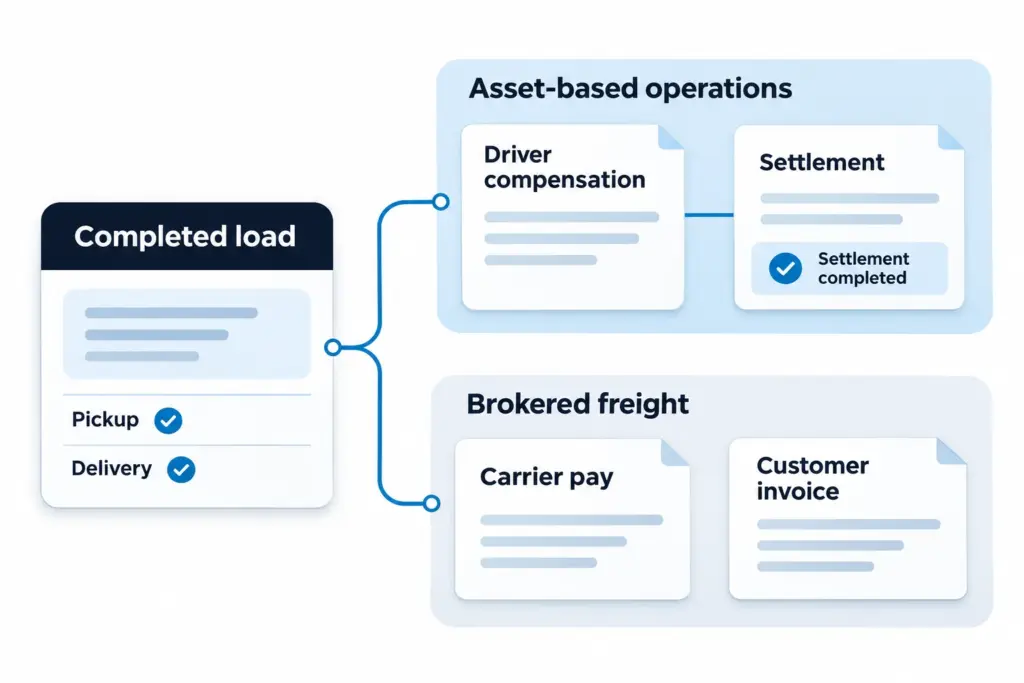
Billing, Driver Pay, and Financial Control
A TMS comparison often looks straightforward until finance joins the demonstration.
Trimble Innovative explicitly offers integrated accounting and payroll modules. A carrier wanting its general ledger and driver pay managed in the transportation system should investigate those capabilities closely.
FTM’s Billing & Reporting connects tariffs, customer charges, carrier settlements, invoices, and financial reporting to Salesforce transportation records.
It also supports connections to external accounting systems, allowing companies to keep an existing financial platform.
The important questions concern the boundaries of each configuration.
For example, a carrier using owner-operators should test settlement deductions, advances, disputed charges, and payment exports.
A brokerage should examine how rate adjustments affect the customer’s invoice and the carrier’s payable amount.
Both vendors should demonstrate those workflows with your actual billing rules.
Integrations and Implementation Requirements
Technology fit depends heavily on what the business already uses.
Trimble offers transportation-focused integrations and API capabilities across its products. For fleets using Trimble telematics, routing, or related systems, existing connections may reduce the work required to introduce additional modules.
FTM’s integration ecosystem supports transportation tools such as DAT, Truckstop, Samsara, Geotab, accounting applications, and carrier compliance providers.
Its Salesforce foundation also supports broader integration with customer management and enterprise workflows.
However, an integration listed on a vendor website does not establish that it supports every transaction your operation requires.
Ask both vendors to show the actual exchange of information between the TMS, ELD, accounting system, load boards, and customer applications.
Implementation deserves the same scrutiny.
FTM advertises core workflow deployment in as little as 14 days for appropriately scoped projects. Larger migrations and complex integrations may require phased implementation.
Trimble’s implementation schedule depends on the selected product, modules, integrations, and migration requirements. Request a project-specific estimate rather than assuming a standard timeframe.
FTM vs Trimble TMS Pricing
FTM publishes starting prices for its core operating packages:
- Carrier Operations: $1,020 per user annually.
- Broker Operations: $1,122 per user annually.
- Additional workflow products: Several start at $149 per month per organization.
FTM can also include Salesforce Enterprise licensing when required. Final pricing depends on user count, products, integrations, and implementation scope.
The current figures appear on FTM’s official pricing page.
Trimble does not publish a directly comparable standard price list for the product configurations discussed here. Buyers need a quote for the relevant system and modules.
For a fair comparison, request a three-year cost model covering software subscriptions, required modules, implementation, migration, integrations, support, and future expansion.
A carrier evaluating native payroll should also account for any financial software it would otherwise need. A brokerage already using Salesforce should assess whether a separate TMS introduces additional administration or integration costs.
Five Workflows to Test Before Choosing
Give both vendors the same operational scenarios and evaluate what the employees actually do.
- Load creation: Import a real customer order, apply the contracted rate, and prepare the load without duplicate entry.
- Dispatch changes: Reassign a driver or carrier after acceptance, preserving the original agreement and notifying the appropriate people.
- Delivery exceptions: Record a missed appointment, add supporting documents, and show how the exception affects customer communication.
- Financial settlement: Complete a shipment with an accessorial charge and trace it through approvals, driver or carrier pay, and customer invoicing.
- Management reporting: Produce margin and performance reports by customer, branch, dispatcher, or terminal using current operational records.
Ask each vendor to demonstrate these scenarios in the product and version included in its proposal.
Also involve the employees who will use the software. A technically capable platform can still require an uncomfortable number of clicks for routine tasks.
Which Platform Fits Your Operation?
FTM is worth a closer look when the business already uses Salesforce or wants customer relationships, brokerage operations, dispatch, and reporting in one Salesforce environment. Its configurable workflows may also appeal to companies operating both owned-asset and brokerage divisions.
Trimble Innovative is a strong candidate for mid-market asset-based carriers prioritizing integrated payroll, driver settlements, safety, and accounting. TMW.Suite deserves consideration for established carriers and brokers with complex transportation requirements.
TruckMate belongs on the shortlist when LTL terminal operations or intermodal complexity drive the purchasing decision.
If your business already has a working Trimble implementation, compare the cost and disruption of extending that system against replacing it.
Ultimately, the better TMS is the one your team can operate effectively across dispatch, customer service, and finance, with the full implementation scope and cost understood before signing.
Frequently Asked Questions
No. Trimble offers several transportation management products. TMW.Suite supports truckload carriers, brokers, and 3PLs, while TruckMate focuses on LTL and complex carrier operations. Trimble also has Innovative Next Generation and a newer modular Trimble TMS. Buyers should confirm the exact product and modules included in their proposal.
No. FTM can include Salesforce Enterprise when required. Organizations already using Salesforce can evaluate deployment within their existing environment. Licensing and implementation details should be confirmed in the final proposal.
Trimble’s Innovative Next Generation advertises built-in driver and employee payroll, settlements, and accounting modules. Capabilities differ between Trimble products, so confirm the specific payroll functions and integrations included in your quote.
Yes. FTM supports owned-asset and brokered freight within Salesforce. Trimble also offers solutions with brokerage capabilities, including TMW.Suite and Innovative. Compare how each configuration handles carrier pay, driver settlements, customer billing, and reporting across both divisions.
A direct price comparison requires a Trimble quote. FTM publishes starting prices for its carrier and broker packages, while Trimble configurations vary by product and modules. Compare three-year costs including licensing, implementation, integrations, support, and required financial software.
Put Your Real Freight Workflow to the Test
Bring your dispatch process, carrier or driver requirements, accounting setup, and integration needs. See how FTM would handle them inside Salesforce before making your TMS decision.
Review Your Workflow with FTM