Most conversations about AI in logistics automation sound exactly the same.
Vague promises about efficiency. Slides showing robots in warehouses. A statistic about how much money someone else saved somewhere, somehow.
What you rarely get is specifics.
So let’s skip the hype and talk about what AI logistics automation is actually doing inside real freight operations right now. The repetitive, time-consuming, error-prone work that your team is still completing manually. Work that, in 2026, simply does not need a human to do it anymore.
Here are seven of the most impactful places it is already making a measurable difference.
1. AI Logistics Automation for Smarter Load Tendering
The Problem With How Most Brokers Tender Today
Manual tendering has a flaw nobody talks about openly.
The carrier a broker calls first is not always the best carrier for that load. It is usually the carrier they called last time. The one saved at the top of their list. The one whose rep answers quickly.
That is not a carrier strategy. That is muscle memory. And it costs money.
How AI Changes the Tendering Logic
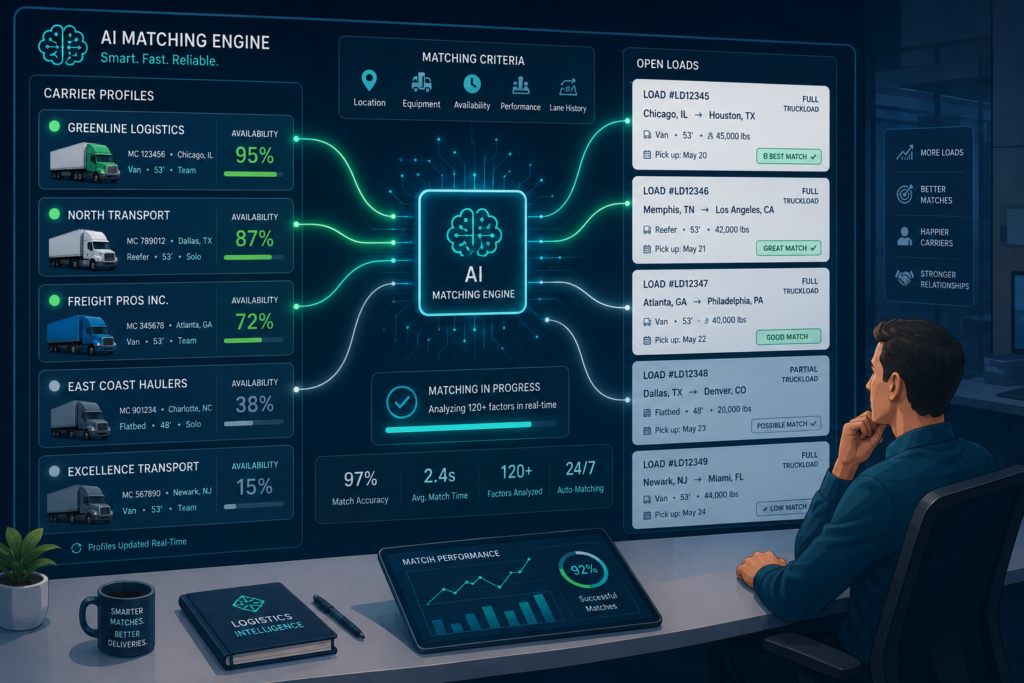
AI logistics automation scores carriers against the specific load in front of you before a single call is made. It factors in:
- The lane and corridor history
- Pickup window and delivery deadline
- Carrier on-time performance on that specific route
- Recent acceptance and rejection patterns
- Current capacity signals by day of week
The system then sequences the tender automatically. If the first carrier declines, it moves to the next, without a dispatcher waiting on hold or manually dialing down a list.
For high-volume operations, this recovers hours every week. More importantly, it improves the quality of who gets the load, not just the speed of who gets called.
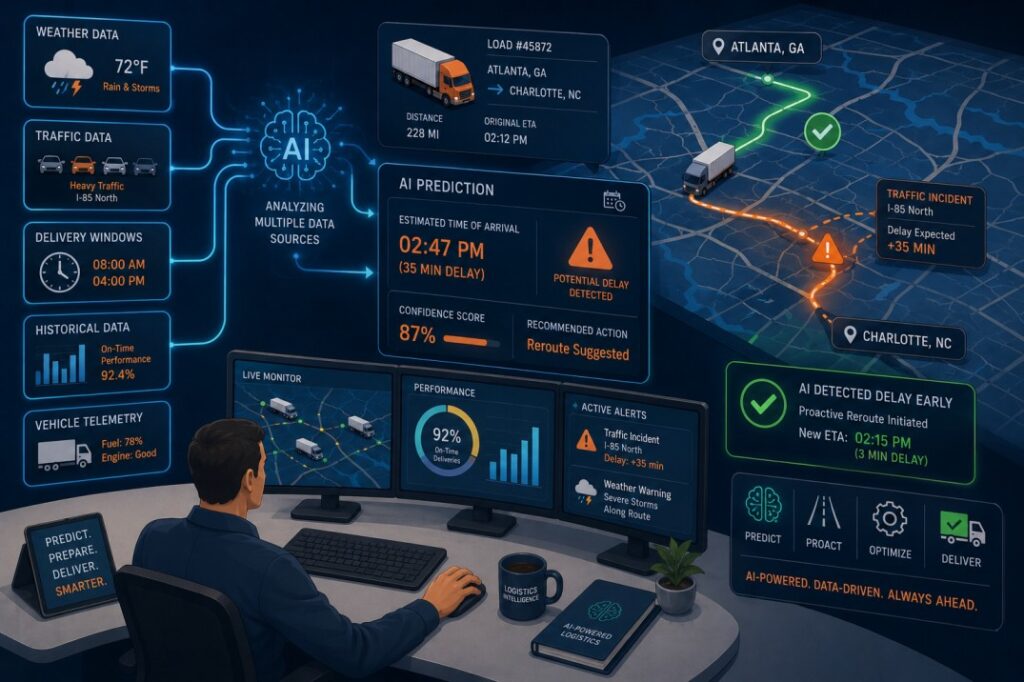
2. Predictive ETA Tracking With AI Logistics Automation
The Old Model vs. The New Model
Old model: A shipment goes late. A customer calls. Someone scrambles to find out where the truck is, what happened, and when it will deliver.
New model: AI flags the delay risk hours before the customer knows anything is wrong. Your team reaches out first. The conversation shifts from explanation to solution.
What Predictive ETA Tools Actually Pull From
This is not guesswork. Predictive ETA tools analyze a combination of live and historical signals:
- Real-time traffic and weather data along the route
- Historical lane performance at that time of week
- Driver behavior patterns and hours-of-service data
- Current dwell times at origin and intermediate facilities
- Known receiver appointment constraints
When those signals point toward a late delivery, the system surfaces it as a flagged exception before it becomes a complaint.
Why This Matters for Customer Retention
For customer-facing teams, the shift from reactive to proactive visibility is hard to overstate.
You stop explaining problems after they happen. You start preventing them from landing on the customer without warning. In freight, that difference is the foundation of a long-term shipper relationship.
Read more: How TMS Technology Simplifies Daily Fleet Operations
3. Document Processing Without the Data Entry
How Much Paper One Load Actually Generates
A single load generates more paperwork than most people outside the industry realize. Consider what moves through your inbox on a typical shipment:
- Rate confirmation
- Bill of Lading (BOL)
- Proof of Delivery (POD)
- Carrier invoice
- Lumper receipt
- Fuel surcharge addendum
- Weight ticket
- Detention documentation
Every one of those documents contains data that needs to enter a system. In most operations, a person types it in, copies it, or reformats a PDF that arrived sideways at 11pm.
What Intelligent Document Processing Looks Like in Practice
AI document processing, often called intelligent OCR, works like this:
- An incoming document is received (email, portal upload, EDI)
- The system reads and identifies the document type automatically
- Relevant fields are extracted: reference numbers, weights, timestamps, charges
- The data is matched to the correct load record in the TMS
- Anything that does not reconcile is flagged for human review
A BOL can be processed instantly, capturing reference numbers, weights, and stop information without manual entry. A POD arrives and the delivery timestamp is logged automatically.
The Real Win Is Accuracy, Not Just Speed
Time savings are real. But the bigger gain is data quality.
Manual entry creates errors. Errors create invoice disputes. Invoice disputes slow down cash. When document processing is automated, that chain breaks at the source.
4. AI Logistics Automation for Carrier Invoice Auditing
The Scale of the Problem
Carrier invoices are not always wrong. But they are wrong often enough that every logistics company needs a structured process for catching discrepancies.
At low volumes, that process is someone reviewing line items by hand against the original rate confirmation. At high volumes, that process becomes a bottleneck, or it stops happening consistently at all.
What AI Auditing Catches at the Load Level
AI logistics automation runs the audit the moment an invoice arrives:
- Rate verification: Carrier rate checked against the confirmed load rate
- Accessorial review: Flags charges that were not pre-approved or not documented at pickup
- Duplicate detection: Catches duplicate billing on multi-stop or repeat lanes
- Fuel surcharge math: Verifies the calculation matches the agreed formula
- Detention validation: Cross-references detention claims against actual timestamps
What This Means for Your AP Team
By the time an invoice reaches accounts payable, the audit is done.
What used to take hours of manual review becomes a short exception queue containing only the loads that actually need a human decision. For operations moving hundreds of loads per month, invoice auditing is one of the fastest-payback automation points in the entire workflow.
Read more: How TMS Improves On-Time Delivery
5. Carrier Capacity Signals Before You Post the Load
The Frustration of Posting Into Silence
One of the most common pain points in freight brokerage is posting a load and getting no response.
You call five carriers. Three do not answer. One is already loaded out. One wants a rate that does not work. The appointment window is closing and you are no closer to covered.
Pattern Recognition Applied to Booking History
AI logistics automation starts solving this problem before you post.
Predictive capacity tools analyze:
- Historical booking acceptance rates by carrier, lane, and day of week
- Current load-to-truck ratios on the corridor
- Carrier app activity and recent posting behavior
- Seasonal and market-driven capacity patterns
When a carrier reliably accepts Chicago to Atlanta loads on Tuesday and Wednesday mornings, that pattern belongs in your tendering logic. AI puts it there, so you lead with the carriers most likely to say yes rather than working through a list by memory.
This is not prediction. It is pattern recognition applied to data that was always available but never organized.
6. Automated Status Updates That Eliminate Check Calls
What Check Calls Actually Cost
If you run dispatch, you already know the math on check calls.
A dispatcher covering 40 active loads makes multiple status calls per load per day. That is not dispatch work. That is administration wearing a dispatch uniform. It pulls your most experienced people away from actual decisions and puts them on the phone asking where a truck is.
How Automated Check-In Works
AI-driven status automation integrates with:
- ELD and telematics systems for real-time location and movement data
- Carrier mobile apps for driver-initiated check-ins at key milestones
- GPS tracking for geofence-triggered status updates at facilities
When a truck departs a shipper, the system records it. When a driver is two hours from delivery, the consignee gets an automated notification. When a truck stops moving for an unexpected period, the system creates an exception flag, not a phone call that may or may not happen.
The Shift That Matters
The dispatcher’s job changes from collecting information to acting on it.
That is the version of dispatch work that actually uses the experience and judgment of your best people. The check call is a task that should not exist in 2026. AI logistics automation is how you remove it.
7. AI Logistics Automation for Real-Time Freight Rate Benchmarking
The Problem With Quoting From Memory
Pricing a lane without knowing where the market sits today is guesswork.
Most operations have contracted rates, lane history, and a general read on the spot market. But in volatile freight markets, that read can be weeks behind. You are quoting based on what the market was, not what it is.
What Live Rate Benchmarking Adds to Your Workflow
AI logistics automation connects real-time market rate data directly into your quoting and procurement process:
- For brokers: See how your quote compares to current market before you send it. Tighten margins when you are competitive. Protect margins when market conditions allow it.
- For shippers: Identify when contracted rates have drifted above spot and renegotiate from a position of data, not intuition.
- For carriers: Spot which lanes deserve rate increases based on actual supply and demand, not a quarterly conversation.
What It Is Not
This does not replace pricing judgment. Rate benchmarking is not a formula that tells you what to charge.
It makes sure that when you exercise judgment, you are working from current market reality rather than last month’s memory. That is a meaningful difference when freight markets move fast.
Read more: Predictive Maintenance with IoT: Preventing Truck Breakdowns Before They Happen
AI Logistics Automation Is Not One Big Leap
Why Most Companies Overthink the Starting Point
There is a version of the AI conversation in logistics that makes implementation sound enormous. A technology project. A migration. A six-month rollout.
That framing holds a lot of companies back, and it is mostly wrong.
AI logistics automation does not mean rebuilding your operation from the ground up. It means adding intelligence to the workflows that already exist inside your TMS. Tendering logic that learns from performance data. Document processing that removes manual entry from a paper-heavy process. Invoice auditing that runs automatically rather than on someone’s to-do list. Status updates that surface themselves.
The Real Question for Logistics Companies in 2026
The question is not whether AI has value in freight. The seven areas above answer that clearly.
The question is whether the platform your team runs on today is built to support it. A TMS that was not designed with automation in mind cannot deliver AI logistics automation no matter how many integrations you stack on top of it.
That is the gap most growing logistics companies eventually run into. And it is the reason platform choice matters more than it ever has.
Where FTM Fits Into This
FTM is built for brokers, carriers, and shippers who want to move more freight without adding more manual work to do it.
From automated tendering logic and intelligent document processing to invoice auditing and real-time visibility triggers, FTM puts AI logistics automation inside the workflow where it belongs. Not as a separate tool that needs its own team to manage. As part of how the operation runs day to day.
If your team is still doing work in 2026 that should be automated, that is not a people problem. It is a platform problem.
