Agentic AI in supply chain is moving from controlled demonstrations into live transportation workflows. The change matters because an agent does more than summarize a load or suggest the next step. Within defined limits, it can watch events, gather context, choose an action, use connected systems, and confirm whether the action worked.
For dispatchers, that does not mean a blank screen while software runs the day.
A more realistic operating model is emerging. Agents handle constant monitoring, repetitive follow-up, routine data collection, and low-risk actions. Dispatchers take control when service, safety, margin, customer commitments, or relationships require judgment.
In March 2026, Google Cloud described logistics agents monitoring networks, detecting anomalies, checking real-time conditions, and acting autonomously on routine decisions while people retain the complex judgment calls. That is a useful description of what is technically possible now, although each deployment still depends on its data, integrations, permissions, and operating rules. See Google Cloud’s 2026 analysis of agentic AI in logistics.
The opportunity is not “dispatch without dispatchers.” It is dispatch with less information chasing, faster exception response, and clearer accountability.
What Agentic AI in Supply Chain Actually Means
Traditional automation, AI copilots, and autonomous agents can all improve dispatch, but they behave differently.
Workflow automation follows a fixed path
A standard workflow applies predefined logic. When a driver enters a geofence, the system changes the load to “Arrived.” If a POD is missing after delivery, it creates a task.
That automation is valuable, but it does not decide among several possible actions.
An AI copilot recommends
A copilot reviews the available information and helps the dispatcher interpret it. It may summarize a delay, draft a customer update, compare carrier options, or suggest which load needs attention first.
The person remains responsible for taking the action.
An autonomous agent acts within boundaries
An agent receives a goal, assesses the current state, chooses from approved tools, performs an action, and evaluates the result.
For example, it might detect a likely missed appointment, request an updated ETA, compare the response with the delivery window, notify the customer, and escalate only if the revised plan still fails.
Autonomy should be bounded. The system needs clear limits on what the agent can change, which communication it may send, when approval is required, and how every decision is logged.
Where Agentic AI in Supply Chain Works Today
Current agentic systems are strongest where the task is frequent, data-rich, and governed by an understandable operating policy.
Monitor every active load continuously
A dispatcher cannot inspect every load, message, telematics event, appointment, document, and margin signal every minute. An agent can.
It can watch for late departures, ETA drift, missed geofences, expiring driver hours, missing PODs, unconfirmed appointments, carrier silence, or a cost change that pushes the load below its margin threshold.
The value comes from prioritization. Instead of producing another dashboard full of red indicators, the agent can rank exceptions by customer impact, time remaining, available recovery options, and financial exposure.
Assemble context before asking for attention
Exception management is slow when the dispatcher has to reconstruct the load before deciding what to do.
A well-connected agent can gather the appointment history, driver location, carrier messages, facility notes, customer service rules, previous delays, available alternatives, and current margin into one concise operating brief.
That capability depends on a shared record. In the FTM Dispatch Console, dispatch, tracking, documents, carrier and driver activity, customer communication, exceptions, and financial signals attach to the same Salesforce load record.
Perform routine follow-up
Agents can handle structured follow-up that consumes time but rarely requires negotiation.
Examples include:
- Requesting a current location
- Asking for an updated ETA
- Reminding a driver to upload a POD
- Confirming an appointment
- Sending an approved delay notification
- Creating a detention review task
- Updating an exception queue
- Routing a missing document to the right team
Field events are more useful when they enter the operation directly. The FTM Carrier and Driver App captures arrivals, departures, signatures, photos, PODs, and operational events on the same load record used by dispatch.
Coordinate several systems
The difficult part of dispatch is often not identifying the next step. It is carrying that step across multiple systems.
An agent may need to read a telematics event, update the TMS, notify the customer, create a task, check a carrier record, and preserve an audit trail. Reliable transportation integrations therefore matter more than the language model alone.
C.H. Robinson reported in March 2026 that hundreds of connected AI agents were operating across pricing, planning, orders, appointments, capacity, routing, tracking, documents, and invoicing. The company also reported faster booking and pickup improvements in workflows supported by its agents. Those results are company-reported, but they show that coordinated agents are being used in live supply chain execution at commercial scale. See C.H. Robinson’s March 2026 agentic supply chain update.
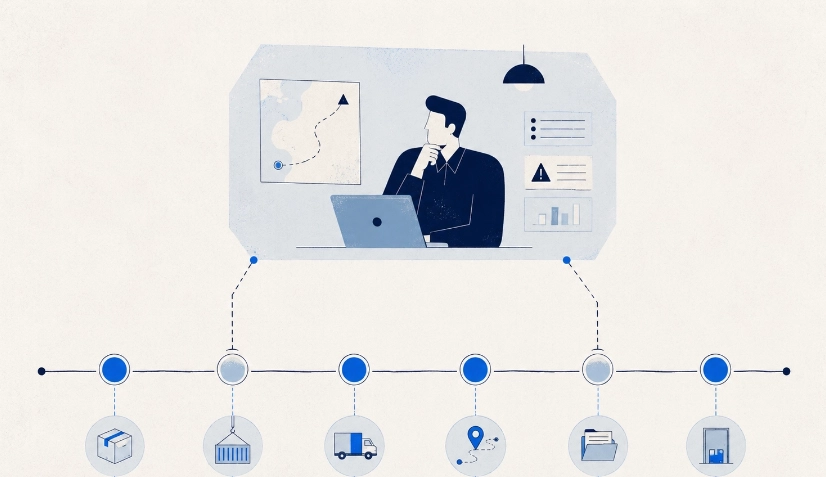
What Autonomous Agents Should Not Own Alone
A capable agent can make dispatch faster. Poorly governed autonomy can make mistakes faster as well.
Safety and compliance decisions
An agent should never pressure a driver to violate hours-of-service limits, continue with unsafe equipment, bypass a compliance hold, or conceal a material operating issue.
Safety rules must override service targets.
Liability and claims admissions
A routine status update is different from accepting responsibility for damaged freight, missed delivery, temperature excursion, or customer loss.
Agents may collect evidence and prepare a summary. Final admissions, settlements, and legally meaningful communication should remain with authorized people.
High-impact commercial changes
Rebooking a routine appointment may fit within policy. Approving an expensive recovery carrier, changing a committed rate, abandoning a load, or accepting a major service penalty requires human judgment unless the organization has deliberately approved a narrow threshold.
Ambiguous relationship decisions
Dispatchers understand context that may not appear in the data. Long-term performance may justify flexibility for a carrier. Strategic customers may require a different communication approach. At some facilities, one trusted contact can solve a problem faster than the formal escalation route.
Agents can surface the history. People should own the relationship.
How the Dispatcher Role Changes
Agentic AI does not remove operational responsibility. Instead, it changes where that responsibility is applied.
The dispatcher becomes less of a status collector and more of an exception commander.
That shift includes four higher-value responsibilities:
- Validate the plan. Confirm that the agent is optimizing the right service, margin, safety, and customer outcome.
- Handle ambiguity. Resolve situations where the data conflicts, the policy is incomplete, or several options carry different risks.
- Own relationships. Negotiate with carriers, calm customers, coordinate facilities, and make tradeoffs that depend on trust.
- Improve the system. Review overrides, failure patterns, and missed signals so the agent becomes more useful over time.
Experienced dispatchers become more important during this transition because they know which operating rules are real, which exceptions are common, and which “efficient” actions create downstream problems.
The best agent designs encode that expertise instead of treating it as replaceable labor.
The Operating Architecture Agentic Dispatch Requires
Adding an agent to fragmented freight systems does not create autonomous operations. It gives the agent fragmented information.
One governed load record
The agent needs a reliable operating object that connects the customer, route, carrier, driver, equipment, appointments, status events, documents, communication, costs, and billing state.
FTM’s Salesforce-native transportation platform uses the load record as that shared operating context. Workflows can act on the same data dispatchers already use instead of reconciling several versions of the shipment first.
Event-driven inputs
Agents need timely events, not yesterday’s export.
Useful signals may come from telematics, geofences, driver updates, email, customer portals, load boards, documents, weather, traffic, appointment systems, or internal approvals. The system should know the source and freshness of each event.
Documents also need structure. FTM AutoFill reads incoming freight documents and connects extracted information to the appropriate operational records for review, reducing the chance that an agent acts on a document no one has translated into usable data.
Permissioned tools
An agent should not have unrestricted access simply because an employee could perform the same action.
Define permissions by action:
- Read a load
- Update a milestone
- Request information
- Draft a message
- Send an approved message
- Reschedule within a defined window
- Create a task
- Assign a carrier
- Approve a cost
- Release an invoice
High-risk tools should require approval, tighter thresholds, or both.
Escalation and fallback
Every agent needs a clear answer to three questions:
- When should it stop?
- Who should receive the exception?
- What context must accompany the escalation?
A useful escalation does not say, “Load at risk.” It explains what changed, what evidence supports the conclusion, which actions were attempted, what options remain, and when a decision is required.
Auditability
Transportation teams need to reconstruct actions after the fact.
The record should show which agent acted, what information it used, which policy applied, what tool it called, what changed, and whether a person approved or reversed the action.
Autonomy without an audit trail is operational debt.
| Dispatch Function | What an Agent Can Do | What the Dispatcher Retains | Required Control |
|---|---|---|---|
| Status monitoring | Watch milestones, telematics events, ETA drift, missing updates, and document status continuously. | Determine whether an unusual signal reflects a real operating risk. | Data-source validation, event freshness, and exception thresholds. |
| Routine follow-up | Request locations, updated ETAs, appointment confirmation, or missing PODs through approved channels. | Handle carrier silence, conflicting information, or relationship-sensitive follow-up. | Approved templates, contact rules, retry limits, and escalation timing. |
| Customer communication | Send preapproved status notices when the facts and next step are clear. | Manage strategic accounts, disputed facts, service recovery, and sensitive explanations. | Customer-specific permissions, message review rules, and communication history. |
| Appointment management | Confirm or reschedule appointments within defined facilities, windows, and service rules. | Negotiate exceptions that affect production, penalties, or downstream commitments. | Facility rules, approved contacts, time limits, and human approval thresholds. |
| Carrier recovery | Surface qualified alternatives, compare availability, and prepare a recovery recommendation. | Approve high-cost replacements, relationship tradeoffs, and major service changes. | Compliance status, cost authority, preferred-carrier policy, and margin controls. |
| Safety, claims, and liability | Collect evidence, organize documents, and prepare an operating summary. | Make safety decisions, liability admissions, claim settlements, and legal commitments. | Mandatory human approval and prohibited-action rules. |
Mini Scenario: A Late Pickup Without Six Manual Check Calls
Consider a load scheduled to pick up at 2:00 p.m.
At 12:35 p.m., the assigned driver has not entered the expected approach radius. The carrier has not sent an update, and recent travel time suggests the truck may miss the appointment.
A conventional workflow waits for a dispatcher to notice the risk.
An agentic workflow begins earlier:
- The agent detects the ETA variance.
- It checks the appointment tolerance and customer notification policy.
- A location request goes to the driver through an approved channel.
- The agent compares the returned location with traffic and facility timing.
- Because the revised ETA falls outside the window, it requests a new appointment through an approved contact path.
- The customer receives a preapproved update with the revised plan.
- Dispatch sees one summarized exception, including the evidence, actions taken, and remaining risk.
If the carrier does not respond, the agent can surface qualified alternatives from the FTM Private Loadboard. Awarding a high-cost recovery option, however, may still require dispatcher approval.
The dispatcher remains accountable. The difference is that the investigation and routine coordination have already happened.
A Practical Maturity Model for Agentic Dispatch
Transportation companies should not jump from manual workflows to open-ended autonomy.
Stage 1: Visibility and alerts
The system collects events and flags exceptions. Dispatchers investigate and act.
Stage 2: AI-assisted decisions
The system summarizes context, ranks risk, drafts communication, and recommends actions. People approve each step.
Stage 3: Bounded autonomous actions
Agents perform low-risk work within explicit policies, such as requesting updates, sending approved notices, creating tasks, or rescheduling within a limited window.
Stage 4: Multi-agent orchestration
Specialized agents coordinate across dispatch, appointments, carrier sourcing, documents, customer communication, and billing. Human approval remains at defined control points.
Most operations can create meaningful value at Stages 2 and 3. They reduce manual work without giving the system broad authority before its data and controls are ready.
How to Implement Agentic AI Without Disrupting Dispatch
Start with one exception that occurs often and has a clear operating policy.
Good initial candidates include missing status updates, likely late pickups, POD follow-up, appointment confirmation, and routine customer notifications.
Define success before choosing technology
Measure an operating outcome, not the number of agent actions.
Useful measures include:
- Time from risk detection to first action
- Exceptions per dispatcher
- Manual check calls per load
- Late pickups discovered before the appointment
- Customer updates sent before an inquiry
- Agent escalation rate
- Human override rate
- Incorrect action rate
- POD cycle time
- Invoice readiness after delivery
Build an action matrix
For each scenario, document what the agent may do independently, what requires approval, and what is prohibited.
The policy should also define confidence thresholds, time limits, customer-specific rules, communication templates, and escalation owners.
Test against messy cases
A pilot should include late data, conflicting timestamps, silent carriers, duplicated messages, cancelled appointments, missing documents, and bad GPS signals.
Perfect demo data proves very little.
Review overrides as operating intelligence
When dispatchers reverse an action, record why.
Frequent overrides may reveal a missing data source, an unrealistic rule, a customer exception, or a judgment pattern worth adding to the workflow.
Where Agentic AI Fits Into the FTM Operating Model
Agentic AI works best when dispatch is already connected to the rest of the shipment lifecycle.
FTM provides that foundation through one Salesforce environment:
- Dispatch Console for live loads and exceptions
- Carrier and Driver App for field events and proof
- Customer Portal for controlled customer visibility
- Private Loadboard for approved carrier activation
- AutoFill for document-to-record workflows
- Billing and Reporting for invoice readiness and financial outcomes
- Integrations for external transportation signals
These workflows use connected operational records rather than isolated dispatch tools.
A practical implementation lesson follows: agents should act on the same Salesforce load record dispatch already uses, not on a parallel AI database that creates another version of the truth.
This architecture does not make every workflow autonomous by default. It makes controlled autonomy possible because the agent, dispatcher, driver, customer, carrier, and finance team can act on the same shipment record.

Agentic AI Will Change Dispatch More Than It Replaces It
The dispatcher’s job has always combined monitoring, coordination, judgment, and relationship management.
Agents can absorb much of the monitoring. They can also complete routine coordination when the action is clear and reversible.
Judgment and relationships remain harder to automate because they depend on incomplete information, commercial context, trust, safety, and accountability.
The practical future is not a lights-out dispatch floor. It is an operation where software watches every load, resolves routine work, and brings people the exceptions that genuinely deserve their attention.
That is what autonomous agents mean for dispatchers: fewer tasks to chase, but more responsibility for the decisions that matter.
Frequently Asked Questions About Agentic AI in Supply Chain
Build Dispatch Workflows Agents Can Actually Use
See how FTM connects live load events, driver updates, documents, carrier actions, customer communication, exceptions, and billing on one Salesforce record.
Review Your Dispatch Workflow