Every minute a freight operation spends on a task that software could handle in seconds is a minute its competitors are using to win the next load. That is not a distant threat. It is happening right now, across every lane, every load board, and every dispatch queue in the country. Dispatchers are still picking up phones to ask where trucks are. Brokers are still typing load details into systems that could populate themselves. And somewhere down the hall, a carrier is waiting on a confirmation that should have fired automatically the moment a load was created.
On this page
The conversation about AI dispatch in logistics is no longer a conversation about the future. It has become a conversation about operational survival. Businesses still running on manual dispatch workflows are not standing still, they are falling behind in a market that does not wait for anyone to feel ready.
This is not about eliminating people from logistics. It is about being precise about what manual processes actually cost, in time, in money, and in opportunities that simply do not stay on the table while your team catches up.
The Myth of the Efficient Manual Operation
Most logistics companies believe their dispatch operation runs reasonably well. Freight moves. Customers receive their deliveries. Invoices go out, eventually. And yet, when you map the actual workflow, every phone call, every spreadsheet update, every carrier follow-up, every status check that someone typed manually into a field, the picture looks very different from what leadership assumes.
A dispatcher covering 30 active loads may spend four to five hours a day on check calls alone. Add manual load entry, carrier communication, exception handling, and document chasing, and the operation that felt manageable suddenly reveals itself as a structure held together by human effort, goodwill, and a tolerance for inefficiency that no growing business should accept as the baseline.
Furthermore, manual operations scale badly. Doubling your load volume with a manual system almost always means doubling your headcount, or doubling the pace at which your existing team makes mistakes under pressure. Neither outcome is sustainable, and neither is invisible to the customers and carriers living on the other side of it.
The irony is that most of the work generating this overhead is not complicated. It is repetitive, rule-based, and time-sensitive, which makes it precisely the category of work that software handles better than humans. The problem is not a people problem. It is a process problem masquerading as one.
Where AI Dispatch in Logistics Draws the Sharpest Line
The clearest difference between AI-driven dispatch and manual dispatch is not speed, it is decision quality under pressure.
Manual dispatch is reactive by design. Something goes wrong, and a dispatcher finds out through a phone call, a missed check-in, or an escalation from an unhappy shipper. The response is triggered by failure. Consequently, the cost is already accumulating by the time anyone takes action, whether that cost shows up as a detention fee, a missed appointment, or a damaged carrier relationship.
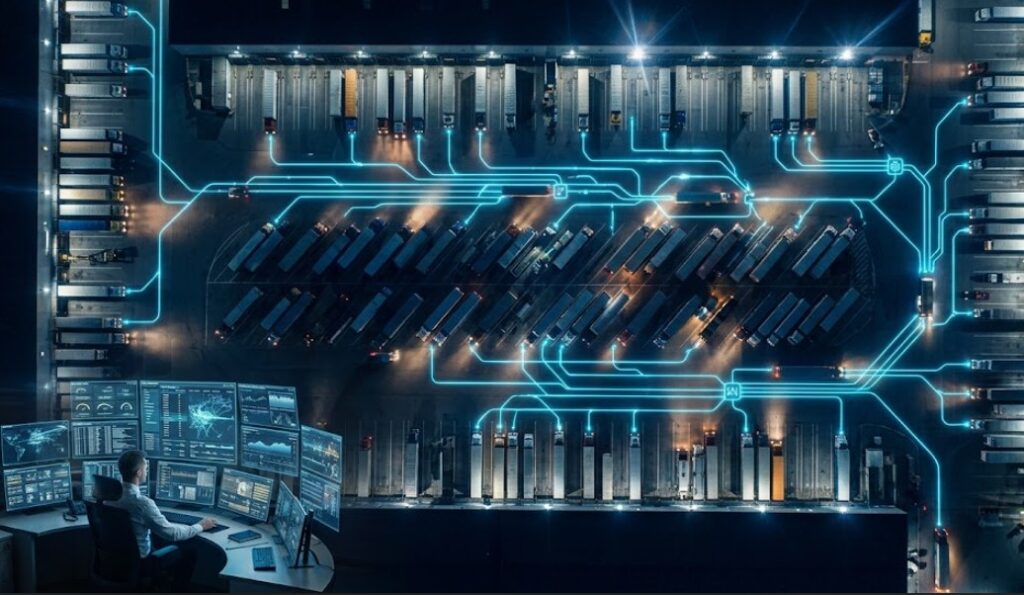
AI-driven dispatch operates on a fundamentally different model. Instead of waiting for a problem to surface, the system monitors every active load in real time, flags anomalies before they become delays, and surfaces exceptions to a dispatcher who can act, not react. Detention risk, geofence breaches, late pickups, hours-of-service conflicts, these appear as alerts before they become line items on an invoice or apologies to a customer.
The second sharpest difference is consistency. A dispatcher managing a high-stress afternoon makes different decisions than the same dispatcher on a quiet morning. AI does not vary with mood, workload, or the number of calls happening simultaneously. It applies the same logic to every load, every time, regardless of volume, and it does so without needing a break, a training refresher, or a supervisor’s approval on a judgment call.
The Data That Manual Systems Cannot See
Manual dispatch operates on visible data, what dispatchers can see, hear, and track across their boards and inboxes. However, the data that drives the best decisions in modern freight operations lives below that surface, accumulating silently inside every load record, every carrier interaction, and every facility appointment your operation has ever touched.
Lane performance trends by day of week. Carrier acceptance rates on specific corridors. Historical dwell time at individual facilities. The probability that a Tuesday pickup in a particular market will run 20 minutes over its appointment window, based on years of load history. No dispatcher carries that information in their head accurately. No spreadsheet organizes it quickly enough to be actionable at the moment a load is being tendered.
An AI-connected system does both, simultaneously. It surfaces patterns that are invisible to manual review and builds those patterns directly into dispatching logic, from carrier sequencing to exception thresholds to route risk scoring. The result is not just faster decisions. It is better decisions, made with a depth of context that no individual dispatcher can replicate at scale.
Additionally, this intelligence compounds over time. The more loads flow through an AI-enabled platform, the more precise its predictions become. A manual operation does not improve with volume. It strains under it, spreading attention thinner and creating more opportunities for the kind of small errors that grow into expensive problems.
Why Dispatchers Are Not Going Anywhere
It would be easy to read this as an argument for eliminating dispatchers from the operation. It is precisely the opposite.
The dispatcher who spends four hours a day confirming truck locations via phone is not adding strategic value to the organization. They are performing administrative work that has automated alternatives readily available. When that work is handed to a system capable of handling it in the background, without calls, without delays, without the risk of a missed check-in slipping through during a busy stretch, the dispatcher becomes something far more valuable: a decision-maker.
Someone who manages escalations. Someone who builds genuine carrier relationships. Someone who navigates the complex customer situations that require human judgment, context, and the kind of direct communication that no algorithm has mastered. Someone who reads between the lines when a carrier’s behavior signals a problem that has not yet shown up in the data.
That is the version of dispatch work that experienced logistics professionals actually want to do. The technology does not eliminate the role, it returns it to its highest and best use. Nevertheless, this shift requires an operation built to support it. A platform that cannot automate tendering, status updates, or exception alerts cannot deliver this outcome, regardless of how talented the people using it are.
AI Dispatch in Logistics: The Risk of Moving Too Slowly
The freight industry has a well-documented history of resisting automation until the moment that resistance becomes untenable. That moment is arriving faster than most operations are prepared to acknowledge.
Research from McKinsey & Company on AI in supply chains indicates that companies adopting AI-driven logistics tools achieve cost reductions of 15 to 20 percent while simultaneously improving service levels, a combination that manual operations struggle to replicate at any volume. These are not experimental results. They are outcomes from operations that made the transition and measured what happened next.
Meanwhile, the companies adopting AI dispatch tools today are not running pilot programs on the margins of their operation. They are building compounding advantages at the center of it. Every load that moves through an intelligent system generates data. That data improves the next decision. The gap between AI-enabled operations and manual ones is not static, it widens every week without deliberate action to close it.
For brokers, the risk is competitive margin erosion. AI-connected brokers quote faster, cover more loads with fewer staff, and recover margin on lanes where manual operations leave money on the table. For carriers, the risk is operational drag that makes scaling expensive and error-prone. For shippers, the risk is the kind of service failure, missed ETAs, invisible exceptions, slow communication, that quietly ends long-term customer relationships before anyone notices the pattern.
The calculus is straightforward. The cost of transitioning to intelligent dispatch is fixed and one-time. The cost of delay compounds indefinitely in lost margin, wasted labor, and foregone growth.

Your Dispatch Strategy Is a Business Decision
The question in 2026 is not whether AI belongs in dispatch operations. That was settled by the outcomes of companies that adopted it early and measured what changed. The real question is how much runway your business is willing to give manual processes before the cost becomes impossible to ignore in your own numbers.
AI dispatch in logistics is not a technology upgrade. It is an operational strategy that determines how much freight your team can move, how accurately, and at what cost per load. Businesses that treat it as optional are not taking a neutral position, they are making an active choice to compete at a structural disadvantage against operations that are already running smarter.
Your dispatchers deserve tools that remove administrative burden so they can do the work that only humans can do. Your carriers deserve faster, more intelligent communication. Your customers deserve proactive visibility instead of explanations after the fact. And your operation deserves the ability to grow without simply adding headcount every time volume increases.
The technology to build that operation exists. The only remaining decision is when to start.
Ready to see what AI-powered dispatch looks like inside a real freight operation?
Book a free demo with FTM and discover how your team can move more freight with less manual effort.
