Choosing a Transportation Management System sounds simple until you realize most companies regret their first choice.
On this page
A polished demo, a confident sales pitch, and a long feature list can make any platform look like the perfect fit. However, once implementation begins, reality shows up. Workflows don’t align. Data gets messy. Teams resist adoption. Costs quietly grow.
That’s why asking the right questions before choosing a TMS is not optional. It’s the difference between operational control and long-term frustration.
This guide breaks down the most important questions logistics teams should ask before committing to a TMS in 2026.
Choosing a TMS is no longer a simple software decision. In 2026, logistics teams rely on transportation management systems to manage planning, execution, visibility, and financial performance in one place. Therefore, the questions before choosing a TMS must focus on how the system supports real operational workflows, not just features shown in a demo. Companies that align their selection process with operational reality consistently achieve faster implementation and stronger ROI.
Why “Questions to Ask Before Choosing a TMS” Matter More Than Ever
TMS platforms are no longer just dispatch tools. They sit at the center of planning, execution, visibility, and financial control.
However, many buying decisions still focus on surface-level features instead of operational fit.
As a result, companies end up with:
- Systems that require heavy manual workarounds
- Poor integration between departments
- Limited visibility into real costs
- Slow response during disruptions
Therefore, asking structured, operationally focused questions early prevents expensive mistakes later.
Questions to Ask Before Choosing a TMS About Operational Fit
A TMS should match how your operation actually runs, not how a vendor thinks it should run.
Start with these questions:
- Can the system support your current workflows without heavy customization?
- How does it handle multi-stop, multi-mode, or cross-border shipments?
- Can dispatchers plan and adjust loads in real time?
- Does it support exception handling without manual intervention?
Moreover, test real scenarios during demos. Do not rely on generic walkthroughs.
If your team cannot execute daily tasks easily, adoption will fail.

Questions to Ask Before Choosing a TMS About Integration
No TMS operates in isolation. It must connect with your existing systems.
Key questions include:
- Does it integrate with your ERP, accounting, and visibility tools?
- Are APIs available and well-documented?
- How long does integration typically take?
- What level of IT involvement is required?
Additionally, poor integration leads to duplicated data, delays, and reporting errors.
A strong TMS acts as a connected system, not another silo.
In global logistics environments, integration requirements become even more critical. Companies operating across North America, Europe, and cross-border regions must ensure their TMS can adapt to different regulatory frameworks, data formats, and carrier networks. As a result, questions before choosing a TMS should include region-specific capabilities, such as multi-currency support, localized compliance rules, and cross-border shipment visibility. This ensures the system performs consistently across all markets.
Questions to Ask Before Choosing a TMS About Visibility and Data
Visibility is often marketed as a feature. In reality, it is a decision-making tool.
Ask:
- Can you track shipments in real time across all modes?
- Does the system provide predictive ETAs?
- How are exceptions flagged and prioritized?
- Can you see cost and performance at the load level?
Furthermore, visibility should drive action, not just display information.
If teams still rely on emails and calls after implementation, the system is not doing its job.
Questions to Ask Before Choosing a TMS About Cost and ROI
Most companies underestimate the true cost of a TMS.
Look beyond subscription fees:
- What are the implementation costs?
- Are there charges for integrations or upgrades?
- How does the system reduce operational cost?
- Can ROI be measured through real metrics?
Consequently, a cheaper system that requires manual work often becomes more expensive over time.
Focus on total value, not just price.
Questions to Ask Before Choosing a TMS About Scalability
Your TMS should support where your business is going, not just where it is today.
Important questions:
- Can the system handle increased shipment volume?
- Does it support new regions or cross-border expansion?
- How easily can new users, carriers, or customers be added?
- Can workflows evolve without major reconfiguration?
Similarly, systems that cannot scale create bottlenecks as your operation grows.
Questions to Ask Before Choosing a TMS About Carrier Management
Carrier performance directly impacts service and cost.
Ask:
- Can you track carrier scorecards automatically?
- Does the system support digital tendering and acceptance?
- Can you segment carriers by performance and role?
- How are compliance and documentation handled?
In addition, strong carrier management tools reduce risk and improve reliability.
Questions to Ask Before Choosing a TMS About User Adoption
Even the best system fails if your team does not use it.
Key questions:
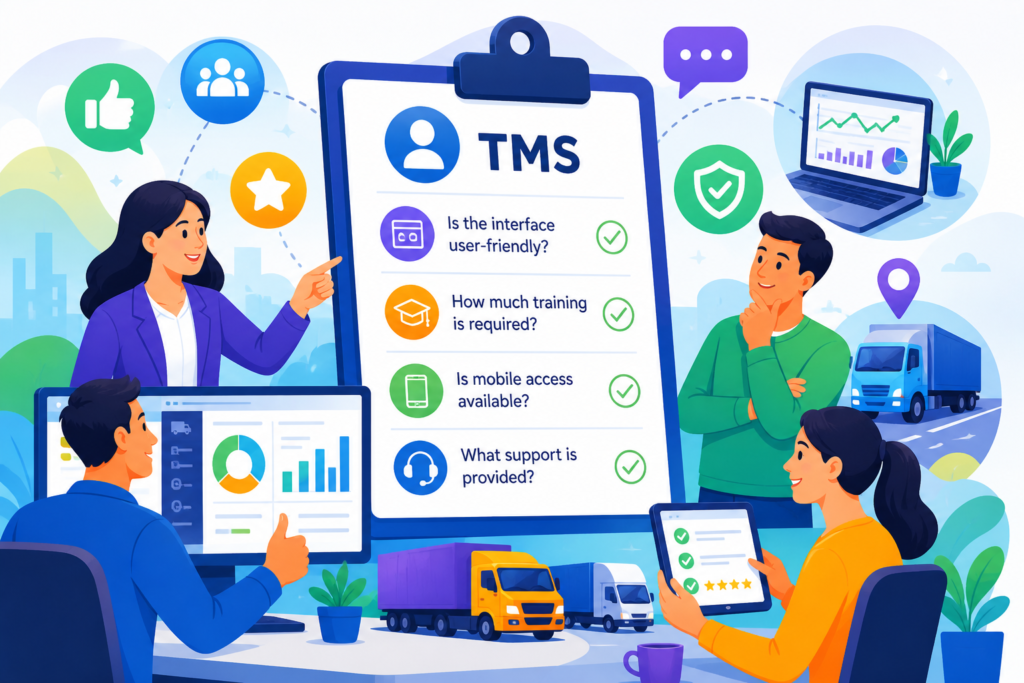
- Is the interface intuitive for dispatchers and planners?
- How much training is required?
- Is mobile access available for drivers and carriers?
- What support is provided during onboarding?
Therefore, usability should be tested with real users, not just managers.
Questions to Ask Before Choosing a TMS About Data Accuracy
Bad data destroys good decisions.
Ask:
- How does the system validate inputs?
- Can errors be detected automatically?
- Are data fields standardized across workflows?
- How easy is it to audit historical data?
Moreover, clean data ensures accurate reporting, billing, and planning.
Questions to Ask Before Choosing a TMS About Security and Compliance
Freight data is sensitive. Security is not optional.
Questions include:
- Is the system compliant with industry standards?
- How is data encrypted and stored?
- Are user permissions configurable?
- How are compliance requirements managed?
As a result, strong security protects both operations and customer trust.
What Smart Logistics Teams Do Differently
Companies that choose the right TMS follow a different process.
They:
- Evaluate systems using real operational scenarios
- Involve dispatch, finance, and IT in decisions
- Prioritize integration and data flow
- Focus on long-term scalability
Instead of chasing features, they focus on operational impact.
Another important factor often overlooked is how quickly a TMS can deliver operational value. While some systems require long implementation cycles, others provide faster deployment with configurable workflows and pre-built integrations. Therefore, questions before choosing a TMS should also address time-to-value, including how quickly teams can begin managing loads, tracking performance, and improving decision-making. Faster adoption directly impacts ROI and operational efficiency.
Ask Better Questions, Make Better Decisions
Choosing a TMS is not about selecting software. It is about designing how your logistics operation will function.
By asking the right questions before choosing a TMS, companies avoid costly mistakes, reduce friction, and build systems that support growth.
FTM helps logistics teams evaluate, implement, and optimize TMS solutions that actually match their operations.
If you want clarity before committing to a system, now is the time to ask the right questions.
Book a demo and see how a connected TMS should work.
