Yellow Freight’s collapse did more than remove a major LTL carrier from the market. It forced shippers to find replacement capacity while competitors acquired terminals, expanded coverage, and reorganized parts of the network around different operating models.
Three years later, those changes still matter.
LTL consolidation affects more than the number of carriers available. It can change which terminals handle a shipment, how many transfers occur, what a lane costs, and whether a shipper has a genuine alternative when service fails.
For transportation managers, the useful question is no longer whether another carrier has capacity somewhere in the country. It is whether that carrier can handle the same freight, between the same facilities, at an acceptable cost and service level.
What LTL Consolidation Actually Means
The term LTL consolidation describes several different developments, and they do not always have the same effect on shippers.
A merger combines businesses or networks under new ownership. An acquisition may add terminals, customers, or regional coverage to an existing operator. Bankruptcy can lead to restructuring, asset sales, or a complete shutdown.
In the last case, the distinction between operating capacity and physical assets becomes important.
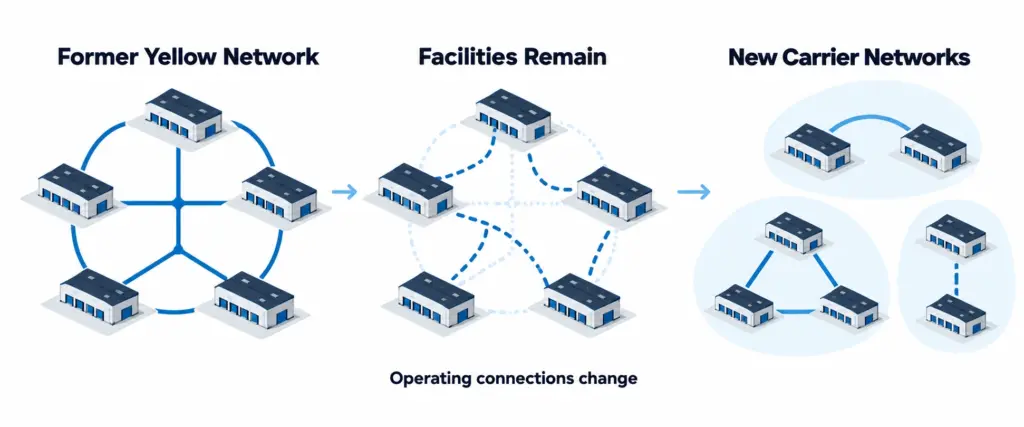
A carrier might close while its terminals remain valuable. Competitors can purchase those properties and eventually put them back into service, but the old carrier’s routes, customer agreements, labor structure, and pricing do not automatically return.
As a result, freight capacity may recover over time without restoring the choices shippers previously had.
Why LTL networks are particularly difficult to replace
LTL depends on coordinated pickup routes, terminals, linehaul schedules, freight handling, and final-mile delivery.
Replacing one regional carrier with another can change the number of handling points or the delivery coverage available in smaller markets.
A provider with nationwide service may still be less competitive on a particular origin-destination pair than the regional carrier it replaces.
That makes lane-level service coverage more useful than national carrier counts.
The Carrier Closures That Reshaped the LTL Market
The current market reflects several years of closures and subsequent network expansion, not a single recent wave of bankruptcies.
New England Motor Freight: February 2019
New England Motor Freight filed for Chapter 11 bankruptcy protection and announced an operational wind-down in February 2019.
Its departure particularly affected the Northeast and Mid-Atlantic markets where it had maintained a significant regional presence.
The event illustrated how losing a regional specialist could disrupt shippers even when numerous national carriers remained available.
Central Freight Lines: December 2021
Central Freight Lines announced that it would cease accepting new freight on December 13, 2021, and expected to deliver the freight already in its system by December 20.
In its official closure announcement, the company attributed its decision to sustained operating losses and exhausted liquidity.
This was an announced wind-down, which should not be confused with Yellow’s Chapter 11 bankruptcy.
Central Freight’s approach also provided an important operational lesson: existing freight may continue moving temporarily after a carrier stops accepting new shipments. Shippers need separate procedures for freight already in transit and freight awaiting pickup.
Yellow Corporation: July–August 2023
Yellow ceased operations in late July 2023 and filed for Chapter 11 protection on August 6.
Its shutdown removed a large national LTL network and affected approximately 30,000 employees, according to the company’s bankruptcy announcement.
However, the terminal properties did not disappear.
In December 2023, a bankruptcy court approved approximately $1.88 billion in sales involving 130 Yellow service centers. Among the largest buyers were XPO, Estes Express Lines, and Saia.
XPO’s initial award included 28 terminals, Estes acquired 24, and Saia secured 17, according to the court-sale reporting.
These were property acquisitions, not the purchase of Yellow’s entire operating network as a going concern.
For shippers, that distinction explains why the industry’s physical capacity and competitive structure could evolve in different ways.
What Carrier Bankruptcies Change for Shippers
Carrier choice becomes more dependent on the lane
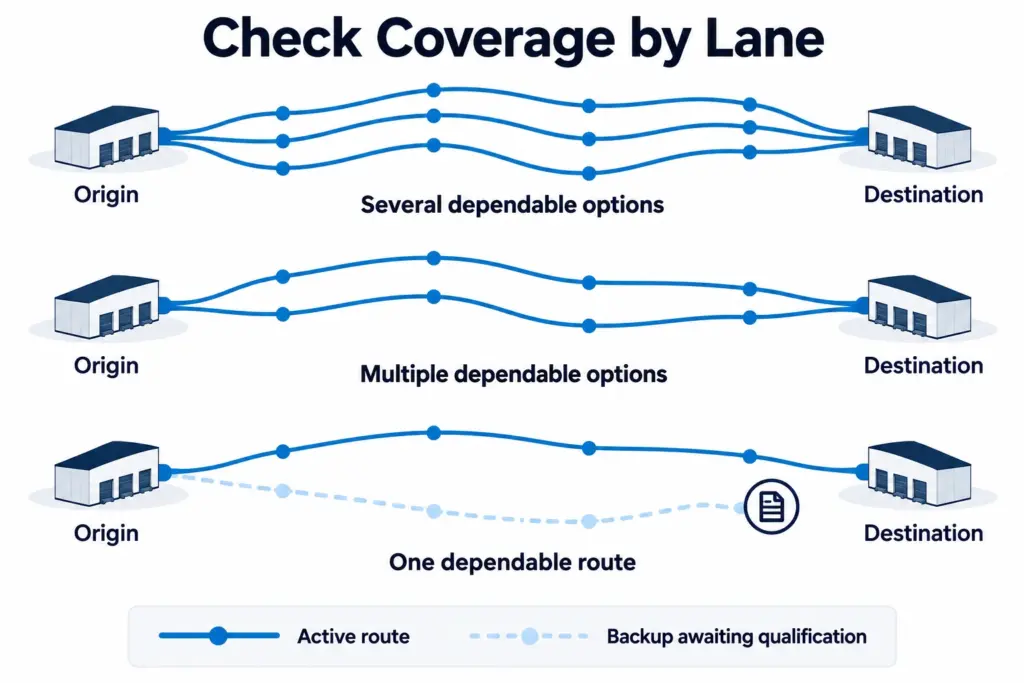
A transportation team might have five approved LTL carriers, yet only two may offer competitive service between a specific plant and customer distribution center.
Following a shutdown, one of those two could disappear from the routing guide.
The remaining carrier may gain greater negotiating leverage, even if competition elsewhere remains healthy.
Therefore, carrier concentration should be measured by origin, destination, shipment profile, and service requirement, rather than national spend alone.
For a broader discussion of network redundancy, see our guide to building a risk-resilient freight network.
Terminal changes can alter transit reliability
A replacement carrier may offer the same published transit time but handle the freight through a different combination of terminals.
That can affect pickup cutoffs, transfer frequency, delivery schedules, and exception recovery.
Consider what happens when a shipper moves freight from a regional direct-service provider to a national network requiring additional transfers. The nominal transit commitment might remain similar, while the risk of damage or missed delivery becomes different.
This is an operational scenario, not a claim that national networks universally perform worse.
Shippers should evaluate actual service data after changing providers, including claims frequency, missed pickups, transit variability, and exception resolution.
Claims and freight documentation become harder during a shutdown
A carrier closure creates special problems when shipments remain inside the network.
Operations must establish where the freight is, which party has possession, whether delivery is still expected, and who can authorize a change.
The original BOL, PRO number, shipment documents, pickup confirmation, and correspondence become essential.
Meanwhile, finance needs to distinguish legitimate outstanding freight charges from duplicate charges arising during recovery.
Negotiating leverage shifts unevenly
A national shipper with balanced volume across several terminals may still have considerable pricing leverage.
A smaller operation dependent on one specialist carrier in a less competitive region faces a different situation.
Consequently, an enterprise-wide routing guide can hide local exposure.
Transportation teams should understand where alternatives genuinely overlap rather than assuming that every approved carrier represents independent capacity on every lane.
| Risk Area | What Can Change | What Shippers Should Check |
|---|---|---|
| Carrier Coverage | Fewer viable carriers on a specific lane | Independent pickup and delivery coverage, not just national network size |
| Transit Reliability | Different terminals, transfers, and service schedules | Actual transit performance, missed pickups, and damage claims |
| Freight Pricing | Revised tariffs, minimum charges, and accessorials | Final invoice cost for comparable freight |
| Carrier Dependence | More volume concentrated with fewer providers | Carrier share by lane, facility, and shipment profile |
| Shutdown Recovery | Uncertain custody of in-transit freight | BOL, PRO number, last location, contacts, and recovery authorization |
Does LTL Consolidation Mean Higher Shipping Rates?
Not automatically. Losing a carrier can reduce competition, but freight demand, available terminal capacity, operating costs, shipment characteristics, and commercial agreements also influence pricing.
Recent carrier reports show why simple conclusions can be misleading.
During the second quarter of 2026:
- XPO reported a 4.4% year-over-year increase in North American LTL yield excluding fuel.
- Old Dominion Freight Line reported a 5.5% increase in LTL revenue per hundredweight excluding fuel.
- Saia reported a 2.2% decrease in revenue per hundredweight excluding fuel, although revenue per shipment excluding fuel increased 1.5%.
These are company-specific results, not a nationwide LTL rate index. Even seemingly similar yield measures can reflect different customer mixes, weight profiles, lengths of haul, and pricing structures.
The data supports a narrower conclusion: pricing conditions vary considerably between carriers.
Shippers should also pay attention to the difference between a quoted rate and the final invoice.
Fuel surcharges, freight classification, minimum charges, liftgate service, limited-access delivery, and reclassification can all alter the amount paid.
Instead of comparing one headline discount against another, procurement teams should examine historical landed cost for equivalent shipments.
FTM’s freight quoting system provides a way to connect rate decisions with customer, lane, and historical shipment information. Meanwhile, Billing & Reporting supports review of freight costs, accessorials, invoices, and rate differences after execution.
For additional market context, read the U.S. Freight Market Outlook.
How Shippers Can Reduce LTL Carrier Concentration Risk
The right response to LTL consolidation is a stronger routing guide, supported by actual operating evidence.
Identify where the network is concentrated
Start with shipment data from the past 12 months.
Group shipments by meaningful origin and destination regions, then examine the share handled by each carrier.
For higher-volume operations, a three-digit ZIP-to-three-digit ZIP view can provide a useful starting point, provided the team drills down where individual facilities have unusual requirements.
Look beyond total freight spend:
- How much volume depends on the leading carrier?
- Which lanes have only one proven alternative?
- Are both carriers using the same underlying partner network?
- Would the backup accept the shipment’s dimensions, freight class, and accessorial requirements?
- Which customers would face immediate disruption if the primary provider stopped accepting freight?
A list of carrier names cannot answer these questions.
Qualify backup carriers before they are needed
A secondary carrier should already have completed commercial and operational onboarding.
Confirm contractual terms, insurance, billing requirements, pickup capabilities, service points, contact procedures, and the conditions under which the company will accept overflow.
If a backup has never successfully completed a shipment on the lane, classify it as unproven, not fully available.
The FTM Carrier Onboarding workflow helps organize carrier information, qualification, compliance checks, and approval records before a transportation team assigns freight.
Test replacement service under normal conditions
A disaster-recovery plan should not depend on the first shipment moving during an actual disaster.
Where practical, route an appropriate portion of routine freight through the secondary provider. Then compare transit performance, final billed cost, cargo claims, and communication quality.
Some carriers are competitive for standard palletized freight but less suitable for long freight, special handling, or restricted delivery locations.
Testing exposes these differences before a closure forces a rushed decision.
Maintain current rate and service information
Stored contract rates are useful, but they cannot confirm that a provider is accepting new freight or maintaining the same service network.
For applicable carrier relationships, rate-shopping integrations can make comparison easier. FTM’s LTL integration ecosystem includes carrier and service-provider connections, while its GlobalTranz integration documents rating, carrier comparison, booking, and shipment workflows.
Integration availability and commercial terms depend on the customer’s configuration and carrier agreements.
What to Do if an LTL Carrier Suddenly Stops Operating
When a shutdown becomes credible, procurement, operations, customer service, and finance need to act from the same shipment list.
First, stop tendering new freight until the carrier’s acceptance and operating status are clear. Identify open tenders, scheduled pickups, in-transit shipments, and freight awaiting delivery confirmation.
Next, separate shipments into two groups.
Freight not yet collected: cancel or redirect the tender through the appropriate process, select an approved replacement, and confirm the new pickup arrangement.
Freight already in the network: preserve the BOL, PRO number, pickup evidence, tracking history, and carrier communications. Establish the last confirmed location and the party currently responsible for the shipment before arranging any recovery.
Do not assume another carrier can collect freight from a closed operator’s terminal without authorization.
Finally, notify affected customers based on the actual status of their shipments. Finance should maintain a separate record of additional transportation charges, unresolved claims, and potential duplicate billing.
The immediate priority is locating and protecting freight, not renegotiating the next annual contract.
What Shippers Should Monitor Next
Carrier bankruptcies attract headlines, but procurement teams need earlier and more specific signals.
Review changes in:
- Lane-level service: missed pickups, extended transit, delivery failures, and unusual terminal handoffs.
- Network announcements: terminal openings or closures, acquisitions, service suspensions, and changes to regional coverage.
- Commercial behavior: revised tariffs, minimum-charge changes, accessorial increases, and carrier willingness to accept additional freight.
- Routing-guide concentration: shipment and spend shares that become increasingly dependent on one provider.
- Carrier operating reports: shipment and tonnage trends, where publicly available.
A change in one of these indicators does not prove that a carrier is approaching bankruptcy.
For instance, publicly reported August 2026 LTL shipment trends varied across major carriers, with XPO reporting growth while Old Dominion reported a decline. The appropriate response is to investigate carrier and lane performance, not infer insolvency from a single monthly metric.
Where FTM Fits Into an LTL Contingency Plan
Carrier diversification only helps when the transportation team can use the alternatives quickly.
FTM’s Salesforce-native TMS for shippers connects carrier qualification, transportation records, quoting, tendering, shipment events, and financial reporting.
That creates a practical foundation for reviewing which carriers handle each lane, how their service performs, what shipments actually cost, and which approved alternatives are available.
It does not predict bankruptcies or create capacity that does not exist. However, keeping the relevant information in connected records can reduce the work required to make and document a replacement decision.
The Real Lesson From LTL Market Consolidation
Yellow’s bankruptcy changed the North American LTL network, but the sale and reuse of its terminals also show that carrier capacity is not a fixed number. It moves between companies, regions, and operating models.
For shippers, LTL consolidation makes the quality of alternatives more important than the number of carrier names on a routing guide.
A resilient transportation program knows which lanes are concentrated, maintains qualified backups, compares actual transportation cost, and has a clear plan for freight caught inside a disrupted network.
That preparation remains useful whether the next change comes from a bankruptcy, acquisition, terminal closure, or a carrier simply deciding that a lane no longer fits its network.
Frequently Asked Questions
Know Your Carrier Options Before a Lane Breaks
FTM connects carrier qualification, freight rates, shipment history, service performance, and transportation reporting inside Salesforce, giving shipper teams better information when carrier availability or service changes.
Explore FTM for Shippers