A dispatcher books a reefer load with a carrier whose MC number checks out, whose insurance certificate looks current, and whose rate confirmation comes back signed within the hour. Two days later, the pickup location calls asking where the truck is. It never arrived. The MC number was real. The company behind it was not the one that answered the phone.
On this page
That gap, between a document that looks legitimate and a carrier that actually is legitimate, is where most freight fraud lives in 2026. Most double brokering is discovered only after pickup, once tracking has gone dark, a shipper calls with a complaint, or a second, unpaid carrier starts demanding money for freight it actually hauled. By then, AI freight fraud detection is not catching anything. The load is already gone, and someone in the chain is absorbing the loss.
This article explains why traditional carrier verification has stopped working on its own, what AI-based detection actually catches that manual checks miss, and where that detection needs to happen for it to matter: before the load moves, not after.
AI freight fraud detection catches double brokering and carrier identity theft by continuously monitoring device, IP, and document patterns rather than checking authority once at onboarding. The FBI estimates these schemes cost the freight industry over $800 million annually. AI systems flag compromised carrier identities before a load confirms, when manual checks only reveal fraud after pickup.
Why Freight Fraud Doesn’t Look Like Fraud Anymore
The fundamental weakness every modern freight fraud exploits is the same one: identity and authorization get assumed rather than verified at the moment a transaction happens. A dispatcher checking a carrier’s MC number against FMCSA’s SAFER database is checking whether that authority exists and is active. It is not checking whether the person on the other end of the email is actually who they claim to be.
That distinction is exactly what chameleon carriers exploit. A fraud ring buys or hijacks a legitimate motor carrier authority with a clean operating history and uses it to inherit years of trustworthy-looking records. According to Highway’s Q1 2026 Freight Fraud Index, change-of-ownership fraud of this kind rose nearly 170 percent year over year, and roughly half of all theft incidents in the quarter traced back to carriers with legitimate MC numbers and previously clean records. The paperwork was real. The operator behind it had already changed hands.
Furthermore, generative AI has made the supporting materials around a fraudulent load nearly indistinguishable from the real thing. Fake insurance certificates, spoofed broker emails, and cloned carrier websites can be produced in minutes rather than requiring the manual forgery work fraud used to demand. The volume backs this up: Highway blocked more than 527,000 fraudulent inbound emails in Q1 2026 alone, up roughly 50 percent year over year, along with over 71,800 spoofed phone calls.
The Real Cost of Freight Fraud in 2026
The FBI estimates double brokering and carrier identity fraud cost the North American freight industry more than $800 million annually, a figure confirmed publicly at FreightWaves’ Freight Fraud Symposium in May 2026. Separately, freight fraud across all categories, cargo theft, identity theft, and double brokering combined, is estimated to cost the industry roughly $18 million every single day.
Those numbers are not evenly distributed. Independent carriers and small dispatch operations absorb a disproportionate share of the damage, because they typically lack the verification infrastructure that larger brokerages and 3PLs have built. The average per-load loss from a confirmed fraud incident now exceeds $40,000, and the average value per confirmed theft has risen 36 percent to nearly $274,000.
Consequently, a single successful fraud attempt is not a rounding error for most operations. It is a loss large enough to meaningfully affect a quarter, and in some cases large enough to threaten whether a small carrier or brokerage survives the year at all.
How AI Freight Fraud Detection Actually Works
Effective AI freight fraud detection does not replace the basic checks dispatchers already run. It adds a layer those checks structurally cannot provide, because a human reviewing a rate confirmation has no way to compare that document against thousands of other transactions happening across the network at the same moment.
Four approaches do most of the practical work:
Continuous identity verification
Rather than checking a carrier once at onboarding, AI systems monitor device fingerprints, IP addresses, login patterns, and document formatting continuously, flagging deviations that suggest the identity behind an account has changed.
Link analysis across the network
Fraud rings rarely use a single identity once. AI systems that map shared devices, IPs, and contact details across many carrier profiles can surface a coordinated ring that no individual broker would ever piece together manually from their own transaction history alone.
Telematics and roadside reconciliation
Companies now cross-reference what a carrier claims about its lanes, equipment, and fleet size against what their trucks are actually observed doing on the road, using nationwide sensor networks to catch a gap between claimed and real operations.
Document authenticity scoring
AI models trained on genuine insurance certificates, rate confirmations, and carrier packets can flag subtle formatting or metadata inconsistencies that a visual review would never catch, even from an experienced dispatcher.
Traditional Verification vs AI Freight Fraud Detection
Here is how the two approaches compare across what they actually check and when:
| Verification Method | What It Checks | When It Runs | What It Misses |
| Manual MC or DOT lookup | Authority status and basic registration | Once, at onboarding | Authority recently transferred to a bad actor |
| Insurance certificate review | COI validity and policy limits | Once, before first load | A forged or recently cancelled policy |
| AI identity verification | Device, IP, contact history, and document patterns against known fraud signals | Continuously, every transaction | Nothing comparable at this speed manually |
| Telematics reconciliation | Claimed lanes, equipment, and fleet size against observed truck activity | Ongoing, passive | A carrier who never actually runs the trucks they claim |
| Cross-network link analysis | Shared devices, IPs, and contact details across multiple carrier profiles | Real time, across the network | Coordinated fraud rings a single broker could never see alone |
What AI Catches That a Manual Check Misses
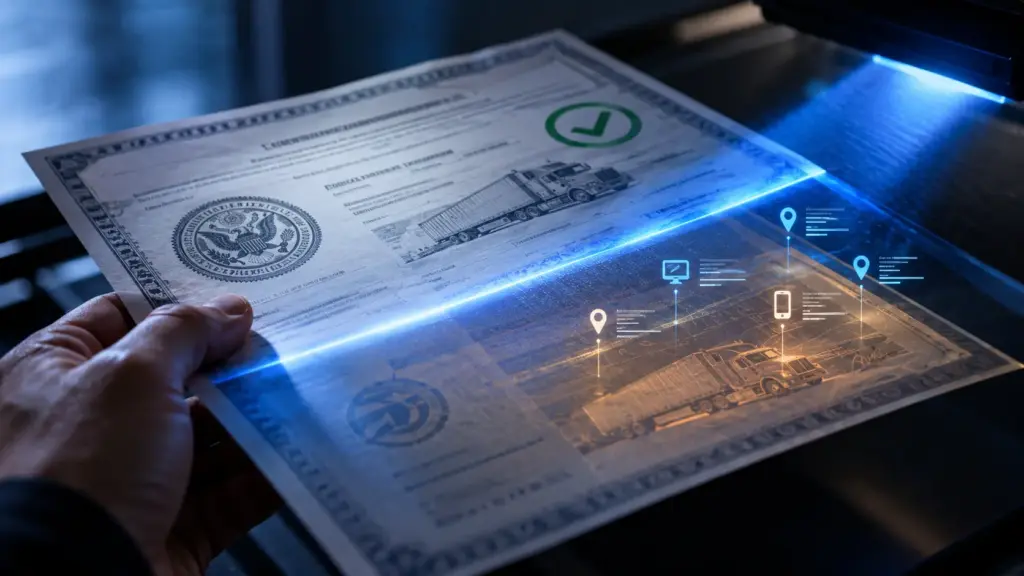
The clearest value of AI freight fraud detection shows up in exactly the scenario that opened this article: a carrier whose paperwork is completely legitimate, because the authority itself was stolen or recently transferred rather than fabricated. A manual SAFER lookup returns a clean result in that case, every time, because the authority really is active and really does have a clean history. The fraud is in who is currently operating behind it, which a one-time document check was never designed to detect.
Continuous monitoring catches this by noticing what changed, not just what currently appears valid. A carrier account that suddenly logs in from a new device in a different region, communicates in a different writing style, or submits documents with slightly different formatting than its historical pattern generates a signal a static check never produces, because a static check has no history to compare against.
Nevertheless, detection only matters if it happens before dispatch confirms the load, not after a pickup window has already passed. A fraud flag that surfaces during a post-incident investigation is useful for the next transaction. It does nothing for the shipment that already walked out the door with the wrong carrier.
Verification Has to Happen Before the Truck Leaves, Not After
Freight fraud in 2026 does not look like a bad actor with no paperwork and an obvious story that falls apart under questioning. It looks like a clean MC number, a current-seeming insurance certificate, and a rate confirmation signed within the hour. That is precisely why AI freight fraud detection matters: the fraud is built to pass the checks dispatchers have always run, and it increasingly does.
The operations absorbing the $800 million in annual losses are not, for the most part, operations that skipped basic verification. They are operations verifying the document instead of the identity behind it, at a single point in time instead of continuously, after the load already shipped instead of before the dispatcher hits confirm.
Therefore, the question worth asking before the next load books is not whether the carrier’s paperwork looks right. It is whether anything in your process would actually catch it if that paperwork belonged to someone else.
Catch the fraud before the truck leaves, not after.
FTM verifies carrier identity continuously through dispatch, not just once at onboarding, so a compromised authority gets flagged before a load confirms, not after it disappears.
Book Your Free FTM Demo